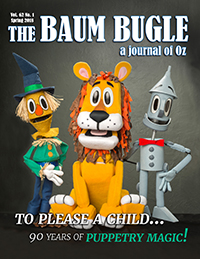
Originally published in The Baum Bugle, vol. 62, no. 1 (Spring 2018), pgs. 29–30
Citations
Chicago 17th ed.:
Cummings, Scott. Review of Dorothy and the Prince of Oz, by BalletMet, Baum Bugle 62, no. 1 (2018): 29–30.
MLA 9th ed.:
Cummings, Scott. Review of Dorothy and the Prince of Oz, by BalletMet, The Baum Bugle, vol. 62, no. 1, 2018, pp. 29–30.
(Note: typographical errors have been left in place to accurately reflect the printed version.)
DOROTHY AND THE PRINCE OF OZ
May 4 – 6, 2018. Ohio Theatre, Columbus, Ohio
Oz is in danger. The Diamond Queen has cast a spell over her son, the Prince of Oz, hiding him from his father, the Sapphire King. To help find the boy and reunite the two kingdoms, Glinda sends for Dorothy in Kansas. This (almost) original Oz story is conveyed through the artistry of ballet, amply supported by exquisite and colorful costumes, scenery, and near-magical puppetry.
Dorothy and the Prince of Oz is a collaboration between the Tulsa Ballet, which premiered the piece in February 2017, and BalletMet of Columbus, Ohio, which offered five performances between May 4 and 6, 2018.
Borrowing elements from Baum’s Glinda of Oz, choreographer and BalletMet artistic director Edwaard Liang and music director Oliver Peter Graber have woven an Oz story that feels fresh and true to the spirit of Oz while evoking classical fairytale ballets.
Throughout the nearly two-hour performance, the ballet offers subtle references to the version of Oz with which audiences are most familiar. The Kansas scenes are dominated by sepia tones and background clouds that resemble the MGM opening credits. Dorothy’s dress, while not a gingham pattern, hints at that with blue stripes. Pink streaks run through Glinda’s tulle gown, and a pastel rainbow arches into Oz. In the concluding scene in Kansas, Aunt Em and Uncle Henry welcome visitors who parallel their Oz characters (“And you were there …”). Not a sight of ruby slippers or green witches are to be seen, though.
Accompanying Dorothy on her journey to save the Prince is the Scarecrow. He provides some welcome whimsy through floppy choreography and a charming smile. After the performance I attended in Columbus, I heard several people wonder why the Tin Woodman and Cowardly Lion had not made an appearance. Avoiding a reunion of the “famous four” helps Dorothy and the Prince of Oz stand on its own and avoid comparisons with the too-many-to-count stage productions of the Wizard. Still, I would have enjoyed seeing more of the grotesque characters and adventurous locales of Baum’s Oz populate this story. A troupe of dancing Loons or a scene on the Merry-Go-Round Mountains would have been welcome.
Still, those who love the Oz books will find much to enjoy here. Glinda’s Great Book of Records (renamed “The Book of Knowledge” in the libretto) is featured prominently in the Prologue, and the iconic intertwined O-Z logo decorates its table. Here we meet the Queen Diamond and her swan, easily recognizable as Queen Coo-ee-oh.
While the audience may at times feel they are in a familiar version of America’s great fairyland, more often the visual and musical cues point toward the famed ballet of The Nutcracker. The musical score by Oliver Peter Graber relies heavily on selections from Glazunov’s The Seasons, which in style evokes Tchaikovsky’s holiday classic. Having Glinda send a messenger phoenix to retrieve Dorothy from Kansas provides another allusion to a classic Russian ballet.
With a central romantic story and an epic battle between opposing armies, Liang’s love-and-war Oz feels more like a European fairy tale than Baum’s light-hearted, whimsical land of Oz. While this Oz is more serious and mature, it remains sweet and magical. How refreshing it was to experience a new interpretation of Oz that steers clear of the tired-and-predictable “dark and edgy.”
Introducing his ballet, Liang noted that “it takes an Ozian village” to launch a such a show, and his collaboration with scenic designer and puppeteer Basil Twist is the strong point of the production. While Liang’s choreography is thoroughly pleasing, the production’s visual design triumphs.
Twist has developed an international reputation in puppetry arts with his original theater pieces and through his recent contributions to the Joffrey Ballet’s new Nutcracker. The opening scene of Dorothy and the Prince of Oz features the pages of the Great Book magically coming to life and expanding to envelope the scene on stage. The Emerald City shines gloriously in various hues of green, complimented by citizens dressed in a rainbow of pastel confections.
In a scene derivative of the Nutcracker’s “Dance of the Snowflakes,” Dorothy and the Scarecrow travel through a mysterious Land of the Mist Maidens. Here the magic of Twist’s set design may be a bit too powerful, with slowly rising and falling clouds so enchanting to watch that they threaten to upstage the performers. Only the breathtaking grace of the solo dance by the leader of the Mist Maidens could pull my head out of the clouds.
The realm of King Sapphire is appropriately designed in cobalt blue and populated by his all-male army. Two enormous puppet dogs romp through the scene. In contrast, Queen Diamond’s palace is designed in silver and white, with a set of graceful arches reminiscent of Neill’s illustration of the glass palace on the Magic Isle. The Queen’s all-female army dances with grace and power, and a life-sized swan puppet awakens to become one of the main performers. The movements of the swan and dog puppets command as much attention as any of the human dancers. I hope Basil Twist returns to the Land of Oz.
The second act opens under golden clouds with an epic battle between the male and female armies. When the Diamond Queen accidentally kills the Prince, we are left wondering what she was thinking would come of a sword fight; her sudden reversal from captor to mourning mother is baffling. After Dorothy dances with the spirit of the Prince, the combined magic of Glinda, Dorothy and the Queen bring the him back to life. Then, the King and Queen reconcile as quickly as they divorced in the show’s Prologue. A magic amulet passed between characters throughout the ballet should have made clearer some of the enchantments, but it didn’t. Too much has been packed into the storyline to convey effectively though the medium of dance; only the printed scenario provided in the program was able to explain so many sudden actions.
For sheer beauty and spectacle, Dorothy and the Prince of Oz is a masterful show. Such a magnificent production deserves to return to the ballet stage. I doubt that it will knock the Nutcracker out of its prime position in the season, but let’s hope that other ballet companies venture into this original vision of the land of Oz.
Authors of articles from The Baum Bugle that are reprinted on the Oz Club’s website retain all rights. All other website contents Copyright © 2026 The International Wizard of Oz Club, Inc. All Rights Reserved.