THE SORCERESS, THE GODDESS, AND THE MATRIARCHATE
by Robert B. Luehrs
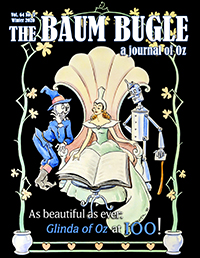
Originally published in The Baum Bugle, vol. 64, no. 31 (Winter 2020), pgs. 16–17
Citations
Chicago 17th ed.:
Luehrs, Robert B. “The Sorceress, the Goddess, and the Matriarchate.” Baum Bugle 64, no. 3 (2020): 16–17.
MLA 9th ed.:
Luehrs, Robert B. “The Sorceress, the Goddess, and the Matriarchate.” The Baum Bugle, vol. 64, no. 3, 2020, pp. 16–17.
(Note: In print, this article was supplemented with photographs that have not been reproduced here. However, typographical errors have been left in place to accurately reflect the printed version.)
L. Frank Baum’s Oz stories depict a fairyland dominated by powerful women, some of whom manipulate arcane natural laws and thus work magic. Most accept the leadership of Glinda and Ozma; they act for the wellbeing and contentment of all. Others, such as Mombi, Blinky, Coo-ee-oh, and Mrs. Yoop, are less altruistic and thus dangerous; they need to be somehow brought to justice. In short, Oz is what Baum’s mother-in-law, the suffragist and brilliant social critic Matilda Joslyn Gage, called a Matriarchate. However, Gage saw the Matriarchate as an actual society which occurred in various early civilizations, while Baum’s version is, of course, purely fictional.
Gage wrote in the opening chapter of her Woman, Church, and State (1893): “Under the Matriarchate, except as son and inferior, man was not recognized in either of these great institutions, family, state, or church. A father and husband as such, had no place either in the social, political, or religious scheme; woman was the ruler in each. . . . . Bachofen and numerous investigators agree in the statement that in the earliest forms of society, the family, government, and religion, were all under woman’s control; that in fact society started under woman’s absolute authority and power.”[1] The Bachofen mentioned by Gage was Johann Jacob Bachofen, Swiss jurist and author of the controversial book Mother Right (1861), which placed the Matriarchate in the second phase of social development after the primitive nomadic, hunting, and foraging phase of human existence.[2] Bachofen said the characteristics of the Matriarchate included agriculture, law, and monogamy; Gage agreed.[3] She added: “He also says the people who possessed the Mother-rule together with Gynaikokraty (girls’ rule) excelled in their love of peace and justice.”[4] Both Bachofen and Gage could have been talking about Oz.
Of course, the Matriarchate would have a religious system which gave precedence to goddesses as creators, nurturers, and guides for the dead. Gage was especially impressed by the ancient Egyptian deity Isis, a mother goddess associated with the moon, medicine, cultivation of grains, embalming, magic, death, and rebirth.. Gage argued Isis was originally a mortal ruler and a law-giver for the earliest phase of Egyptian civilization. In addition, she taught the Egyptians how to make bread and provided them with the essential tenets of their literature. So successful and beloved was she that her people elevated her to the ranks of the gods and named her the mother of all. Gage noted: “The most sacred mysteries of the Egyptian religion . . . owed their institution to Isis and were based on moral responsibilities and belief in a future life.”[5]
Glinda the Good embodies many of the positive attributes of Isis. Since the inhabitants of Oz are immortal, she has no need to promote belief in life after death, but she certainly asserts the importance of moral responsibilities. Glinda’s origins remain mysterious. She appears as a red-haired, attractive adult, never losing her youth despite her apparently advanced age. Isis was the mother of the hawk-headed solar god, Horus. Glinda does not have children but acts in a maternal fashion toward both Dorothy and Ozma, giving them love and counsel. Her relationship with Ozma is rather complicated; Ozma is her protégée. Glinda is Ozma’s superior in terms of wisdom, experience, talents, and magical abilities but, even so, recognizes the girl as the ultimate ruler of Oz. After all, Glinda had installed her as such. Ozma’s name reflects this complexity, for, as Gage pointed out, the syllable “ma” means both mother and creator.[6]
As governor of the southern quadrant of Oz, Glinda is humane and wise. Her court consists of a hundred young women, engaged like priestesses in spontaneous singing and dancing as well as embroidery; Isis gave the arts of weaving and working with cloth to humanity as a gift. As Ozma herself admits, Glinda’s magic transcends everyone else’s: Isis’ magic was likewise superior to that of the other Egyptian deities. Glinda’s powers are not infallible, however. Despite her wonderful Record Book, which notes every event as it happens, Glinda does not have godly omniscience. For example, she does not know in The Land of Oz the lad Tip is Ozma transformed or the particulars of the feud between the Skeezers and Flatheads in Glinda of Oz. Even so, her sorcery is formidable. She turns all of Oz invisible in order to protect it from tourists and other destructive pests at the end of The Emerald City of Oz. The Nomes claim she is able to command “air spirits,” presumably what Paracelsus called sylphs or air elementals.[7] As befit a philosopher queen, when she is not laboring to increase the happiness of her people, she is studying “mystic scrolls” to advance her mastery of the magical arts and other mysteries.
There is a curious reference to the Isis mythology in Glinda of Oz. Glinda is worrying about the disasters which might befall Dorothy, as the girl sets out on an adventure with Ozma. Dorothy is an “Earth child,” unprotected by innate occult defenses. “She could, for instance, be cut into pieces, and the pieces, while still alive and free from pain, could be widely scattered.”[8] That was precisely the fate of Isis’ husband, the vegetation god Osiris, at the hands of his unpleasant brother, Set, lord of desolation and adversity. Isis, ever the perfect wife, traveled the Nile valley to find the scatttered pieces, reconstructed Osiris’ body, mummified it, and brought him back from the dead as master of the Other World.
Glinda of Oz has another odd element. Much of the action takes place in boats moving on and under the Skeezer lake as individuals move into and out of the submergible, domed capital city. Gage wrote: “The ship, or ark, is peculiarly significative of the feminine principle, and wherever found is reminiscence of the Matriarchate.”[9] The story features a number of women displaying a variety of magical abilities: Glinda, Ozma, the three Adepts, Reera the Red, Coo-ee-oh, and Rora, wife of the Supreme Dictator of the Flatheads. Each woman displays her own outlook, personality, and brand of magic. There are two male magicians. One, the Wizard of Oz, learned his craft from Glinda; the other, the Supreme Dictator, is deemed inferior to his wife in supernatural power. Glinda of Oz does present some of the multifaceted possibilities of the Matriarchate in their full glory, complete with lessons about proper governance and the mischief caused by abuse of authority.
Gage’s Woman, Church, and State chronicles how the Matriarchate decayed and was replaced by the oppressive Patriarchate under which men and Christianity oppressed women, costing them their former status, their economic and legal standing, their independence, their judgment, their will, and their self-respect. Any woman who tried to keep alive the old knowledge, for example by healing the sick or manipulating the laws of nature, was branded a witch and destroyed; the word “witch,” Gage observed, really meant “wise woman.” [10] In Oz the Patriarchate is personified by the Kingdom of the Nomes, nasty, subterranean elementals. The Nomes are sadistic, militaristic, and regimented. Their king is cruel, tyrannical, and slave of violent emotions. He has imperialistic ambitions and a desire to conquer or crush Oz. The Nomes fear only one thing: eggs. According to Gage, eggs are symbols of life, creativity, ancient mysteries, and the Matriarchate itself.[11]
Notes
[1] Matilda Joslyn Gage, Woman, Church, and State, 1893 (Dumfries and Galloway: Anodos Books, 2019), 5, 9.
[2] Bachofen argued that the matriarchal or lunar phase of humanity was succeeded by a transitional period where patriarchal institutions emerged and then the triumph of a fully-developed patriarchal or solar culture.
[3] J. J. Bachofen, Myth, Religion, and Mother Right: Selected Writings of J. J. Bachofen (Princeton: Princeton University Press, 1967), 190-192.
[4] Gage, 9.
[5] Gage, 14.
[6] Gage, 10.
[7] L. Frank Baum, The Emerald City of Oz (Chicago: Reilly and Britton, 1910), 46.
[8] L. Frank Baum, Glinda of Oz (Chicago: Reilly and Lee, 1920), 29.
[9] Gage, 14.
[10] Gage, 112–113.
[11] Gage, 9–10.
Authors of articles from The Baum Bugle that are reprinted on the Oz Club’s website retain all rights. All other website contents Copyright © 2026 The International Wizard of Oz Club, Inc. All Rights Reserved.