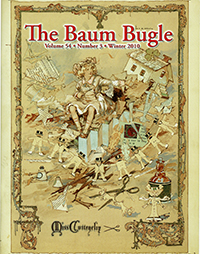
Originally published in The Baum Bugle, vol. 54, no. 3 (Winter 2010), pgs. 16–17
Citations
Chicago 17th ed.:
Berman, Ruth. “Matching the Fuddles: The Jigsaw Puzzle Craze Behind the 1910 Oz Book.” Baum Bugle 54, no. 3 (2010): 16–17.
MLA 9th ed.:
Berman, Ruth. “Matching the Fuddles: The Jigsaw Puzzle Craze Behind the 1910 Oz Book.” The Baum Bugle, vol. 54, no. 3, 2010, pp. 16–17.
(Note: In print, this article was supplemented with illustrations that have not been reproduced here. However, typographical errors have been left in place to accurately reflect the printed version.)
In Baum‘s The Emerald City of Oz, when Dorothy and her companions encounter the scattered Fuddles of Fuddlecumjig, three-dimensional jigsaw-puzzle people, Dorothy is adept at doing jigsaws. Finding a nose and eye that belong together, she says they should look for the mouth, to get enough of the face for the Fuddle to talk and help them out. The Shaggy Man, less skilled, finds a mouth, but it doesn‘t match. “That mouth belongs to some other person,” says Dorothy. “You can see we need a curve here and a point there to make it fit the face” (p. 135). She proceeds to find a piece that fits, of an ear and a bit of red hair, and switches strategies to hunt by color, locating red-haired pieces. Soon she has most of the Cook‘s head completed when Omby Amby finds the mouth. On the Cook‘s advice, after they‘ve completed him, they put together Larry, the Lord High Chigglewitz, who is not slowed by a missing piece from half of one of Larry‘s knees. (As with so many jigsaw puzzles, lost pieces can be a problem.) He congratulates them on their skill: “I was never matched together so quickly in my life. I‘m considered a great puzzle, usually.” Dorothy replies: “There used to be a picture puzzle craze in Kansas, and so I‘ve had some ‘sperience matching puzzles. But the pictures were flat, while you are round, and that makes you hard to figure out” (p. 137).
It probably doesn‘t occur to most readers (well, it didn‘t to me, anyway) that Baum wasn‘t referring just to the general popularity of jigsaw puzzles, but to a specific period of a craze for puzzles. In fact, the period was only just coming to an end when Emerald City appeared in 1910, and the craze had swept the whole nation, not just Dorothy‘s home state. Anne D. Williams‘s The Jig-Saw Puzzle: Piecing Together a History (Berkley Books, 2004) explains the background of this craze in the development of the jigsaw puzzle. As a popular amusement, it was fairly new in 1910, even though jigsaw puzzles go back (before the invention of the jigsaw per se, in 1873) to the mid-eighteenth century, when educators and mapmakers invented educational toys—maps made of thin boards of wood and cut into pieces along the boundary lines of countries—for children to put together as an aid to learning geography. In the nineteenth century, advances in printing and the development of foot-powered saws made it possible to make such puzzles somewhat more cheaply and to make them more elaborate and colorful. The new saws were on display at the 1876 Centennial Exposition in Philadelphia, and caught on for doing fretwork and scrollwork. Towards the end of the century, people were also occasionally using the new saws to make puzzles. Then in 1907, a woman in Massachusetts, looking for a way to raise money for charities, made a lot of jigsaw puzzles of 100–200 pieces. (The woman wasn‘t named in the contemporary article that Williams cites as documenting the explosion of the craze, “Seizing the Chance, II: The Picture -Puzzle ‘Craze‘,” by Edward Williston Frenz, in Youth’s Companion, October 29, 1908. Williams, however, looking at some ads for puzzles in the November and December issues of the humor magazine Life, notes that one Prudence Pride of Deerfield, Massachusetts, claimed to have made the original puzzles ―that set Boston crazy,‖ and thinks she probably is indeed the one who set off the craze.)
The toy caught on in Boston in 1907 and in 1908 spread over the rest of the U.S. The craze as such died down in 1910, but the wooden puzzles continued to sell in smaller quantities for the next twenty years. Cut by hand from wood, the puzzles were still a fairly pricey toy, although people who couldn‘t afford to buy their own could borrow them from commercial lending libraries.
So Baum was drawing on a very current craze in putting the Fuddles of Fuddlecumjig in Oz in 1910. The kind of three-dimensional puzzle represented by his Fuddles existed at the time, after a fashion, having been developed toward the end of the nineteenth century, but the technology available meant that 3-D puzzles had to be made of only a few pieces (Williams mentions an 1884 “Captain Kidd‘s Castle,” a 30-piece 3-D puzzle). Complicated, many-pieces puzzles like the Fuddles were still imaginary when Baum found them in Oz. In the 1930s, there were 3-D puzzles of one hundred pieces being made, but Williams says it wasn‘t until the end of the century, with a change in technology—making the pieces out of polyethylene foam instead of wood—that there got to be much in the way of 3-D puzzles. Even so, the 3-D puzzles are a good deal more expensive than the flat puzzles, and less versatile in what kinds of images can be suitably reproduced, so that puzzles in-the-round are still uncommon, and the flat puzzles continue to be much more popular.
The thickness of the pieces in John R. Neill‘s color plate of Fuddlecumjig in The Emerald City of Oz makes it clear that Neill was thinking, as Baum must have been, too, of puzzles cut from boards of wood, not cardboard. In 1932, the invention of die-cut cardboard puzzles made puzzles much cheaper, as they could be stamped out in quantity, and the Depression-era need for inexpensive amusements produced another several years of a jigsaw puzzle craze. Although this second craze again died down somewhat, the puzzles remained—as they still are—a major source of family amusement.
Interestingly, the first known commercial Oz jigsaw puzzles were produced in 1932, at a time when the very first die-cut cardboard puzzles were manufactured. Prior to then, the expense was evidently still high enough to discourage any pre-cardboard puzzle-makers from trying Oz jigsaws. As an advance tie-in with the 1933–1934 radio serialization of “The Wizard of Oz” sponsored by Jell-O, Reilly & Lee issued two boxed sets. Each included reprints of two of Baum‘s 1913 Little Wizard stories and a cardboard jigsaw of one of Neill‘s color illustrations from each. The chapter on “Oz Games and Puzzles” in Jay Scarfone and William Stillman‘s The Wizard of Oz Collector’s Treasury (Schiller Publishing Ltd., 1992) shows photos of these and several other Oz jigsaw puzzles.[1]
Over the years, a good many other Oz jigsaw puzzles have been issued, using original Oz artwork and images from dramatic adaptations such as MGM‘s 1939 Wizard of Oz, Disney‘s 1985 Return to Oz, and the 2003 Broadway musical Wicked. But no other commercially produced puzzles have used artwork from the Oz book series.
I wonder if a pair of puzzle-themed Oz puzzles, appealing to puzzlers as well as to Ozites, and drawing on the books‘ attractive original art might be a possibility—say, Neill‘s Emerald City color plate of Dorothy and friends with the scattered Fuddle pieces, or Denslow‘s Wizard color plate of Dorothy with the Scarecrow and the Tin Woodman in combination with an appropriate quotation to go around the edge:
I shall ask for brains instead of a heart; for a fool would not know what to do with a heart if he had one.” / “I shall take the heart,” returned the Tin Woodman; “for brains do not make one happy, and happiness is the best thing in the world.” / Dorothy did not say anything, for she was puzzled to know which of her two friends was right.
(Thank you to Regalia Oz discussion e-group participants J. L. Bell, Blair Frodelius, Scott Hutchins, and Tyler Jones, who offered suggestions for this article.)
Notes
[1] Images of the Little Wizard puzzles also appear on p. 173 of David L. Greene and Dick Martin‘s The Oz Scrapbook (Random House, 1977), and on p. 64 in John Fricke‘s 100 Years of Oz (Stewart, Tabori & Chang, 1999).
Authors of articles from The Baum Bugle that are reprinted on the Oz Club’s website retain all rights. All other website contents Copyright © 2026 The International Wizard of Oz Club, Inc. All Rights Reserved.