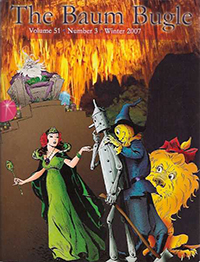
Originally published in The Baum Bugle, vol. 51, no. 3 (Winter 2007), pgs. 19–24
Citations
Chicago 17th ed.:
Riley, Michael O. “Ozma of Oz: The Beginning of the End?” Baum Bugle 51, no. 3 (2007): 19–24.
MLA 9th ed.:
Riley, Michael O. “Ozma of Oz: The Beginning of the End?” The Baum Bugle, vol. 51, no. 3, 2007, pp. 19–24.
(Note: In print, this article was supplemented with illustrations that have not been reproduced here. However, typographical errors have been left in place to accurately reflect the printed version.)
L. Frank Baum’s third Oz book, Ozma of Oz (1907), is near the top of just about everyone’s list of favorite Oz stories. It was the second Oz book that I read as a child, and it has always retained that place in my affections, second only to The Wonderful Wizard of Oz (1900). Simply put, it is one of Baum’s best stories; it has thrilling adventures and a totally involving plot—who can forget the storm it opens with and the guessing game in the underground palace? Baum’s new characters immediately become old friends: Billina, Tiktok, and the Hungry Tiger, and his villains, Princess Langwidere and the Nome King, are two of the most interesting in the entire series. But of course, to readers of the other Oz books, the event of supreme importance is the reappearance of their favorite character, little Dorothy from Kansas. But even with this familiar central character, this volume is one of several in the series that works especially well as a stand-alone story for readers who have no prior knowledge of Oz.
Why this is so would be an intriguing idea is to pursue, but the approach to Ozma of Oz here will be to highlight another significant point about the book’s place in the Oz canon. The year 2007 was the hundredth anniversary of the publication of Ozma of Oz, but I also believe that it was the hundredth anniversary of the real beginning of the Oz series. This idea will need some explanation.
Series Books
Series books are a fascinating area of study: how they are developed—how they work—why they are so appealing. From the formulaic series created by committee like Nancy Drew and the Hardy Boys to a planned, limited series like J. K. Rowling’s seven Harry Potter books to such adult series as Mazo de la Roche’s Jalna books (1927–1960), Simon Raven’s Alms for Oblivion (1964–1976), and John Galsworthy’s Forsythe Saga (1906–1921), the development and interactions of the individual books are handled in a variety of interesting ways. The individual elements are important and, if possible, each book should be able to be read without reference to the others, but each of those stories should also contribute to building up a larger picture of the fictional world and characters being depicted. In the best series, the sum of those individual stories creates something much greater than the parts.
In the Oz series, I believe this process really began with Ozma of Oz, the first Oz book that Baum knew, while writing it, would be followed by sequels. Ozma, I also believe, is the introductory volume of a sequence of four Oz books that Baum intended to be interconnected, beginning a longer, overarching story that only ended with The Emerald City of Oz in 1910, which Baum intended to be the final volume of the series.
The First Two
Despite the fact that L. Frank Baum ended up writing so many books that are parts of series (the Boy Fortune Hunters [1908-1911], Aunt Jane’s Nieces [1906-1918], Mary Louise [1916-1918], etc.), series work did not come naturally to him. Story was supreme with Baum. He was a natural storyteller, and he needed the freedom of the storyteller to let the story dictate its development—his imagination was too inventive and too filled with ideas to need or want to fit plots to pre-existing characters or countries. As he himself once observed, he had to let his characters do what they wanted.[1] For example, in The Enchanted Island of Yew (1903), he attempted to create the entire background before the story, giving his readers a complete description right up front of a new fantasy world, but then he ended up with more country and background than he was able to make use of when his story and characters grew in directions he had not foreseen in the beginning.[2]
On the other hand, in The Wonderful Wizard of Oz the symmetry of plot, characters, and place make it obvious that all developed more or less at the same time in service of the story. It is also apparent that Baum never intended to follow Wonderful Wizard with sequels; the story is perfect and final as it stands. Oz in that story is a place alien to Dorothy. She does not belong there, and her objective is to return to her aunt and uncle. The sequence of encounters in the final third of the book repeatedly makes the point that Oz is an inhospitable place for her.
Even though Baum’s Wonderful Wizard was adapted into an unbelievably successful stage extravaganza in 1902, he still resisted for four years his readers’ pleas for “more about Dorothy.” And when he did publish The Marvelous Land of Oz in 1904, he did not write about Dorothy; instead, he wrote what he hoped would be the basis of another successful musical comedy extravaganza, one that would lure his reluctant stars Montgomery and Stone back to his stage world. One of the saddest facts of Baum’s life is that his great love of the stage was not returned. The successful stage play The Wizard of Oz was a fluke; the barest skeleton of his story was decorated by a savvy and worldly producer into a carnival entertainment that seized the public’s fancy in the first decade of the twentieth century. The second Oz book, The Marvelous Land of Oz, was a very successful book, but failed completely when it was adapted for the stage as The Woggle-Bug. The letters Baum received showed him that his readers, indeed, did want more of his fantasy world, but also, that Dorothy (who had not appeared in Marvelous Land) was an integral part of that world. The book sold so well that it helped launch a new Chicago publishing house, the Reilly & Britton Company, and Baum became their principal author.
Despite this evidence of the continuing demand for his stories about Oz, Baum still was not ready to settle down permanently—as a fantasy writer—and be content to turn out an Oz story every year; his imagination was too fertile for that to be a congenial idea. But Baum needed financial security, and therefore agreed around 1906 to an exhausting writing schedule. The most risk-free part of this schedule for him and his publishers was to return to his most successful creation and write more stories about Oz. Therefore, in 1907, three years after Marvelous Land and seven years after Wonderful Wizard, the third Oz book, Ozma of Oz, was published, and it finally gave his readers what they wanted, “more about Dorothy.”
For Baum, returning to Oz was an expedient—a short-term solution—until he hit it big in the theater, and I have no doubt that when Baum agreed to write more Oz books, he already had much of the short run of the series in mind—that he saw the end right there at the beginning. Baum hints at this with some of his plot devices and in his prefaces. For example, at the end of Ozma of Oz, when Ozma uses the magic belt to send Dorothy back to Uncle Henry, provisions are made for Dorothy’s future return to Oz. This was the first time Baum provided for a sequel within the plot of the story itself. In the preface to the second volume of this sequence, Dorothy and the Wizard in Oz (1908), Baum promised to tell more about Toto in the following book. And finally, in the preface to The Road to Oz (1909), in which Toto returns, Baum wrote that his book for the next year would be “the last story that will ever be told about the Land of Oz.”
After both Wonderful Wizard and Marvelous Land, Baum had considered his saga of Oz at an end, and if he had been correct either time, we would not feel that anything was missing. However, something would have been missing if Ozma of Oz had turned out to be the last book Baum wrote about Oz. A comparison of the content and structure of Ozma with Wonderful Wizard and Marvelous Land will demonstrate why Ozma functions best as the introductory story of an interconnected four-book unit. In addition, I will also note some of the questions and criticisms that might have arisen had Ozma turned out to be Baum’s last Oz story.
Ozma of Oz has one of Baum’s best plots, but compared to the first two Oz books, an important element is missing: Oz. What part does Oz really play in how the story functions? If there were no further books to look forward to, many readers would be frustrated that this story contains so little new information about that endlessly fascinating place. Moreover, compared to the first Oz book, the ending of Ozma would not be satisfactory if it had turned out to be the last volume written about Oz as Dorothy simply returns home after a nice visit in a pleasant place! Oz has not been saved or developed or explored. Baum, of course, defused any fear that this was all there would be about Oz even before it could develop by providing the means for Dorothy’s return to Oz and, with it, the hope for more information about that fairyland. It is this potential that creates the satisfaction at the conclusion of Ozma. But that is something he did not have to worry about in Wonderful Wizard because there the ending is final, a completion of the action, and satisfying because all the loose ends are tied up and all the characters are settled. The same is true in Marvelous Land.
In both Wonderful Wizard and Marvelous Land, the whole power structure of the country is changed in the course of the stories. In the first book, Oz is a place under an enchantment. Two wicked witches in the east and west, two good witches in the north and south, and a Wizard in the center whom all fear create a balance of power that keeps anything from changing. Oz is frozen in the status quo—at least until Dorothy’s arrival. Her entrance is the stuff of the best folk and fairy tales. Her house crashing down on the Wicked Witch of the East destroys the balance of power by breaking the enchantment, and her journey through Oz in search of a way home rids the country of the other wicked witch and of the humbug Wizard. She becomes the national heroine of Oz, but she doesn’t become part of Oz.
In The Marvelous Land of Oz, the results are almost as radical. Although the story begins in a remote part of the Gillikin Country, the sequence of events set in motion by a scared boy running away with his pumpkinheaded companion ultimately reveals the country’s rightful ruler and restores the golden age of Oz. Compared to these two plots, what part do the affairs of Oz play in the third book? Could not the plot of Ozma of Oz function even without reference to that wonderful fairyland?
The answer to that is yes, because the main objective of the plot—freeing a royal family from the Nome King—was adapted from Baum’s non-Oz fantasy King Rinkitink (1905, unpublished). At the end of Ozma of Oz. it is another country, Ev, that is put right with the restoration of its royal family. The plot is wound up quite well, but as far as Oz is concerned, the story seems unfinished. Oz is merely the setting
for the final celebrations. Dorothy ends up in Oz, but getting there was not the goal of the main adventure and the reader is given very little new information about that marvelous land. But this was not necessary this time, because Baum intended Ozma of Oz to be the first of several books about Oz, and his larger theme would stretch through all of them.
I am convinced that this sequence of four books was planned as a unit—that Ozma can be viewed as the first part of a four-part story-and that these four stories work better together than individually, like the four movements of a symphony. The larger story is, of course, Dorothy’s growing involvement in Oz, and it culminates with her move there in the fourth book of this sequence when there is no longer any doubt that Oz is her true home.
The Way the Four Books Work Together
Even after the publication of Marvelous Land, the letters asking about Dorothy continued to pour in until even Baum finally realized that she was the most beloved character from his original book. He also soon discovered that of all his creations his readers loved those original characters from Wonderful Wizard best, including the Wizard! Probably his only later character to match the superstar status of the original group was Ozma herself.
It may have been from such simple realizations as these that Baum developed his series because these are the characters he concentrates on in these four books. First, Dorothy is re-introduced in Ozma of Oz, and she is reunited with the Scarecrow, the Tin Woodman, and the Cowardly Lion (who himself is making his first appearance since Wonderful Wizard). Dorothy’s second visit to Oz is very different from her first. The dangerous events occur outside of Oz; inside Oz, Dorothy is safe and happy. This becomes the pattern for these four books. This time she enjoys her stay in Oz and soon becomes the best friend and companion to Ozma and is even made a princess of Oz. Therefore, on her second visit, Dorothy becomes part of this fantasy world, and this time, she returns to our world reluctantly, only because of her worry about her Uncle Henry.
The next year, in Dorothy and the Wizard in Oz, Baum re-introduces his humbug Wizard, having Dorothy meet him and take him to Oz where he stays. As it is for Dorothy, Oz is the Wizard’s true home. At the end of this adventure the original group, with the exception of Toto, is together again. But in the next book, The Road to Oz, even Toto returns to Oz on an adventure to celebrate Ozma’s birthday. Thus, Baum built each book around characters from his original story and had Dorothy centrally involved in each. The only thing left for the last story, to give this sequence a final ending as satisfying as that of Wonderful Wizard, is to bring Dorothy to Oz to live so that this group of friends can be together forever.
But this last book is more than a tying up of loose ends. If Dorothy and her aunt and uncle are to be happy there and the readers arc to accept this, Oz has to be a utopia that outshines even the American Dream, and Baum has to present it as such in our last glimpse of it.
Despite the fact that The Emerald City of Oz was the sixth book published about Oz, Baum had given his readers very little concrete information about the country since Marvelous Land. The majority of Ozma of Oz takes place outside of Oz with only a quick visit there at the end. At least three-fourths of Dorothy and the Wizard is set outside of Oz, with the last fourth taking place only in the Emerald City. In The Road to Oz the characters do make a short, peaceful journey through a part of the Winkie Country to reach the Emerald City, but only after a long series of exciting adventures in the countries surrounding Oz. In all three of these books, there had been little exploration or description of the country, elements so very important in Wonderful Wizard and Marvelous Land, but things change drastically in the final book of the four, The Emerald City of Oz.
The Emerald City of Oz
In Ozma of Oz, Dorothy and the Wizard in Oz, and The Road to Oz, Baum had developed Oz only as much as he needed it for his plots. If he had intended to continue with the series, he would probably have continued in the same manner; otherwise, if he had provided too much accumulated detail it would have been harder to fit a story into the pre-existing background. Because The Emerald City of Oz was to be the end of Oz, Baum now could do what he would never have done otherwise: give concrete form to this world without regard to the future. He could elaborate as much as he wanted for the final book; he could even make the elaboration of that world a part of the plot—or one of the plots, for in contrast to the single, linear plots of the previous books, in Emerald City he utilized double, and sometimes triple, plot lines, alternately following separate sets of characters and bringing them all together at the end of the· story.
In The Emerald City of Oz, Baum constructed the most complex of his tales to date, a tale that has one of his most exciting and suspenseful plots, ties up loose ends, settles the fates of his main characters, and eliminates the possibility of another sequel—all while leaving his readers satisfied and unworried about the future of this beloved Oz. Of course, to do all this, he had to develop his fantasy world in ways that he would never have attempted had this not been intended to be the last look at Oz. Because of the way he developed Emerald City, however, Oz could never again be merely the country where magic and marvels were common that it had been in Wonderful Wizard; Oz became a utopia in Emerald City.
Making a brilliant connection between the first and the fourth books of this sequence, Baum brings back the villain from Ozma of Oz, the Nome King, and has him plan to conquer Oz. The Nome King starts to dig a tunnel under the desert to invade the Emerald City. To aid him in this plan, he recruits all of the most evil races of beings that live in this now very large fantasy world.
The second plotline has Dorothy’s Uncle Henry and Aunt Em facing bankruptcy in Kansas, and follows Dorothy’s plan to take them to Oz to live. Thus, in these two ways, Baum establishes Oz as the most desirable place to conquer as well as the most desirable place to live. Oz has become the ideal America in Baum’s imaginary world. Then, as if to further establish the richness of this fantasy country and to emphasize what will be lost if it is destroyed, Ozma sends her new subjects on a tour. Chapters filled with wonderful places and unusual characters alternate with chapters that detail the progress of the Nome King’s army on its way to the Emerald City.
What makes this country so desirable? Baum had only given his readers glimpses of that in the past
—often confusing and contradictory glimpses. In The Emerald City of Oz, Baum at last provides a long, detailed description of the country and its government:
Altogether there were more than ha!f a million people in the Land of Oz . . . and every inhabitant of the favored country was happy and prosperous.
No disease of any sort was ever known among the Ozjtes, and so no one ever died unless he met with an accident that prevented him from living. This happened very seldom, indeed. There were no poor people in the Land of Oz, because there was no such thing as money, and all property of every sort belonged to the Ruler. The people were her children, and she cared for them. Each person was given freefy by his neighbors whatever he required for his use, which is as much as any one may reasonabfy desire. . . .
Every one worked ha!f the time and played ha![ the time, and the people enjoyed the work as much as they did the play . . .
Oz being a fairy country, the people were, of course, fairy people There were all sorts of queer characters among them, but not a single one who was evil or who possessed a selfish or violent nature. They were peaceful, kind-hearted, loving and merry.
. . . Only peace and happiness reigned in Oz.[3]
From the rural, rather primitive, oftentimes frightening Oz that Dorothy first experienced in Wonderful Wizard, to this vision of utopia is quite a distance. It is understandable here why the evil powers would want to conquer such a prosperous and good place and there is no doubt why Dorothy and her family would want to live there. That she now belongs to Oz, having also traveled a long road since the first book, is clear when she rejects escape to safety as the armies approach and elects to stand with her friends as a princess should in defense of her homeland. It is a fitting end to Dorothy’s adventures in Oz.
Such a place of perfection also needed to be protected and preserved, and as Baum really did intend this book to be the last of his series, he took care of that also, cutting Oz off from any possible contact with our world—to keep it safe, but perhaps also to free himself.
Conclusion
With hindsight, we know that after an interval of two years, Baum was forced by financial considerations to revive the Oz series, and he went on to add eight more books to it. How he worked himself out of the dilemma he had created at the end of The Emerald City of Oz is another story and beyond the scope of this discussion, but as the series worked out, the book that had been intended to end it now stands near the middle of Baum’s Oz canon, and the later eight books obscure the symmetry of this sequence of four books that began with Ozma of Oz, obscure the culminating structure of Emerald Ciry, and obscure the really innovative development of that other-world that took place there—development that took place only for the reason that these four books were to be our final look at this fantasy country. Our picture of Oz might be more symmetrical and less contradictory if Baum had been able to end his series at six books, but we would have lost much that is magical and much that is beautiful.
One of the most fascinating aspects of the way series books work is that each book alters the reading of all that follow, and even of all that have come before. With each new book, the story becomes larger, more unwieldy, more complex, more untidy—and strange to say when talking of fantasies—more like life. The writer Gore Vidal said after rereading the Baum Oz books as an adult, “I find that all of the books tend to flow together in a single narrative.”[4] And I say, that is what the individual elements of the best series are supposed to do—create a story that is larger than the sum of its parts.
Notes
[1] “‘Dear Sergeant Snow’: Maud Baum’s Correspondence with Jack Snow,” Baum Bugle 26:3 (Winter 1982): 10.
[2] This would have been an asset if The Enchanted Island of Yew had been the basis for a series, but it is clear from the way his story culminated that Baum had no intention of trying to turn the book into a series; in fact, he did not even include this country on the first official map of his fairylands that appeared on the rear endpapers of Tik-Tok of Oz (Chicago: Reilly & Britton, 1913).
[3] L. Frank Baum, The Emerald Ciry of Oz (Chicago: Reilly & Britton, 1910), 29–33.
[4] Gore Vidal, “On Rereading the Oz Books,” in The Wizard of Oz, The Critical Heritage Series, ed. Michael Patrick Hearn (New York: Schocken Books, 1983), 257.
Authors of articles from The Baum Bugle that are reprinted on the Oz Club’s website retain all rights. All other website contents Copyright © 2026 The International Wizard of Oz Club, Inc. All Rights Reserved.