RESTORATION OZ
by Kenneth R. Shepherd
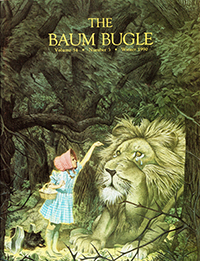
Originally published in The Baum Bugle, vol. 34, no. 1 (Spring 1990), pgs. 19–20
Citations
Chicago 17th ed.:
Shepherd, Kenneth R. “Restoration Oz.” Baum Bugle 34, no. 1 (1990): 19–20.
MLA 9th ed.:
Shepherd, Kenneth R. “Restoration Oz.” The Baum Bugle, vol. 34, no. 1, 1990, pp. 19–20.
(Note: In print, this article was supplemented with illustrations that have not been reproduced here. However, typographical errors have been left in place to accurately reflect the printed version.)
L. Frank Baum recorded the story of Ozma’s ascension to the throne of Oz in The Marvelous Land of Oz (1904). Like many good storytellers, however, Baum started his recounting of Ozma’s accession in medias reg, i.e., in the middle of the full tale. The crowning of Ozma of Oz was both an end and a beginning, an event which marked the end of a long period of misrule and the beginning of a new age. By examining the Royal Histories of Oz, we can chart the events which brought Ozma to her rightful place. Ozma’s ancestry has been the source of much scholarly controversy over the years. Robert R. Pattrick outlines early Oz history in the International Wizard of Oz Club publication, Unexplored Territory in Oz (Kinderhook, Illinois, 1990), tracing Ozma’s ancestry back to the enchantment of the country by the fairy queen Lurline, and hypothesizes two generations of rulers preceding Ozma—Pastoria, erstwhile king of Oz, and Pastoria’s father (for whom he suggests the name Ozroar). All students of Ozian history are agreed that her most immediate relative was Pastoria, but it is uncertain whether she is his direct descendant or merely his successor. The Royal Histories are vague on this problem, perhaps because the Ozites themselves are unsure of the truth of the matter. At the time of Dorothy’s arrival, however, Pastoria had disappeared and was presumed destroyed. Ozma’s existence—or at least, whereabouts—was also unknown.
When Dorothy first came to Oz, the country was organized into five relatively autonomous lands. They were not exactly states, for they were held together not by an organized government but by the personalities of the most powerful people in the area, most often magic-workers. In Dorothy and the Wizard in Oz (1908), Ozma says that the entire country (with the possible exception of the area surrounding the Emerald City) had at one time been under the influence of wicked witches. In later books we learn that Good Sorceress Glinda defeated the Witch of the South, and another Good Witch (later named Tattypoo by Ruth Plumly Thompson) had driven Mombi, the former Witch of the North, into exile in the Gillikin country. The Wizard of Oz, O.Z. Diggs, had carved a niche for himself in the very center of the country.[1] However, the Munchkins in the East and the Winkies in the West were still dominated by wicked witches.
Dorothy’s stay in Oz precipitated a political upheaval. Before she arrived, political power was more or less evenly divided between the good and evil witches, with the Wizard rather precariously balanced between them. Dorothy’s arrival eliminated the Wicked Witch of the East, she later melted the Witch of the West, and finally she inspired the Wizard’s decision to leave. By removing three of the country’s five most potent personalities, Dorothy created a political vacuum: the Munchkins, the Winkies and the denizens of the Emerald City were left leaderless. We can speculate that this made a situation ripe for exploitation by the last remaining wicked witch: Mombi.
Dorothy’s actions removed Mombi’s potential rivals for the throne of Oz. The only magic-users left were Glinda and the Good Witch of the North, who could be counted on to oppose her on principle. Of the two, Glinda provided the greater threat. Although in The Giant Horse of Oz (1928) we learn that the Good Witch of the North drove Mombi out of her territory south towards the Emerald City, we also find out that it was Mombi who had originally enchanted Queen Orin of the Ozure Isles, turning her into the Good Witch of the North. Patrick Maund believes it highly unlikely that Mombi could be overpowered by someone whose powers she herself wag responsible for, and suggests instead that the Wicked Witch surrendered her Gillikin territories for the greater prize of becoming ruler of Oz.
Certainly Mombi adopted a low profile after her encounter with the Good Witch of the North. For years, she lived in a small Gillikin backwater near the outskirts of the Emerald City, but she still maintained an interest in Ozian politics. Through some not-fully-understood process, she managed to obtain custody of the child Ozma from the Wizard, and she also kept track of events in other areas of Oz, especially the land of the Munchkins. Of all the peoples of Oz, only the Munchkins were left without a controlling figure.[2] We know that Mombi had earlier dealings in the Munchkin country; in Giant Hor8e, the newly disenchanted Queen Orin of the Ozure Isles reveals that many years before, the witch had fallen in love with young Cheeriobed, ruler of the Ozure Isles and heir to the Munchkin throne. When he rebuffed her, she spirited away his father, the King of the Munchkins, and destroyed him. She later isolated the Ozure Isles from the rest of Oz, using the fear-fish Quiberon.[3] Also, the magic powder which Mombi used to bring Jack Pumpkinhead was produced by Dr. Pipt, a Munchkin magician.[4]
It is conceivable that Mombi, in fact, raised the Army of Revolt to oust the Scarecrow from the Emerald City. General Jinjur told Tip that the Army was made up of girls drawn from all parts of the land of Oz, but she herself was a Munchkin. The front panel of her skirt is blue, representing her land of origin and, in later volumes of the series, she is identified as living in the Munchkin country. Also, soon after the Scarecrow’s party made their second escape from the Emerald City, Jinjur summoned Mombi, and the two of them began openly working together—an act that strongly suggests the possibility of a previous connection between the witch and the revolutionary leader.
It is possible that Jinjur’s opportune encounter with Tip just after he had broken free of Mombi’s control was not a coincidence. Perhaps Mombi had finally set the Army in motion on her last trip, while Tip was making the Pumpkinhead. Maund’s theory about Mombi abandoning her Gillikin power base for the opportunity of becoming ruler of Oz becomes even more plausible when one recalls that Mombi had Tip/Ozma in her power for nine years without substantially harming him/her. Now she suddenly decides (s)he has to be removed. The very night that Mombi returned from her visit to Dr. Nikidik, she began preparing the brew which would change Tip/Ozma into a marble statue. Her plans were made; the rightful ruler of Oz could now be eliminated with impunity.
Glinda the Good was the other major figure in the sequence of events through which Ozma was restored to her rightful form and placed on the throne of Oz. In The Wonderful Wizard of Oz (1900), Glinda installs the Tin Woodman as Emperor of the Winkies and the Wizard names the Scarecrow Ruler of the Emerald City. Only a few years into his reign the Scarecrow was attacked by General Jinjur and the Army of Revolt, as related in Land, he and his companions sought the assistance of his friend and ally, the Tin Woodman. When their combined forces proved inadequate, they turned to Glinda for help.
Glinda refused to help the Scarecrow recover the Emerald City on the grounds that it was not legitimately his. Glinda now recognized Mombi’s involvement in the disappearance of Ozma; she knew that only the reemergence of the rightful ruler could quell dissent in Oz for good.[5] She also recognized the political importance of the Scarecrow and the Tin Woodman: they were popular leaders, chosen by the people they governed, and she enlisted their support for the as-yet undiscovered Ozma of Oz.
Ozma’s restoration comes to a head in a confrontation between Glinda and Mombi. When Glinda’s army confronts Jinjur, she effectively forces Mombi’s hand, and the sorceress and the witch engage in a magical duel of wits.
Once aware of Mombi’s deceptions, Glinda proved able to break all of the witch’s spells: she discovered Mombi’s Jellia Jamb impersonation, she quickly discovered the witch after Mombi had transformed herself into a rose and an ant and, thanks to the Sawhorse, captured the witch (transformed into a griffin) after a chase halfway across Oz and into the 0sandy wastes. Once Mombi was captured and Ozma restored to her natural form, Jinjur and her army collapsed, and Glinda easily compelled the surrender of the Emerald City. Mombi had provided the spirit of the revolt; without her planning, it had no chance of surviving. (Ozma ultimately let the former rebels go home on promise of good behavior.)
Ozma’s accession marked the climax of Glinda’s labors. The Good Sorceress had no desire to play power politics, and she would willingly follow her young ruler’s lead in the future. The new queen’s first duty was to unite the four sections into one nation, the Land of Oz. In doing this, she had the assistance of Glinda, the Scarecrow, the Tin Woodman, and the Good Witch of the North. The East, however, remained without a designated head for nearly twenty-five volumes of the Royal Histories, and Mombi was gone before Ozma proclaimed a new King of the Munchkins.[6]
The new queen had only two potential rivals to threaten her after the removal of Jinjur and the neutralization of Mombi: Dorothy Gale and O.Z. Diggs (the Wizard). Neither of them returned to Oz for some time after Ozma’s accession and, when they did, they were both enlisted to aid the new regime. Ozma won them over through love and kindness, a method natural to her and one with which she had the most success in gaining adherents. Using her natural inclinations, she disarmed most of her political opponents.
Notes
[1] The Wizard’s actions in those early years have been examined by several authorities. See the analyses by Kenneth Reckford, The Wizard’s Magic,” The Baum Bugle, Autumn 1973, pp. 22-26; Hal Lynch, “Commentary,” The Baum Bugle, Spring 1983, pp. 25-26; Ruth Berman, “Lurline’s Source,” The Baum Bugle, Autumn 1982, pp. 2-3; Michael Patrick Heam, The Annotated Wizard of Oz (New York: Clarkson N. Potter, 1973), pp. 259-71, and pp. 268-69; and Raylyn Moore, Wonderful Wizard, Marvelous Land (Bowling Green, Ohio: Bowling Green University Popular Press, 1974), pp. 118-19.
[2] This is confirmed in The Patchwork Girl of Oz (1913), p. 48, where we learn that kings ruled the Land of the Munchkins until it was unified with the Land of Oz. Although a king of the Munchkins is mentioned as welcoming Ozma upon her return from Ev in Ozma of Oz (1907), p. 255, and as appearing in the parade celebrating Ozma’8 birthday in The Road to Oz (1909), pp. 247–48, he must have been either a local ruler or perhaps a royal appointee.
[3] Orin’s statements are in Giant Horse, pp. 258–59. Apparently even the old King of the Munchkins did not dominate all of what we call the Munchkin territory; see the statements in Ojo of Oz (1933), pp. 236-37, where it appears that the kingdom of Seebania dominated the southern half of the territory.
[4] Dr. Pipt’8 wife Margolotte tells of Mombi’s visits in Patchwork Girl, pp. 29–30. On the confusion between Drs. Pipt and Nikidik, see Maw Rakestraw, “Some Observations Concerning the Identities of Dr. Nikidik and Dr. Pipt,” The Baum Bugle, Spring 1990.
[5] Glinda’s analysis of the situation is in Land, pp. 239–45.
[6] Mombi’s interest in the territory of the Munchkins predated Dorothy’s arrival. As noted, the old witch had once been in love with the heir to the throne. See Giant Horse, pp. 255–59
Authors of articles from The Baum Bugle that are reprinted on the Oz Club’s website retain all rights. All other website contents Copyright © 2026 The International Wizard of Oz Club, Inc. All Rights Reserved.