AFTER THE WIZARD
The Influence of America’s Best Loved Fairy Tales on Other Fantasies for Children
by Barbara S. Koelle
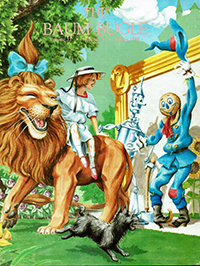
Originally published in The Baum Bugle, vol. 33, no. 1 (Spring 1989), pgs. 16–21
Citations
Chicago 17th ed.:
Koelle, Barbara S. “After The Wizard: The Influence of America’s Best Loved Fairy Tales on Other Fantasies for Children.” Baum Bugle 33, no. 1 (1989): 16–21.
MLA 9th ed.:
Koelle, Barbara S. “After The Wizard: The Influence of America’s Best Loved Fairy Tales on Other Fantasies for Children.” The Baum Bugle, vol. 33, no. 1, 1989, pp. 16–21.
(Note: In print, this article was supplemented with illustrations that have not been reproduced here. However, typographical errors have been left in place to accurately reflect the printed version.)
The immense popularity of L. Frank Baum’s The Wonderful Wizard of Oz resulted in numerous imitations among works of children’s fantasies. It was the best selling American children’s book the year it was published in 1900, and shortly afterward, it was turned into a hit Broadway musical. Children’s book authors and illustrators, as well as publishers, undoubtedly took notice of The Wizard’s success and attempted to duplicate it.
The effect of The Wizard can be traced from close imitations, such as Zauberlinda, the Wise Witch (1901), to a general similarity of scenario, as in The Kingdom of Why (1913), to stories which, sounding faintly familiar, feature a collection of grotesques discovered by human children, as does The Wonder Hill (1914). Many of the stories have the same elements of The Wizard: An American girl, accompanied by a pet, travels to a fairyland, succeeds on a quest, and returns.
The quality of art of many contemporaries of The Wizard is, on the whole, higher than that of the writing. The Wizard may deserve credit, because its lavish use of illustration and color broke new ground in the publication of children’s literature. Several of Baum’s illustrators, in fact, collaborated on other children’s fantasies in the post-Wizard period.
A surprising number of titles, most of them published by Bobbs-Merrill, were written in connection with a proposed musical extravaganza, no doubt influenced by the stage version of The Wizard. Baum followed this procedure with the publication of Tik-Tok of Oz (1914) after having first written the script for the musical comedy, The Tik-Tok Man of Oz.[1] However, by then he was an experienced writer and knew how to compel the reader’s attention. Many of the authors of this type of book were not professional writers (some were primarily musicians and songwriters), and did not succeed in creating a satisfying and believable story.
The listing that follows is not claimed to be either representative or inclusive. It is based on what I own or could borrow. Certain arbitrary criteria were used: (1) Books were at least 8 ½ inches in height. (2) Books were illustrated, and included at least a few full-page pictures. (3) Stories were fantasies directed toward a child audience. (4) Books were published between 1900 and 1920. (5) Stories were either one long continuous story, or a series of short stories held together by a common thread (as in The Magical Monarch of Mo).
In some cases, the influence of The Wizard is immediately apparent. With other books, the influence is more subject to speculation. Obviously there are gaps in what was available to me and I would appreciate any knowledgeable reader’s willingness to fill them in.
It is also possible to find in these books incidents and characters suggestive of Baum’s later Oz books or non-Oz fantasies, as well as incidents which may have inspired Baum or his illustrators.
I would like to thank Dick Martin and Michael Patrick Hearn for helpful information; Fred Meyer for the loan of books; and Vincent A. Lenti for his article on and pictures from Zauberlinda. Douglas G. Greene and Michael Patrick Hearn’s fine biography, W. W. Denslow (Clarke Historical Library, Juvenile Series, Central Michigan University) was an invaluable resource.
Zauberlinda, the Wise Witch, by Eva Katharine Gibson, illustrated by Mabel Tibbets. Chicago: Robert Smith Publishing Co., 1901.
Annie lives in the midst of the great South Dakota prairie with her father, a mining prospector who is often away, and her grandmother, who never finds time to talk with her. Her best friends are Silvertip, her Maltese cat; and Pete Pumpernickel, the German hired man. One day Annie rescues a prairie dog caught in a trap—an animal who turns out to be the son of the Gnome King in disguise. After releasing him, she is carried off (by a windstorm) down a large rabbit hole to the domain of the Gnome King, who decides to marry her to his son. But a prince helps Annie escape to seek the help of the good witch Zauberlinda in the Enchanted Wood of Pix-Sylvania. Accompanied by a little Indian boy, Annie reaches Zauberlinda, and, after relinquishing a magic ring to her, she is carried home in a basket drawn by three white gulls.
The format of this book is strikingly similar to that of The Wizard. Covers, spine, endpapers, and chapter title pages are all reminiscent of the Baum book. In addition to the general design, Zauberlinda’s illustrations immediately suggest those of W. W. Denslow: Annie’s dress and bonnet look remarkably like Dorothy’s; the page arrangement of the Gnome King’s courtiers is obviously inspired by Denslow’s characteristic groupings of three similar characters; the one portrait of Zauberlinda, a Nature deity, brings to mind the sorceress Glinda the Good.
Its derivative qualities are neither redeemed by the writing—mediocre at best—nor by the uneasy mixture of fairyland with Indian myth and the animals of the American prairie. In Twinkle and Chubbins, Baum succeeded in this kind of fantasy. Eva Katharine Gibson does not.
Zauberlinda, which appeared the year after the publication of The Wizard, is eagerly sought after by collectors as the most blatant attempt to capitalize on the success of the latter book.
Little Miss Dorothy, by Martha James, illustrated by J. Watson Davis. New York: A.L. Burt, 1901.
Two children, Dorothy and Ray, have a number of adventures with fairies and various household objects, such as a magic teapot, a calendar, a pudding, and a talking chair. Toward the middle of the book the two protagonists simply disappear, and the chair becomes the focus of attention as it introduces additional fairy stories. The book’s last lengthy story, “The Sleepy King,” is never completed—it simply stops!
This has to be the most poorly written and carelessly constructed of any of the books in this survey. In addition to its confusing story-within-a-story technique and its inexcusable failure to finish the last tale (where was the editor?), Little Miss Dorothy’s author commits the cardinal sin of sentimentalizing and preaching to children. In this story, supposedly addressed to children, there is only one color plate, and the black and white illustrations are not well coordinated with the text. One of them depicts a young lady who is elsewhere described as a little girl!
It is difficult to believe that this book, drenched in Victorian pieties and pale imitations of Andrew Lang fairy tales, came out only a year after The Wizard. It must have been rushed into print because of the similarity of names of the two heroines, but the contrast could not be more striking. The Wizard is a book of the 20th century, Little Miss Dorothy of the 19th, is of historical interest only.
The Rambilicus Book, Wonder Tales for Children from 7 to 70, told and pictured by Walt McDougall. Philadelphia: George W. Jacobs and Co., 1903.
The Rambilicus Book is a collection of short stories about the adventures of ordinary children with various outrageous animals and a few giants and wizards thrown in for good measure. McDougall’s imaginary beasts put him in a select company of American illustrators of children’s books that include Winsor McKay, John R. Neill, and, more recently, Maurice Sendak.
The book abounds with puns, topical allusions, and a sprinkling of ethnic humor. The writing is casual and the plot minimal, but somehow it all works. A major part of its charm is, of course, McDougall’s art. McDougall’s children are grubbier and his monsters more bizarre than Baum’s, and his fantasy is set solidly in the United States. Still, there is a resemblance to both the text and Frank VerBeck’s illustrations in The Magical Monarch of Mo.
Perhaps this is not surprising, as McDougall illustrated Baum’s comic page, Queer Visitors from the Marvelous Land of Oz, and thus has a claim to be considered one of the Royal Illustrators of Oz.[2]
The Rambilicus Book originally appeared as a newspaper series in The Philadelphia North American.
The Pearl and the Pumpkin, by Paul West, illustrated by W. W. Denslow. New York: G.W. Dillingham Co., 1904.
Little Pearl Pringle’s cousin, Joe, discovers the secret of growing huge pumpkins, and his fame reaches under the sea to the pie-loving pirates who live in Davy Jones’ Locker. They send the Ancient Mariner to discover Joe’s secret. Joe becomes a pumpkin-headed boy, and is kidnapped with the help of the Corn Dodger. Things get complicated with the introduction of Mother Carey, King Neptune, the village pieman, and a Bermuda canner.
An excessively complicated plot line is evidence that The Pearl and the Pumpkin does not suffer from a dearth of imagination. Unfortunately, things do not quite jell, and the story is not only impossible: it is implausible. Denslow had the idea for both a play and a full-length novel for children, and he brought in a songwriter friend, Paul West, to do the actual writing [3].
Not surprisingly, The Pearl and the Pumpkin bears a strong physical resemblance to The Wonderful Wizard of Oz, since Denslow designed both. The Pearl and the Pumpkin is about the same size as The Wizard, and both are bound in green cloth. The Pumpkin Boy bears some resemblance to Jack Pumpkinhead in The Marvelous Land of Oz, published the same year. The Pearl and the Pumpkin was originally planned as a stage play, just as The Land was based on Baum’s short-lived stage play, The Woggle-Bug.
The Golden Goblin, or the Flying Dutchman, Junior, by Curtis Dunham, illustrated by George Kerr. Indianapolis: Bobbs-Merrill, 1906.
Two Dutch children, Jan and Gurtruida, are shipwrecked on a raft in the south Indian Ocean. They have a number of adventures on and below the ocean surface before being restored to a Dutch steamer. They meet various characters including the captain and crew of the Flying Dutchman, Neptune, the Queen of the Sea, and the Golden Goblin, whose coral palace is at the bottom of the sea. The story is occasionally interrupted by song and verse.
Perhaps because it was first conceived of as a musical extravaganza, this story has a number of weaknesses. It is dedicated to “all manly little boys . . . all womanly little girls . . . who believe in the kind of enchantment that rewards good thoughts and kind deeds,” thus exhibiting kinship with 19th century moralizing children’s literature of the kind that Baum consciously rejected. The fact that The Golden Goblin was written with the stage in mind does not excuse this sort of inane refrain:
All day long, up stairs and down
Romps Polly with her dolly.
Although the illustrations are attractive enough to justify searching out this book, they, as well as the format, are occasionally derivative. The picture of the Queen of the Sea on her throne (p. 99), for example, owes a great deal to W. W. Denslow’s portrait of Glinda asking Dorothy for the Golden Cap in The Wizard. The artist, George Kerr, also illustrated the second and third editions of Baum’s American Fairy Tales (1908).
Bobbs-Merrill, which published The Wonderful Wizard of Oz in 1903 as The New Wizard of Oz, published a number of books in the same format as The Wizard and with similar stories. Bobbs-Merrill also published a number of Baum titles, including The Magical Monarch of Mo (1903), The Enchanted Island of Yew (1903), and Baum’s American Fairy Tales
The King of Gee Whiz, by Emerson Hough, lyrics by Wilbur D. Nesbit, illustrated by Oscar E. Cesare. Indianapolis: Bobbs Merrill, 1906.
The Widow Pickles’ children, Lulu and Zuzu, have hair colored blue and green, the Royal Hereditary Colors of the Land of Gee Whiz. They are transported to the magical land by means of a Talking Banjo, a Private Secretary, and a combined airship-submarine. They meet the king, Jankow the Dragon, a wicked fairy, and the Fairy Queen Zulena. They journey to the Valley of the Fairies and the Valley of Gold before returning to their own home.
Emerson Hough, like Baum, became successful late in life, and published a number of works before attempting fantasy. [3] He and Baum collaborated on a musical comedy, The Maid of Athens and an extravaganza to be called The King of Gee Whiz, neither of which was produced. Hough went on to take one of the names for this book, in which only the dragon, the Golden Valley, and a number of lyrics appear to be carryovers from the outline of the musical.
The story has a number of resemblances to certain characters and objects in Baum’s books. Queen Zulena’s name at once suggests Baum’s Fairy Queen Zurline from The Life and Adventures of Santa Claus (1902). The magic powder that fuels the submarine may have been inspired by the Powder of Life from The Marvelous Land of Oz (1904), and a Candy Man by the candy people in Dot and Tot of Merryland (1901). A more serious criticism is the episodic plot style which all too obviously betrays its origin as a proposed musical. The children jump from one exotic setting to another without a unifying theme, and the characters do not command the reader’s belief.
Billy Bounce, by W. W. Denslow and Dudley A. Bragdon, with pictures by Denslow. New York: G.W. Dillingham, 1906.
Billy Bounce is a messenger boy sent by Nickel Plate and the bee Bumbus to find the Bogie Man. The three villains plot to kidnap Princess Honey Bee, and eventually are foiled by Billy’s bravery. Equipped with an inflated rubber suit which enables him to soar through the air, Billy visits such absurd places as Shamville, Eggs-Aggeration, Mirage Town, Spooksville, and Never Was, where he encounters Al Bumen, Gehsundheit, General Merchandise, Sterry Optican, and Umberufen, among many other characters.
Billy Bounce began life in 1901 as a popular weekly comic strip drawn by Denslow. Denslow revived his old character in an unproduced play, Billy Bounce and the Boogieman, collaborating with Dudley A. Bragdon, a writer of theatrical sketches. Like the comic strip and play, it is overcrowded with forced puns; its story is confusing and chaotic. The preface and the unmasking of Bogie Man owe much to The Wizard. But like The Pearl and the Pumpkin, Billy Bounce is a highly desirable collector’s item for Denslow’s wonderful, colorful illustrations.
The Jeweled Toad, by Isobel Johnston, illustrated by W. W. Denslow. Indianapolis: Bobbs-Merrill, 1907.
In the Kingdom of Wonderland, a tyrannical king rules over his impoverished subjects with the aid of magical spyglasses, a Tell-ee Everything Machine, a sword Sham hir, and the wonderful Jewel of Knowledge. When the Jewel is stolen by a mysterious Toad, suspicion falls on a girl named Towsey. Despite the machinations of the wicked Duke of Cork, the Royal Historiagrapher, and an unfriendly cat and monkey, she manages to free the kingdom and restore the Toad to his real form as the Knight of Truth.
Greene and Hearn [4] point out that The Jeweled Toad is one of the few post-Baum collaborations where Denslow worked with an author whose talent matched his own. The result is a charming and beautifully designed and illustrated fairy tale. Denslow seems to have been inspired by his material and his pictures of children and animals are among his best. And for once, the fact that Mrs. Johnston wrote the book after a proposed play has not produced the usual chaotic script so typical of most children’s books designed for the stage.
This is another example of a Bobbs-Merrill title similar in format to The Wizard.
Bobbie in Bugaboo Land, by Curtis Dunham, illustrated by George Kerr. Indianapolis: Bobbs Merrill, 1907.
Bobbie and his dog, Sport, fall into a hole in the ground while waiting to be reunited with his friend, Enid, at the spot where she had earlier disappeared. Carried by a great white bat, they float down to Fairyland in the center of the earth. There they find Enid, now a Princess, and such denizens as Robin Goodfellow, King Oberon, Queen Titania, and Merlin. Fairyland is next door to Bugaboo Land, whose dreadful ruler, Quake, is stealing all Fairyland’s flowers, ambrosia, and nectar. A visit by Bobbie helps to straighten things out before he returns to the surface via an explosion.
Although Bobbie in Bugaboo Land has the same author-illustrator as The Golden Goblin, this book is by no means a sequel, being quite different in both content and format. The action seems more unified here, in spite of a too-large cast of characters, and the boy protagonist more believable. Quake and Snore, the two villains, are original and interesting—more so than the “good guys” who are merely standard versions of the traditional court of Oberon.
Is it possible that Dorothy’s descent into the underground land of the Mangaboos owes something to Bobbie’s descent into Fairyland? Dorothy and the Wizard in Oz was published in the year following this book’s appearance. Also, Baum could have read of Dunham’s Half-Men before writing Sky Island. The Half-Men in this book have been sliced in two at the whim of the ruler, just as were Jimfred Jonesjink and Fredjim Jinkjones by the ruler of Sky Island. But whereas the Half-Men of Sky Island are patched to each other after slicing, the creatures of Bugaboo Land are attached to a wooden slab. Eventually the two halves are united. This is reminiscent of Mr. Split in Dot and Tot of Merryland (1901).
This is yet another Bobbs-Merrill Wizard-like volume.
Pinky and the Plumed Knight, by Frederick Chapin, illustrated by Merle Johnson. Chicago: Saalfield Publishing Co., 1909.
A little Scots boy and his dog, a resurrected French knight from the army of Joan of Arc, a talking pig, a French barber, and a Scots fisherman comprise the cast of characters in this engaging but carelessly written fantasy. The unlikely crew get shipwrecked, meet mermaids in the sea and Arabs in the desert, and manage to rescue the Princess Lotus in Egypt before being dropped off in Scotland by an obliging whale.
The influence of Baum and Neill’s John Dough and the Cherub (1906) can plainly be seen in the format and art of the book. Merle Johnson’s illustrations are derivative, though attractive, and Pinky has other borrowings. Surely the dark powder in the snuff-box, which confers life on anything on which it is sprinkled, was inspired by the Powder of Life from The Marvelous Land of Oz (1904). The author, Frederick Chapin, was certainly exposed to Oz material: He was the composer of the score for Baum’s 1905 musical production, The Woggle-Bug, based on The Land.
Yama Yama Land, by Grace Duffie Boylen, illustrated by Edgar Keller. Chicago: Reilly and Britton, 1909.
Sylvie, a San Francisco girl, drives an automobile through a crack in the earth to reach Yama Yama Land, “the heart of the world, where she becomes Princess Runaway. Among the many characters who pop in an out of the story are Bibbo the Wanderer, an Irish policeman, a street peddler, a witch, live Totem Poles, and assorted Yamas.
The sentimental style of writing seems very dated (“The tender, secret words that children know”), the punning is strained (“I yam just yamused about a number of things.”), and the moralizing too obvious (“She tried, like the brave little girl she was, to forget herself and make other people happy”). Boylan may have been inspired by the San Francisco earthquake and Baum’s use of an earthquake in Dorothy and the Wizard in Oz. There is some attempt at using different colors for illustrations in sequence throughout the book (as in the early editions of The Wizard), but the effect is dissipated by the insertion of black and white illustrations.
Nevertheless, the art is effective.
Yama Yama Land was developed from the song hit, “The Yama Yama Man” in the musical review, Three Twins, starring Bessie McCoy. Like The Wizard, this stage version was also successful.
The Magical Man of Mirth, by Eldridge H. Sabin, pictures by Elenore Plaisted Abbott and Helen Alden Knipe. Philadelphia: George W. Jacobs & Co., 1910. The book was reprinted in 1911 under the title, The Queen of the City of Mirth.
Dollie, Sir Oliver Owl, and Miss Martha, visit the City of Mirth in the clouds. It is now a City of Gloom because the Queen has offended her Magician who has cast a spell over all its inhabitants. Dollie and her friends descend into the depths of the ocean to find and punish the magician, and they encounter talking fish and lobsters, mer people, a sea turtle, and the ghost of a cat. After facing an evil monster, Dollie carries out her mission.
One might ask if Baum had read this book prior to publication of The Sea Fairies (1911).
Consider this description of the menacing undersea creature of Mirth (p. 233):
His thick-scaled body, long as a telephone pole and twice as big, was furnished with a set of fins, large as an eagle’s wings, while below each fin swayed a short and powerful leg, sharp-clawed like those of an alligator; his jaws ended in a beak pointed and cruel; his dark red eyes gleamed balefully, while from a hole in the top of his head poured a cloud of foul and darkly-colored steam that railed far behind him, as the smoke from a locomotive.
And from The Sea Fairies (p. 210):
Now, with his horned head and its glowing eyes thrust forward, wings flapping from his shoulders and his eely body—ending in a fish’s tail—wriggling far behind him, this strange and evil creature was a thing of terror, even to the sea dwellers, who were accustomed to remarkable sights.
If there was borrowing here, it seems to have been mutual. Sabin’s monster turns into a little man—the wizard for whom the party was searching! The motivation of the quest, to kill the magician, is reminiscent of Dorothy’s quest to kill the Wicked Witch.
A clear similarity is the alliteration in the titles The Wonderful Wizard of Oz and The Magical Man of Mirth. Also, the heroine of Mirth is Dollie, which is a diminutive of Dorothy.
The Kingdom of Why, by Stuart B. Stone, illustrated by Peter Newell. Indianapolis: Bobbs Merrill, 1913.
Lucile, a most inquisitive youngster, lives in Chicago with her parents. One night, along with her pet goat Jupiter, she accompanies an aerocow to the Kingdom of Why high above the clouds, beyond the Heights of Imagination and the Gulf of Probability. Lucile visits such kingdoms as Cloud Land, Invisible Land, the Province of Problems, and the Rhythmical Realm of Rymo; and she meets such characters as a Foolish Idea, a Jester made of rubber, and the Topsy-Turvies. She returns home, being cured of asking “why.”
Certain comparisons to The Wizard are unavoidable. There is a moving pavement rather than a yellow brick road, a pet goat instead of the dog Toto, a Foolish Idea who wants to be wise instead of the Scarecrow, and a Jester who wants to make people laugh instead of the Tin Woodman. The adventurers land in a blue country and travel to a Purple City where they must pass a soldier guarding the gate.
This is an interesting, though uneven book. Lucile is a believable child heroine, the goat and the Jester are good characters, and such inhabitants of Why as the Bogie-Men of the Dismal Darks, the Gigantic Germs, and the Topsy-Turvies are imaginative and entertaining. In spite of some similarities to Baum’s books, is this no mere imitation of The Wizard. Peter Newell has contributed original and entertaining illustrations.
The Wonder Hill or the Marvelous Rescue of Prince Iota, by Albert Neely Hall, illustrated by Norma P. Hall. Chicago: Rand McNally, 1914.
Santa Claus and Jack Frost must have been popular characters in early 20th century children’s books—they pop up at the end of this long, rather complicated story. The main characters are the children Bob and Betty, their pet monkey, the Handyman, a drum majorette, a Barber Pole, and a Jumping Jack. After Bob and Betty discover an underground region, they have many adventures in the course of rescuing Prince Iota of Iola Isle, and encounter many Oz-like places and beings. Among the more interesting are Tell Tale Snakes, a canary ship, Cat Island, a Taletelograph, a Sand Witch, and a giant Weather Bureau. Needless to say, the children and their friends succeed in their rescue attempt and return safely home.
The Wonder Hill has a number of similarities to The Wizard. The Barber Pole Man’s origins resemble that of the Scarecrow, and an invisible man was formerly a wood chopper. A Moving Picture Machine brings to mind the Magic Picture of later Oz books. Whether these borrowings were conscious or not, there are a number of original touches that would fit well into an Oz locale.
The color plates and line drawings, as well as some full page black and white illustrations, defintely add to the book’s attractions.
NOTES
[1] Frank Joslyn Baum and Russell MacFall, To Please a Child. Chicago: Reilly and Lee, 1962. p. 252.
[2] “L. Frank Baum Studied by McDougall,” The Baum Bugle, Spring 1970 (Vol. 14, 1, pp. 18-19).
[3] Alla Ford and Dick Martin, The Musical Fantasies of L. Frank Baum, Chicago: The Wizard Press, 1958.
[4] Douglas G. Greene and Michael Patrick Hearn, W. W. Denslow, Mount Pleasant, Michigan: Clarke Historical Library, Central Michigan University, 1976. pp. 136-137.
Authors of articles from The Baum Bugle that are reprinted on the Oz Club’s website retain all rights. All other website contents Copyright © 2025 The International Wizard of Oz Club, Inc. All Rights Reserved.