AN INTERVIEW WITH PAUL TAYLOR
by Barbara Arnstein
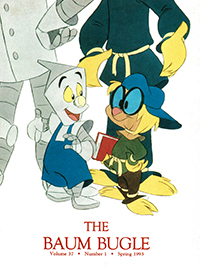
Originally published in The Baum Bugle, vol. 37, no. 1 (Spring 1993), pgs. 15–16
Citations
Chicago 17th ed.:
Arnstein, Barbara. “An Interview with Paul Taylor.” Baum Bugle 37, no. 1 (1993): 15–16.
MLA 9th ed.:
Arnstein, Barbara. “An Interview with Paul Taylor.” The Baum Bugle, vol. 37, no. 1, 1993, pp. 15–16.
(Note: In print, this article was supplemented with photographs that have not been reproduced here. However, typographical errors have been left in place to accurately reflect the printed version.)
“I love Dorothy,” Paul Taylor remarked enthusiastically. “Nothing dismays her. She never complained. She would find herself in these strange situations, but she always took things for granted, and everything turned out all right.” This love was one of the reasons behind his Oz ballet, a Nutcracker Suite-like series of entertainments, presented at New York’s City Center from October 27 to November 8, 1992. Dorothy is the only character in it from the familiar foursome. The others are her cousin Zeb, Tik-Tok, the Patchwork Girl, Polychrome (simply called the Daughter of the Rainbow), the Crooked Magician, Jellia Jamb, and the Giant Porcupine. Two of the characters, Raggy Man and Raggy Woman, are respectively the Shaggy Man under another name, and his female counterpart. Finally, two of the three magical pearls from Rinkitink in Oz are brought to life as the male and female Blue Pearl and Pink Pearl.
Paul Taylor has been winning awards for dance, choreography and writing, too, for almost forty years. He won a 1985 MacArthur Foundation Fellowship (the “genius award”) and an Emmy for outstanding individual achievement in choreography in 1992. He was made a “Commandeur de l’Ordre des Arts et des Lettres” by the French government, in 1990, after being made an Honorary American Member of the American Academy and Institute of Arts and Letters the year before. As an interview subject Taylor is soft-spoken, unassuming and down-to-earth. He was more than glad to run through his Oz characters one by one and elaborate on his reason for choosing them.
“I didn’t use the movie characters other than Dorothy because I couldn’t compete with Bert Lahr and Jack Haley,” he began. “I didn’t want to draw any comparisons.”
“Polychrome was a natural,” he said, referring, of course, to her habit of dancing continuously. Her veils on sticks were inspired by Loie Fuller, a figure in our American dance heritage early in the century—the same time the books were written.”
“I chose Tik-Tok because I was matching characters to certain dancers, and I’ve always teased one dancer, Andrew Asnese, about being stout. He’s not fat—there’s not an ounce of extra fat on him—he’s just big, and such a good sport. I saw an illustration of Tik-Tok walking in a goosestep, and that inspired me. He did a wonderful job as a mechanical man, as good as any I’ve ever seen.”
“The Raggy Man,” he continued, “was the same as the Shaggy Man, the character whose rags are carefully curled. There was confusion when he was being named, and I don’t think it was mine. I added Raggy Woman because I just thought he should have a companion.”
“To me, Jellia Jamb was always more than a maid because she welcomed the guests,” he said. “I thought of her as the power behind the throne. Onstage she’s flighty; she’s always dusting.”
“The Patchwork Girl,” he went on, “is floppy and just a mess, but she exudes joy all over the place. She has stuffed gloves in the illustrations, and we gave her those onstage. We also gave her shoes with heels that bow in, which aren’t easy to dance in. It was nice to give her a wobbly look. If I had been able to elaborate on her character, I would have played up how smart she is, although everyone thinks she’s silly.”
In a rueful aside, he commented, “If I only had more rehearsal time, I could go back and fiddle. It’s very expensive, so usually a piece is done when rehearsal time is over.
“I included Dorothy’s cousin Zeb,” he continued, “because I thought it would be nice to have a friend along with her.”
“One of the dancers, Tom Patrick, is very young looking, and I wanted something special for him that would involve his background. He came all the way from the Midwest for his audition—and the first thing that happened to him when he got off the bus was that he was mugged. Since the character heads from the country into a chaotic adventure, he was just right for Zeb.”
“The guy that danced the Great Porcupine (David Grenke) always has to slick his hair down, and I said it made him look a little like a porcupine, so that’s another inside joke. The Porcupine’s a very ominous character. He’s supposed to be the scariest of all.”
“I gave an extra power to the Crooked Magician. Besides bringing things to life, he can also kill them off. He does in everybody at the end. It’s kind of a relief. Originally I left the bodies on the floor, but I found them a little distracting somehow. So they get bounced off by the Magician. He walks very heavily, and when he stamps on the ground, the reverberation makes them bounce up and off the stage.”
About the remaining characters, the pearls, he said, “There was one magic pearl, so I added another . . . there were three? The important thing was that they were included, in a duet.”
Taylor’s replacement for “Over the Rainbow” is “Deliver Me.” Elaborated the choreographer, “Dorothy is saying, ‘I wanna go home. Get me outta here’ after experiencing chaos. As the dance progresses, things get more and more chaotic until the whole thing is turned into a three-ring circus. Too noisy and too much.”
“We didn’t have a lot of dollars for effects,” he continued. “I would’ve loved to have an earthquake, to have the ground open up and let Dorothy and Zeb fall into it. (It was wonderful how Baum always found a new way for her to get to Oz.) I could have done that if the money was there. But I simply have them go to sleep and seemingly wake up in Oz. I don’t know how many people noticed that it’s all supposedly a dream. I never liked the way the movie turns everything into a dream.
“It begins with a shadow train that arrives with Dorothy in it,” he related. “She has her birdcage, parasol and her wicker basket. (Nobody knows this, but her kitten is in it.) Then they’re tired and want to rest, so she lies down on the bench and sleeps, and Zeb lies on the floor nearby.”
“The stage changes at that point,” he continued. “You see the planets, the spheres, in different colors in the background; light coming through the holes. The color changes according to which characters dance. The two of them are observers after that.”
“You know that woman general [Jinjur]? I wanted to put her in. Women’s Lib these days would just eat it up. But I was afraid of unintentionally saying something bad about it. I found that reading the Oz books is like going through history books,” he said. “All the popular notions of the day are there in some form.”
“Some of the best writers use ordinary surroundings and ordinary people and then have these remarkable things happen,” he continued. “Hitchcock did this. Baum knew that. So many of the magical things he created were common, everyday objects, like the flour sifter containing the Powder of Life. (I found an authentic one we used in the dance.) They’re never anything like the shiny gold lamp in Aladdin, not that kind of thing at all.”
“We made up this language that we spoke during rehearsal, to get into the mood. It wasn’t really talking, but it sounded like it, to sound like whatever it is they speak in Oz.”
Taylor comes naturally by all of this Ozzy passion, and it’s a life-long fascination. He now smiles reflectively, “As a little boy, I had an aunt who gave me Oz books. My favorite was the one with the flying things that include the sofa.”
Authors of articles from The Baum Bugle that are reprinted on the Oz Club’s website retain all rights. All other website contents Copyright © 2025 The International Wizard of Oz Club, Inc. All Rights Reserved.