BAUM’S DRAGONS
by Camilla Townsend
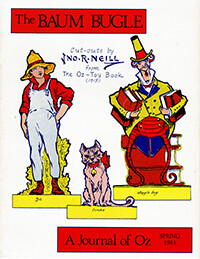
Originally published in The Baum Bugle, vol. 27, no. 1 (Spring 1983), pgs. 9–12
Citations
Chicago 17th ed.:
Townsend, Camilla. “Baum’s Dragons.” Baum Bugle 27, no. 1 (1983): 9–12.
MLA 9th ed.:
Townsend, Camilla. “Baum’s Dragons.” The Baum Bugle, vol. 27, no. 1, 1983, pp. 9–12.
(Note: In print, this article was supplemented with illustrations that have not been reproduced here. However, this digital version corrects numerous minor typographical errors that appeared in the print edition.)
Oz is an American fairy tale, with real little boys and girls who laugh and have adventures. But a fairy tale is a fairy tale, and there are always princesses and witches, woodland dells and castles, enemies and power. And in many a fairy tale, there are, of course, dragons.
So the great beasts lumber through the Oz stories, with shining scales and burning breath, and though they are not as famous as Tolkien’s Smaug,[1] no one can ever forget a dragon:
. . . The underground cave . . . was dimly lighted by dozens of big, discs that looked like moons. They were not moons, however . . . They were eyes. The eyes were in the heads of enormous beasts whose bodies trailed far behind them . . . There was no mistaking them, for they were unlike any other living creatures.[2]
These particular dragons are, in fact, Baum’s only native dragons of Oz. Their cavern is somewhere underground in the southern part of the Gillikin country. They have been driven from the surface long ago, and they are only allowed to come forth once every hundred years to find food. Woot the Wanderer (then the Green Monkey) comes across them in The Tin Woodman of Oz, and he sorely regrets it. They are called the “Quarrelsome Dragons,” and they really are a most unfriendly, irritable bunch. They argue about whether or not Wood is large enough to make a tasty morsel, and if not, how best to punish him for disturbing them. Their most frightening trait, which causes Woot to “scream in terror,” is the fire that shoot from their mouths and eyes, “bright but not very hot.” They are beasts of timelessness: years, centuries mean nothing to them. One hasn’t eaten for eighty-seven years. Another wakes from a little nap of over sixty years, and she could have done with an extra forty. Baum is not overly fond of these dragons. True, they are the “Dragons,” never the “dragons,” but he emphasizes their unwieldy bodies and mentions that thinking is very bad for them.
These creatures are by no means the first dragons to appear in the Oz books: long before, in Dorothy and the Wizard in Oz, Dorothy and her companions stumble across a den of dragonettes. They are journeying under Pyramid Mountain, just across from the Deadly Desert. Luckily, it is only a den of dragonettes (baby dragons), and their mother is away hunting. The entire episode is very similar to Woot’s encounter. The beasts would make a mouthful of Dorothy and her friends in a wink, but their mother has tied their tails to the cavern walls. The idea of time is a bit different here. The dragonettes have just turned sixty-six, which they consider “very babyish,” but there is no question that it is longer than a “nap.” (In fact, each dragon we find in the Oz stories seems to have a different idea of “ancient”). Baum tells us these dragons are very important in dragon lore:
“Permit me to say,” returned the dragonette, “that we have a pedigree I challenge any humans to equal, as it extends back about twenty thousand years, to the time of the famous Green Dragon of Atlantis, who lived in a time when humans had not yet been created.”[3]
If Baum doesn’t like his dragons, however, it is only because they are doing exactly what one would expect of typical dragon specimens. The very word dragon comes from the ancient Greek drakon, serpent, connected with derkesthai, to see, clearly and sharply. Like all dragons, Baum’s beasts are great snake-like creatures with remarkable eyes. Dragons are famous for their armor-like scales, and Baum never forgets to describe that part—“round as pie-plated” or “shining green.” Besides these readily apparent traits is the very image of the dragon. In the western world, it is a symbol of everything evil. Dragons were our ancient monsters, the villains of classical mythology, the beasts of the Middle Ages. Today, Smaug and his contemporaries carry on the tradition. We have always loved to hate dragons. We would have been surprised if the Quarrelsome Dragon hadn’t threatened to munch upon Woot. Dragons can be sarcastic and threatening. And some do more than threaten. Even in the supposedly mild stories of Oz, the nome Kaliko tells us, “it is not in good taste to sneer at a dragon,” for he once found a small piece of a nome who had been attacked and scattered by a dragon.
Of course, Baum always makes his creations at least a little bit “different.” His dragons apparently can’t fly, and unlike the wily dragons of mythology, such as those vanquished by Heracles and St. George, they aren’t at all clever. It seems to have affected their power and status, for they have been driven underground, with no treasure to guard. Whatever their idiosyncrasies, these dragons are Western World dragons—delightfully, detestably evil.
Baum, however, also creates dragons who certainly are meant to be liked, and his story of Tititi-Hoochoo, the Great Jinjin, is full of them. In Tik-Tok of Oz, the Nome King sends a large party of Ozites down a tube that goes right through to the other side of the world, to the land of the mighty Jinjin. This land is also the home of many dragons, who are greatly respected by the fairy inhabitants. They are all descended from the original Dragon, who is as “old as the world” and advises the people well. All of the nobility wear dragon heads embroidered on their robes, powerful, “horrible to look at.” The dragon we become well acquainted with is Quox—a rather friendly beast who ends up playing a hero’s role.
The head and face of Quox were not especially ugly, when you consider that he was a dragon; but his eyes were so large that it took him a long time to wink and his teeth seemed very sharp and terrible when they showed, which they did whenever the beast smiled . . . those who stood near him were liable to smell brimstone—especially when he breathed out fire; as it is the nature of dragons to do.[4]
Lodged between the other two dragon encounters, I was at first quite at a loss to explain this one. Then I remembered the Chinese dragon. Little children in America are told not to dig a hole too deep, or they might fall through to China. If Oz is an American fairyland, then on the other side of the fairy world there must be a fairy China. In the real China, the dragon is the symbol of goodness, wisdom, secrets. It is prestigious. It was once worshipped. It brings spring to the land. It has been the symbol of the royal family and the national emblem. In fact, we should expect that the dragons from the other side of the fairy world would also be wise, would also stand proudly on the gowns of the royal family.
In another Baumian tale, though, Santa Claus fights a terrible battle against evil. “There were three hundred Asiatic Dragons, breathing fire that consumed everything it touched. These hated mankind and all good spirits.”[5] What should we think? Did Baum use classical legend to make Ozian legend, or was the heroism of Quox a coincidence? We do hear of some Chinese dragons whose eyes are “those of a demon.”[6] Perhaps the “theory” still holds?
However, it’s rather hard to make a dragon family tree combining legend and Baum—assuming that dragons hatch from eggs. We could say that there was an Original Dragon; his children separated. Some young dragons stayed with their father and became the Dragons of the East—of China and the land of the Great Jinjin, where the new “humans” respected them. The Great Green Dragon settled in Atlantis. Happily, all his children did not perish with him there. Some came to Imagi-Nation and survived, though they were persecuted by the western peoples, and so became fierce. Some lived in the area of Europe, and by now have apparently been wiped out by St. George and his fellows. Some slipped into the sea and no one really knows about the serpents. Perhaps the Loch Ness monster could tell us something. If Baum adopted some of the traditional dragon legends, he made up for it by creating at the same time the most unorthodox dragons ever. Dorothy and her party, in their search for Ozma in The Lost Princess of Oz, come across some of the oddest in the fairy world. They are manufactured “at the famous dragon factory in the city of Thi,” quite harmless—in fact, not even alive. They are machines that pull chariots, only working when loud music is played.
They saw coming around the corner a car drawn by a gorgeous jeweled dragon, which moved its head to right and left and flashed its eyes like the headlights of an automobile and uttered a growling noise as it slowly moved toward them.[7]
I once thought these dragons were just another of Baum’s mechanical creations that he used to delight in, but it was recently pointed out how closely they resemble the mechanical dragon, Fafner, in the Metropolitan Opera’s version of Wagner’s Ring of the Nibelung.[8] That dragon of necessity moved slowly, with loud music covering its whirring sounds, and Baum is known to have used other parts of the opera in his various stage productions. It seems fitting that the greatest American tale of fantasy should be related to the mammoth opera of fantasy.
Then there is the Purple Dragon of Mo. Baum points out that scientists agree purple dragons are the dragons “most disagreeable to fight with.” (They have raspberry juice for blood.) His strange color fits with his cantankerous, almost perverse nature, though it has been stated that he “is not frightening but naughty.”[9] He serves to unite a collection of rather unrelated stories, causing trouble at the end as successfully as he does at the beginning . . . To punish him, he is stretched out and cut into fiddle strings “as easily as if made of India-rubber.”
The Royal Dragon of Spor makes an appearance in The Enchanted Island of Yew. He, like many of his Baumian cousins, is covered with jewels. He has eyes “like a bathtub.” His tail ends in a golden ball. (Some creatures with a golden balled tail must have made an impression on Baum. The Li-Mon-Eags of The Magic of Oz are equipped in the same way.) His teeth, as well as his horns, are beautifully carved, “so that if any of them broke off it would make an excellent umbrella handle.”[10] This dragon is the “pride and terror of the kingdom of Spor,” but he cannot spout fire for the moment, having been caught in a gale; he has rheumatism in his tail; his teeth ache. He won’t kill Prince Marvel, as Prince Marvel does not want to be killed, and he is a true gentleman. It was his very own father who “got into trouble with Saint George!”
To top off this remarkable dragon collection, Baum created a friendly sea serpent, King Anko, of The Sea Fairies. Sea serpents are probably the most terrible and mysterious type of dragon, but in Neill’s drawing King Anko reminds me of a favorite stuffed animal, with droll features and a stubble of whiskers all around his face. He is so long that only a part of him leaves his cave at one time, and he has lived so many years that he knew Adam personally, when Cain was still a baby. He rules the ocean well, and though he has two brothers, no other sea serpent is as good. In fact, like Quox, he becomes a hero.
But of course all these dragons are relatively ordinary in comparison with the Great Beast Choggenmugger. It is far more terrible than any dragon: indeed, when it is first mentioned in Rinkitink in Oz, it has already devoured all the dragons of the island, as well as any other serpents or crocodiles. We don’t know what sort of beast it is, but a description leads me to believe that Baum was in fact imagining an “extra-large” dragon, or at least a relative of the great worms.
Choggenmugger was so old that everyone thought it must have been there since the world was made, and each year of its life the huge scales that covered its body grew thicker and harder.[11]
After all this, however, Choggenmugger is finally chopped into small pieces by the poor charcoal burner, Nikobob, meeting a fate similar to that of the Purple Dragon.
So the age-old classic menagerie slipped into our American fairy tale. No one can escape the dragons. The bad ones and the good ones found their way in, and both kinds sometimes seem so similar to their real-world cousins that we wonder if Baum was “following the rules” more closely than he cared to admit. It is true, though, that Baum’s different ideas of time and history sometimes make it hard to reconcile real world dragon lore with Ozian legend, but things do fit after a fashion. And some of Baum’s creations may seem odd, even for dragons, but then dragons never did aim to please. Behind everything is that constant worry that dragons may be an endangered species. It seems they are being forced to retreat. But we don’t really need to worry. They will survive, for the same reasons that they found their way into Oz. Dragons belong to Imagi-Nation. For us, after all, Quox is very much alive. As long as there are fairy tales, there will be princesses and fairies and dragons, and fairy tales, I think, will live as long as people.
A Dragon is forever.
Notes
[1] J.R.R. Tolkien, The Hobbit, Houghton Mifflin.
[2] The Tin Woodman of Oz, Reilly & Lee, pp. 122–23.
[3] Dorothy and the Wizard in Oz, Reilly & Lee, p. 161.
[4] Tik-Tok of Oz, Reilly & Lee, p. 142.
[5] The Life and Adventures of Santa Claus, Dover Publications, p. 114.
[6] Paul Hogarth & Val Clery, The Nine Resemblances, Dragons, Viking Press, p. 53.
[7] The Lost Princess of Oz, Reilly & Lee, p. 135.
[8] Daniel P. Mannix, “Ozma, Tik-Tok, and the Rhinegold,” The Baum Bugle, Spring 1978, p. 8.
[9] David L. Greene, Introduction to “Tales from Phunnyland,” in Baum’s The Purple Dragon and Other Fantasies, Fictioneer Books, p. 18.
[10] The Enchanted Island of Yew, Bobbs-Merrill, p. 84.
[11] Rinkitink of Oz, Reilly & Lee, p. 144.
Authors of articles from The Baum Bugle that are reprinted on the Oz Club’s website retain all rights. All other website contents Copyright © 2025 The International Wizard of Oz Club, Inc. All Rights Reserved.