CHRISTMAS IN OZ
by Patricia Eliot Tobias
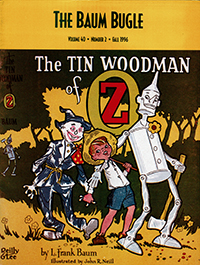
Originally published in The Baum Bugle, vol. 40, no. 2 (Fall 1996), pgs. 22–29
Citations
Chicago 17th ed.:
Tobias, Patricia Eliot. “Christmas in Oz.” Baum Bugle 40, no. 2 (1996): 22–29.
MLA 9th ed.:
Tobias, Patricia Eliot. “Christmas in Oz.” The Baum Bugle, vol. 40, no. 2, 1996, pp. 22–29.
(Note: In print, this article was supplemented with illustrations that have not been reproduced here. However, typographical errors have been left in place to accurately reflect the printed version.)
Shortly after completing The Wonderful Wizard of Oz, L. Frank Baum came up with the idea for another children’s book. In it, he would create his own legend of that jolly elf, Santa Claus. The Life and Adventures of Santa Claus (1902) tells of the mortal boy Neclaus, who had been reared by the fairy Necile. After he has grown, Claus ventures out to meet his destiny as a human being. He tells Necile, “I must devote myself to the care of the children of mankind, and try to make them happy . . . Since your tender care of a babe brought to me happiness and strength, it is just and right that I devote myself to the pleasure of other babes. . . .”
The chapter titles in The Life and Adventures of Santa Claus relate Baum’s version of the beginnings of Santa Claus traditions, such as “How Claus Made the First Toy,” “The Tradition of Christmas Eve,” “How the Stockings Were Hung,” “The First Journey with the Reindeer,” and “The First Christmas Tree.” Baum also imbued the book with his personal philosophy of Christmas. David Greene, writing in The Baum Bugle, agreed, stating:
The Life and Adventures of Santa Claus is, I believe, Baum’s most humane fantasy, with many of his deepest insights. Most important of these is the universality of childhood matched with the inequality of man’s lot. The real world of Santa Claus is not sugar coated; it is a world where suffering is frequent, and Claus’s service to the children takes its meaning against this background.
Of Santa’s life-mission, Baum wrote:
. . . and, afterward, when a child was naughty or disobedient, its mother would say: “You must pray to the good Santa Claus for forgiveness. He does not like naughty children, and, unless you repent, he will bring you no more pretty toys.” But Santa Claus himself would not have approved this speech. He brought toys to the children because they were little and helpless, and because he loved them. He knew that the best children were sometimes naughty, and that the naughty ones were often good. It is the way with children, the world over, and he would not have changed their natures had he possessed the power to do so. And that is how our Claus became Santa Claus. It is possible for any man, by good deeds, to enshrine himself as a Saint in the hearts of people . . . “In all this world there is nothing so beautiful as a happy child,” says good old Santa Claus; and if he had his way the children would all be beautiful, for they would all be happy.*
* Years later, the animated version of The Life and Adventures of Santa Claus was intended to be a holiday television perennial, but never caught on.
Baum rewrote one of the chapters from The Life and Adventures of Santa Claus, retitled it “A Kidnapped Santa Claus,” and sold it to The Delineator, one of the best-selling women’s magazines of the time. The story was later reprinted on its own as a book. Baum also wrote introductions to The Christmas Stocking Series of stories and included Christmas references in his Queer Visitors From the Marvelous Land of Oz comic page series.
With The Life and Adventures of Santa Claus, Baum also set a literary precedent by establishing the link between Christmas and Oz. Although Santa Claus was not an Oz story, Baum never discarded a good character, and so his Santa travels to the Emerald City in The Road to Oz, where he is featured as an honored guest at Ozma’s birthday party.
The only other direct reference to Christmas in the Oz books is the self-trimming Christmas tree in Thompson’s Jack Pumpkinhead of Oz. But the relations between Oz and Christmas began before The Wizard of Oz was written, and continue today.
Christmas was an especially important holiday for Frank Baum. The following recollections from Baum family members support this contention:
Baum spent [the] Christmas holidays of 1881 with his family in Syracuse. One of his first calls of the season was at the home of his sister, Harriet Neal. “I was glad to see Frank home for this holiday,” Mrs. Neal recalled later, “for there was a certain girl I wanted him to meet.” The following evening Frank found quite a few of his old friends gathered at Harriet’s house. He crossed the room to greet his sister, sitting in a large armchair. Around her were gathered a group of young people in animated conversation. As he came up and greeted them, [his] Aunt Josie took the arm of a young lady standing nearby. Drawing her close, she said: “This is my nephew Frank. I want you to know Maud Gage. I’m sure you will love her.” He smiled down at the animated features of a girl with long, dark brown hair, mischievous eyes and slightly retrousse nose. “Consider yourself loved, Miss Gage,” he said, smiling.
The girl, of course, was his future wife. And their first date was Christmas Eve of that year.
There are many recorded memories of what Christmas was like in the Baum home. After their third son, Harry Neal Baum, was born on December 17, 1890, there was a big Christmas celebration at the house on Ninth Street. It was one in a long line of family dinners, for Baum and Maud enjoyed making occasions of holidays, just as later they welcomed their sons’ wives and children into the family circle at Christmas . . . no matter how lean the purse, there was always money enough for a family celebration.
The first time Baum’s niece, Matilda Jewell Gage, remembered meeting her Uncle Frank was on Christmas Eve 1890:
I have a vivid recollection of getting in a sleigh and driving up to 512 Kline and going in the Baum house with a number of packages. That was probably our purpose of going there. Father was taking the packages and I went in, and I was enthralled at the sight inside. In the corner of the living room was the most beautiful Christmas tree, all lighted with candles burning and beside that tree stood Uncle Frank Baum, and in the middle of the room were my young cousins, that is Frank Joslyn and Robert and Harry . . . playing. I thought it was the most delightful place I had ever seen, but I soon had to leave and go with my father way back to West Hill where I was all alone and had no young cousins to play with. I’m sure I had a tree and many gifts, but I remember how I longed to stay with the Baums. Santa Claus was not merely folklore in the Baum household, for the four boys had plenty of evidence that their father was familiar with the old saint and shared his spirit.
Harry Neal Baum remembered:
We always had a Christmas tree, and this was purchased by Father and set up in the front parlor behind drapes that shut off the room. This, Father explained, was done to help Santa Claus, who was a very busy man, and had a good many houses with children to call upon. Santa Claus (Father) came a little later to deck the tree, and we children heard him talking to us behind the curtains. We tried to peek through the cracks in the curtains, but although we could hear Santa Claus talking, we never managed to see him, and only heard his voice. On Christmas Day, when the curtains were opened, there was the Christmas tree that Santa had decorated—a blaze of different colors, and the presents for each of the boys stacked below it! It was an exciting and thrilling experience, and we had no doubt that Santa had really called at our house and left these wonderful presents for all of us. One Christmas, we had four Christmas trees—one for each of the four boys—in the four corners of the room!
In 1900, The Wonderful Wizard of Oz had become a best-seller for that Christmas season. Harry Neal Baum, in To Please a Child, recalled:
. . . his mother asked Baum to go to [publisher George M.] Hill a few weeks before Christmas to request an advance on royalties so that she could buy presents for the family. Baum demurred, explaining that royalties were paid twice a year and that he disliked asking for money in that way. But Maud insisted and her husband took the streetcar downtown and went to Hill’s office. After some casual conversation, he asked whether he might have whatever royalties had accumulated. Hill called in his auditor and told him to make out a check for the money due Baum. Baum took the check, passed the season’s greetings with Hill and without looking at the check, buttoned it in his coat pocket and went home.
Maud was in the kitchen, ironing her husband’s best shirt.
“Did you get it?” she inquired.
“Yes,” was the reply. Maud asked how much it was.
“I don’t know. Didn’t look at it,” said Baum as he took off his overcoat.
“Well, give it here and let me see,” she demanded and Baum handed over the check. As Maud glanced at it, she clutched the ironing board for support. “Look,” she said in a small voice. “It is for $3,432.64.”
“What!” replied Baum incredulously. “You must be mistaken,” but a glance verified the figure and he and Maud stood looking at each other in astonishment.
A few years before her death, Maud herself recalled the incident and the mark it had made on her memory.
On Christmas 1903, when Matilda Jewell Gage was seventeen, her Uncle Frank sent her a very special gift:
I remember he sent me five dollars, and I had never had five dollars before in my life, and he said in a letter, “This is to be spent entirely on nonsense, and by you. Not a sensible thing must be bought with it.” I remember that five dollars, and I couldn’t bear to spend it all at once, so I broke it up into dollar bills and spent a dollar or two dollars at a time.
Almost from the beginning, the Oz books were a Christmas tradition for many American children. According to Dan Mannix’s Oz article in the December 1964 issue of American Heritage, “For thousands of American youngsters, finding a new Oz book under the tree had become a part of Christmas.”
Over the years, the publishers advertised the books in special Christmas gift promotions. The “Oz book for Christmas” idea was so strong by 1918, when The Tin Woodman of Oz came out, that Baum used this quote from a reader’s letter in his introduction: “Since I was a young girl, I’ve never missed getting a Baum book for Christmas. I’m married, now, but am as eager to get and read the Oz stories as ever.”
W. W. Denslow connected Oz and Christmas even more by including the Tin Woodman in his illustration of Santa’s sack of goodies. Likewise, all major Oz authors and illustrators have at one time or another written or illustrated the Christmas theme, including Jack Snow, who wrote a story called The Magic Sled, and Ike Morgan who drew Christmas cartoons, as well as Maxfield Parrish and Dick Martin. In spite of the fact that these different writers and illustrators created their own images of Christmas independent of each other, their views of the holiday were remarkably similar. Their Christmas was never particularly religious but instead was a special time devoted to childhood innocence, the myth of Santa Claus, and closeness in families. In fact, both W. W. Denslow and John R. Neill illustrated versions of ‘Twas the Night before Christmas in the same year, 1902. Neill also illustrated A Christmas Carol, Christmas Ties That Bind, and A Ballad of Christmas among other stories.
Christmas was as important a time for John R. Neill as for L. Frank Baum. According to Mrs. Neill:
As the sun peeps over the horizon and shines on the snow-covered world, the quiet of Christmas morning is broken by the joyous cries of children leading sleepy parents toward Christmas trees. Thus does Christmas begin all over the world and such was indeed the case at the home of the John R. Neills in Great Neck, Long Island.
With a sudden rush from the stairway, the air was pierced by the merry voices and shouts of glee as three little girls descended to the living room and beheld their Christmas tree loaded with gaily wrapped packages. Their long stockings, bulging with bright colored parcels, were hung over the mantel of the huge fireplace.
One of the chief joys of Christmas was the latest Oz book which had just arrived from the publisher. Each child found a copy autographed to her, from her father, the Royal Illustrator of Oz.
The highlight of the day was the moment when, after plotting and planning to take him by surprise, the children would surround the Royal Illustrator and demand a story. He was always a willing captive, and from his great store of wit and imagination he would entertain them with tales of leprechauns, elves, and gremlins. Finally, after much laughter and merriment, the day was over.
The 1939 MGM movie has had several Christmas tie-ins. Upon the film’s initial release, the W. L. Stensgaard Company produced elaborate department store displays especially for the holiday season. For its first several American television airings, the movie was considered a Christmas treat. And, according to Allan Eyles in The World of Oz, “Acknowledged an international classic, the film’s appeal is undiminishing. In six Christmas broadcasts on British television since 1975, it has accumulated a total estimated audience of eighty million—more than the country’s entire population.”
It was Ruth Plumly Thompson who, apart from Baum, contributed the most to the holiday spirit. According to John Fricke, “. . . of the five non-Oz books written by Miss Thompson, The Curious Cruise of Captain Santa comes closest to being an Oz-styled adventure.” In the book, Ruth originally planned to have Santa travel to New York. The following quote comes from her first proposal for the book, turned down by the publisher: “Suddenly Santa springs from his chair in great excitement, waving a letter over his head. No wonder! It is the first letter he has ever received that asks him for nothing. In fact, it is an invitation to a little girl’s birthday party in New York City.”
Eventually Ruth wrote the book as it is now known. In it, Santa takes a voyage to discover new toys and eventually winds up on Doll Island. Ruth, on writing about Santa in Curious Cruise, said: “Santa Claus is so lovable, so laughable and so altogether jolly an old character, I think it would be fun to bring him a bit closer to earth.” Curiously, Santa’s Barrel Bird, created by Thompson, reappears in Neill’s Oz book, Lucky Bucky in Oz.
Ruth had a more philanthropic interest in Christmas, one that reminds us in spirit of Baum’s Life and Adventures of Santa Claus. While working at the Philadelphia Public Ledger, she started the Santa Claus Club. Mabel Assheton, one of Ruth’s closest friends, remembered:
Through [her children’s] page, Ruth set up her Santa Claus Club. She reminded the children that they would be receiving many Christmas presents, but that there were other children who could expect no gifts at all on Christmas unless something were done. She suggested that her readers help Santa by contributing all the toys and books that they had tired of or outgrown. She had distributed piggy banks and asked her readers to save their pennies and then send them in to supplement the toy donations. There never would have been enough dolls without these pennies to buy them.
Some weeks before Christmas, Mr. Curtis of the Curtis Publishing Company supplied a large room where parents and children could bring their offerings. He also sent as many girls as needed to do the wrapping. Men from the Ledger often dropped in to play with the toys, and it was there that Dorothy (Ruth’s sister) met Tom Curtis from the advertising department—the man she would later marry.
The Santa Claus Club was a very personal charity, as Mabel Assheton recalled:
Charitable organizations gave us cards containing names and addresses of needy families. We would take one of these cards and walk around, choosing something for each: Billy—seven, a book; Mary—five, a doll; Bob—three, a toy. My most poignant recollection of those happy days was a small girl who had never had a doll. Dorothy and Ruth chose the most beautiful doll in the room, sat the child down, and placed the doll in her arms. She froze—hypnotized, immobile—perhaps afraid that it was all a dream and she might wake. We continued to bustle around, but for a long time she did not move a muscle.
Ruth herself recalled how the Club worked:
Here we collected the toys and money sent in by my suburban and city boys and girls and later distributed to Philadelphia’s less fortunate children. It was often the tired office workers who helped us wrap packages for the ten- to twelve-thousand families we cheered up on December 24th, packages delivered in style by the Ledger’s own trucks. How dull have seemed Christmases since!
As a result of the Santa Claus Club, Ruth’s good-deed doing took an unusual turn. When her Club became a resounding success, the post office began sending her children’s letters to Santa Claus, which she dutifully answered whenever it was possible to decipher a return address. If the lawyer in Miracle on 34th Street was correct and the person to whom the post office delivers its Santa Claus letters is Santa Claus, then Ruth Plumly Thompson was indeed Santa Claus to thousands of children in Philadelphia.
The International Wizard of Oz Club has had its own Christmas traditions. Originally, The Baum Bugle’s winter issue was called the Christmas issue, and Ruth Thompson often wrote special poems for the season that were included in those issues. More recently, the story A Tree for Dorothy, written by Jane Albright and illustrated by Eric Shanower, was printed in a recent issue of Oziana. Winkie club member Robin Hess has written a book titled, appropriately, Christmas in Oz.
Club Secretary Fred Meyer’s Ozzy Christmas cards came about in this way as remembered by Fred:
About the time the International Wizard of Oz Club started in 1957, I developed an overpowering urge to design a Christmas card with an Oz theme. When I was growing up in the 1930s and early 1940s, an Oz book was what I always wanted most for Christmas. When I received it, I would hardly look at another present until I had read it. Hence, a new Oz book was always part of the happy day for me. It assumed an importance distinct from the religious aspects, the tree, the family dinners, etc.
Other Club members have also produced Oz Christmas cards including Rob Roy MacVeigh, Chris Sterling, Bob Baum, John Van Camp, and Eric Shanower.
In closing, here are some final words on Christmas from two Royal Historians of Oz. According to Ruth Plumly Thompson:
Santa Claus is one of the most beautiful things that can come into a child’s life. It stimulates the imagination of the child to picture such a jolly old fellow as St. Nicholas and it brings into every life, no matter how barren it may seem, something of great significance of the greatest day in the calendar of the civilized world. It means more than mere presents and gifts to the child. It means a benevolent saint, whose trail through childhood is strewn with gracious bounty and a spirit of giving that brings to every boy and girl an especial significance of Christmas and the wonderful event that it commemorates. It would be a sacrilege to the trusting faith of childhood to destroy this most beautiful of our legends.
And finally, from To Please a Child, Frank Joslyn Baum and Russell MacFall wrote of what Christmas meant to the man who created Oz, L. Frank Baum: “To Baum these things were essential and important, for they symbolized the affection with which parents cherish their children and the love that binds families together.”
Authors of articles from The Baum Bugle that are reprinted on the Oz Club’s website retain all rights. All other website contents Copyright © 2025 The International Wizard of Oz Club, Inc. All Rights Reserved.