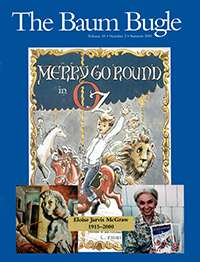
Originally published in The Baum Bugle, vol. 45, no. 2 (Autumn 2001), pgs. 20–24
Citations
Chicago 17th ed.:
Wickwar, Gina. “Early Morning Musings: Writing The Hidden Prince of Oz.” Baum Bugle 45, no. 2 (2001): 20–24.
MLA 9th ed.:
Wickwar, Gina. “Early Morning Musings: Writing The Hidden Prince of Oz.” The Baum Bugle, vol. 45, no. 2, 2001, pp. 20–24.
(Note: In print, this article was supplemented with an illustration that has not been reproduced here. However, typographical errors have been left in place to accurately reflect the printed version.)
(Those who have not yet read The Hidden Prince of Oz may wish to defer perusing this article until they have done so— Ed.)
My Love Affair with Oz
My fascination with Oz is longstanding. My father had received all the Baum Oz books and most of the Thompson ones as a child, and when I was little, he duly passed on his love of Oz to me, and I’d eagerly add my name to the “This book belongs to” space whenever I could. My father, my sister, and I would play “hangman” and other guessing games, using various Oz characters and places as clues.
I admit the Wicked Witch of the West nearly frightened me to death when I saw the 1949 rerelease of the movie, but that never dampened my enthusiasm for the books. I continued reading them in junior high and throughout high school.
Oz to the Rescue!
Even in college I didn’t abandon Oz. Near the campus of the University of Alaska, Fairbanks, I discovered a small bookstore dealing in old books, and haunted it once I found it carried the Oz stories. I bought the remaining Thompson books my father hadn’t owned (he was already grown when they appeared), as well as my first Neill books. The later Thompson books were a joy (especially The Wishing Horse of Oz), though the Neill books never caught my fancy.
I wrote an outline of a book idea entitled Toto of Oz, sending it in the mid-1960s to Ruth Plumly Thompson in care of Reilly & Lee. RPT graciously wrote back, advising me to make some changes and encouraging me to keep plugging away. But marriage and the serious business of getting my master’s degree forced me to lay Toto aside. It was while taking a graduate course in utopian literature that I discovered my lifelong love affair with Oz could be put to practical use. Searching for a topic on which to write my research paper, I pounced on Oz. After all, what could be more utopian than Baum’s fairy world?
I knew nothing of Edward Wagenknecht when I wrote the paper; in fact, I was totally unaware of any of the serious research or scholarly work that had been done on Baum or his books. Later, my professor, who, as luck would have it, became my thesis adviser, urged me to expand my utopia paper into a master’s thesis.
That’s how I came to write “An American in Fairyland: A Study of L. Frank Baum’s Oz Books.” It was while doing research for the thesis that I came across Wagenknecht’s classic essay on Oz, Utopia Americana; Martin Gardner and Russell B. Nye’s seminal book, The Wizard of Oz and Who He Was; and information about the International Wizard of Club (then less than a decade old), which I immediately joined. I wrote my thesis while our first son was less than a year old, and while I was pregnant with our daughter. That slowed me down, to be sure, but the real challenge was typing the thesis—on a manual typewriter!
As our three children (including another son) grew older, I read them my old Oz books and began seriously to expand Toto, dreaming of someday publishing it and becoming “a Royal Historian of Oz,” writing books “founded on and continuing the famous Oz books by L. Frank Baum.” After our last child went off to college in 1988, I finally completed Toto and mailed it to Fred Meyer, who passed it around to some of the Club folks. It met with modest praise, but, alas, no one jumped to publish it.
The Centennial Contest
For several years, I’d been outlining another story—this one about Bungle—which I was then calling The Glass Cat of Oz. Two years later, when The Baum Bugle announced the Club’s centennial contest for a new Oz book, I was ready! Knowing that Toto was unlikely to dazzle the judges (I rightly suspected some would be those who’d already read it), I decided to finish my brand-new Oz book. About this time I learned Books of Wonder had published an Oz pastiche entitled The Glass Cat of Oz, so I changed my title to The Hidden Prince of Oz.
I am the very essence of a very proper procrastinator, and began getting serious about writing only in March 1996, while at Vandenberg Air Force Base in California. Rocket engineers from Utah State University’s Space Dynamics Laboratory were there, readying the SPIRIT III satellite for a Delta II launch into polar orbit. Being the project’s technical writer meant I had my laptop with me wherever I went. So, it wasn’t too hard to add a few pages to Hidden Prince during evenings in my motel room or during the long graveyard shifts spent babysitting the satellite in the “cleanroom.” By the time SPIRIT III launched in April 1996, allowing us to return home to Logan, Utah, I had the makings of a cool Oz mystery.
For the next several months I worked steadily, usually arising at 3:00 AM to write for three hours before getting ready for my technical writing day-job. By the end of summer 1996, I was two-thirds finished with Hidden Prince—I knew what my ending was to be, and I knew most of the adventures my characters were to encounter. But I was still stumped on a few transitional chapters, and they took me the rest of the fall and winter to choreograph and complete.
Probably most of the Oz book contestants finished their manuscripts with weeks to spare, but because I am who I am, I was writing down to the wire. In fact, as late as the morning of March 27, 1997, I was frantically Xeroxing the three copies of my manuscript I needed to FedEx to John Fricke to meet the March 31 deadline. That done, I came home and . . . waited. Months later, on November 4, 1997, Peter Hanff, the Club president, called to tell me I’d won the centennial contest.
My job was not finished, however. There was to be a round of editing that would begin in early February and last until mid-April 1998.
Color, Rain, Crowds, and a 101-Year-Old Mystery
I’d set out to do several things in Hidden Prince. First, I wanted to make the Oz centennial a thematic part of the story. To do so, I constructed a scenario to answer a question that had plagued me since I was a child: Why did the usually careful Tin Woodman allow himself to be caught in a rainstorm that rusted his joints and forced him to stand immobile for a whole year?
I decided that anything that happened 101 years ago had to involve the Wicked Witch of the East, before Dorothy’s home destroyed her. And it turns out it did; infuriated by something Zeebo had done, the Wicked Witch of the East took away his magic powers for 101 years. Hidden Prince begins as these 101 years draw to a close, just when Zeebo attempts, with disastrous results, to resume his magic-making. And it turns out that it’s exactly 101 years since the Tin Woodman rusted, for Dorothy discovered him one year after he’d been caught in a rainstorm.[1] These two events are mysteriously connected, and Hidden Prince sets out to explain how.
Color was another thematic device I employed, because the Oz books are infused with it. Color plays an integral role in the story’s magic (the magical recipe books, the blue wishing bracelet), and it is a strong component of several of the characters, notably Ketzal, the feathered boa; Beak, the blue parrot; Penny, the purple poodle; and Chief Thundercloud, with his varicolored headdress.
And color is behind the entire subplot of Paddy’s search for the missing pot of gold. It’s amazing what a single, inspired thought can do for a writer. The idea that the Rainbow should fall from the sky suggested Paddy as the Rainbow-painting leprechaun, and the lost Rainbow gave me an excuse to bring in Polychrome, one of my favorite Oz characters. I simply love her uncle, the Rain King, and by making him knowledgeable about recipe books, I was able to give him a small, but pivotal, role.
Another organic theme I used was rain. Oregonian and Oz author Eloise Jarvis McGraw, who worked with me to edit the book, observed that it rained more in Hidden Prince than it did in Portland. While unusual in Oz, rain occurs in Hidden Prince for some very good reasons—Zeebo’s mistaken use of the blue recipe book, his subsequent encounter with the Big Dipper, and the Rain King’s vacation.
Then there are all those people! One of my favorite Baum books is The Lost Princess of Oz, in which a whole horde of adventurers sets out to find stolen Ozma. Neill captures the vastness of this crowd in his visually compelling illustration of the band of travelers watching a picture of Ugu watching them watching him watching them, and so forth. I had Baum’s tour de force in mind when I concocted not one, but two search parties seeking the Prince of the Blue Mountain. These parties eventually join forces, then the group grows larger in number once joined by the Tin Woodman, the Wizard, Smithereens, and Venté, and even larger yet, when the Sawhorse arrives. This crowd of prince-seekers is so huge, in fact, that Paddy despairs, and the poor forester is forced to entertain them on his front porch. I wanted this “crowd effect,” and was especially pleased with the two-page illustration showing them all in the Prince’s palace.
I also wanted my characters to reflect the central theme of Baum’s books: that love and kindness are what make the Land of Oz what it is—a place of open-mindedness and tolerance. So when Beak assures Penny that it’s okay to rely on her teacup and advises her not to be too critical of Feric and Dipole, and when Tik-Tok reminds Dorothy that Bungle can’t help her feline haughtiness, they’re acting in the best Oz tradition. Even Mr. Chips, despite his misgivings about the Chief, treats the wooden Indian courteously, and Thundercloud, despite his forbidding appearance, soon wins over everyone with his gallantry, kindness, and thoughtfulness—the very qualities most esteemed in Oz.
Wordplay, Names, Past Lives, and Using Baum’s Characters
Like Baum, I love puns, though, unlike the Wogglebug, I try to be subtle about using them. Consequently, I introduced the Draw Bridge, Silica Valley and all its inhabitants, the Magnetic Field, the Babbling Brook, and the Snap Dragons and Dragon Flies. The names of several of Silica’s inhabitants came easily to me, a Latin student in my high-school days: Vitrea, Vitrix, and Vitriol are variations on the Latin vitnum, or glass, and Vitriol’s name aptly describes his caustic character. The origins for Smithereens, Slivers, and Splinters are, of course, obvious. As for dear old Huffin Puffin, I can’t imagine a glassblower with any other name.
With Mr. Chips, I was playing with the image of Silicon Valley and computer chips, and perhaps hinting at Goodbye, Mr. Chips, as well. I gave some French-sounding “wind” and “flying” connotations to Venté, who is literally a “carrier” pigeon. She’s another character I enjoyed developing, especially her penchant for low burblings and for startling folks by suddenly speaking up. And she instinctively understands Smithereen’s craving for adventure, taking him, as it were, under her wing.
The Babbling Brook originated with my daughter, Melody. She tossed out the idea in a phone conversation, saying only that “it should be a brook that really babbles,” and then promptly left it to me to determine exactly how it did, and where, and when. I’d already introduced a magnetic field for the benefit of my physicist husband who studies magnetic fields in the upper atmosphere. Though he was flattered, I know he cringed a bit at my loose interpretation of the laws of magnetism. And it was Mel again who contributed Princess Dipole. We thought calling her “Princess Di” for short would provide some giggles, but Princess Diana’s tragic death in August 1996 ended that idea, so the Magnetic Field’s princes remains “Dipole” throughout.
Chief Thundercloud comes straight from my childhood. As a young girl I’d lived in Yuma, Arizona, and even in the mid-1950s, it was an old-fashioned Western town, its wide main street still lined with covered, raised sidewalks and tall storefront facades. An immense wooden Indian stood guard in front of one of the drugstores, and every time my sister and I went to town with Mother, I’d head straight for him. I’d stand before him, mesmerized, fantasizing he was a magical, mystical warrior who’d been enchanted and who, if brought back to life, would marry me. So when it came to an enchanted prince in my book, the first thing I thought of was my wonderful wooden Indian. Thundercloud’s name, too, echoes Chief Thunderthud of my Howdy Doody youth, and neatly reinforces the rain theme that runs throughout the book, while keeping the American Indian flavor I wanted.
Ketzal comes from my more recent past. My sister and her husband lived in Mexico City in the early 1980s, and when we visited them and toured Teotihuacan and other pyramid ruins, we encountered numerous depictions of Quetzalcoatl, one of the principal gods of the Toltecs. The name is Nahuatl for “plumed serpent,” and it wasn’t much of a leap from “plumed serpent” to “feathered boa.” I’m particularly fond of Ketzal, and the minute I imagined her, I was positive she was a flirt, spoke with a Southern belle’s accent, and wore pearls. That’s the way it is with some critters: you just know.
Beak and Penny were there from the moment I set fingers to keyboard. I haven’t known many parrots, but I thought a sorcerer might be likely to own one—and one who’d be a tad sassy, at that. And there just had to be a poodle in the story, because my husband and I own two of them. But ours are standards, which I felt wouldn’t be small or cozy enough for the story. Since there’s a type of poodle described as being “teacup” size, I decided that was what Penny should be. The notion that she’d wear her teacup and sleep in it, as well, as sheer whimsy on my part, but I liked the image.
Zeebo was there at the creation, too, and so was his name. It popped into my head in the very first paragraph, just a Penny’s and Beak’s did, and I never looked back. I knew he’d ultimately prove to be a good guy, although I also knew he’d done some things in his past to set in motion a great deal of trouble.
My own Alaskan background was the basis for the gold panners. I really do have an old college chum who owns a placer mine in the Yukon Territory. We’ve visited his claim on Higher Creek, near Mayo, several times, and have been amazed at the gold nuggets he extracts—with D-8 Cats, though, not gold pans. His litany of the bureaucratic tangles involved in gold mining and selling prompted my description of the persnickety Inspector and the unpleasant panners.
Vitrea was fairly easy to envision—she’s every wronged young maiden, yet so beautiful and sweet that everyone wants to help her. And in this story, just about everyone does. Her inability to believe ill of her uncle turns out to be her blind spot, but her eyes are opened about him during her quest for the Prince of the Blue Mountain, as well as about her dear friend, the Chief. As for Thundercloud, I wanted him to grow worthier and worthier as the story progressed, so that by the time Polychrome works her purple magic, we already know he’s a true prince of a fellow.
And of course, there’s Emma Lou, who’s my “Dorothy.” A baseball-pitching tomboy, she’s a no-nonsense child with a great deal of common sense, plus a lot of courage and a good heart. She knows instinctively that Thundercloud is special, and remains his champion throughout.
The blue glass beads? Well, once I decided the Chief would be my hero, they were a natural. And they just had to come from Silica Valley, because the story couldn’t have been written any other way. I never really explain why they work only when it rains, but it probably has something to do with Zeebo’s mistaken use of the blue book.
People ask if I found it easier to develop my own characters than to write about Baum’s, and the answer is, not really. I don’t share Eloise’s ambivalence about using Baum’s or Thompson’s inventions.[2] In fact, I found it rather a pleasure to conjure up some “what-ifs” about them. That’s why making Bungle a major player in Hidden Prince was so much fun. Baum sketched her so consistently and so convincingly that I had few qualms about taking her on as a character. I think giving her a history before Dr. Pipt brought her to life provided one of the story’s nicer touches, and made me feel she was more “my” character, too.
The Tin Woodman is another character I’ve always felt close to, as is the Sawhorse, who, I think, is the ultimate steed. (I’d give anything to ride on his back like Glinda!) So, it wasn’t hard for me to provide Nick Chopper with an additional (and unknown) background that would reinforce the centennial theme and shed light on the mystery. Nor was it hard to make the logical, dispassionate Sawhorse the only character privy to a major piece of the puzzle.
Working with Eloise: Bridges, Rivers, and Brooks, Oh My!
It was the brooks, rivers, and bridges that gave Eloise the most heartburn when she and I were editing the book. She felt that I’d put too many in my original draft.
She was right. I had a babbling brook, a crying brook, and a ticklish river. I also had a covered bridge, a runaway bridge, and a drawbridge. “Condense and collapse them!” Eloise exhorted me in one of her letters, and I eventually did. I eliminated the covered bridge entirely, kept the runaway bridge, and changed the crying river into the Caterwauling Cataracts, which became a part of the Babbling Brook. I also kept the ticklish river to solve the Runaway Bridge’s predicament.
Initially, my drawbridge was much more concretely described, too: it was a real bridge decorated with drawings, and opened up nastily just as the travelers crossed it, tossing them into the river. But I agreed with Eloise that it was visually cumbersome. In one of those unexpected bursts of imagination, I had a vision of a giant hand appearing in midair to “draw” a bridge, and went from there. While the new, abstract Draw Bridge is a more fantastical one, Eloise (and I) approved of it heartily. I also think it’s much more in keeping with Baum, as is the garrulous Runaway Bridge and annoying Babbling Brook.
Eloise urged me also to better differentiate between the evil Vitriol and his nephew Vitrix. They were too much alike, she said, which made it hard to rationalize how everyone in the end can forgive Vitrix. Taking her advice, I made Vitrix a more sympathetic character earlier on, gradually allowing him to grow into a more forceful one, so that by the time Ozma sends him to the Meadow of the Dragon Flies and Snap Dragons, everyone knows he’ll make a thoughtful ruler. The greater contrast between the gentle Vitrix and the really wicked Vitriol served to make both into better-drawn characters.
Smithereens was another character Eloise urged me to “beef up.” She liked him a lot, but was convinced he was lost among the others. Long before I’d heard of Harry Potter, I’d envisioned a bright little boy with horn-rimmed glasses, wild hair, and a penchant for flying into adventure, and I’d placed just such a character in what I thought was a starring role. But to satisfy Eloise, I emphasized his wistfulness, his yearning to have adventures. So now, when Mr. Chips orders Smithereens to seek Glinda’s help, the reader is ready to believe he’s the right person for the job, which makes his development from third assistant to chief bottle washer more believable.
It also alarmed Eloise that, aside from raiding a few doughnut bushes, my characters had to do a lot of scrounging for food. “This is OZ, after all,” she admonished me, suggesting I try something like saddlebags for Penny and a soup sea as a magical food source in the Magnetic Field. Liking the saddlebag idea, I expanded and incorporated it, but I reminded her there was a Soup Sea in Ruth Plumly Thompson’s Kabumpo in Oz, so I couldn’t really use that. Instead, I came up with the Coconut Grove.
Working with Eloise was always fun and often amusing—especially when she’d forget certain Ozzy details, and I’d remind her of her lapses. For instance, she raised the question of the Chief’s coming to life in Arizona, wondering if that were canonically “kosher.” I assured her it was, citing The Giant Horse of Oz, in which the Public Benefactor is brought to life in Boston, of all places, and calmly causes chaos in the Commons before falling into Oz. And, I reminded her gently, the carousel ringmaster in Merry Go Round was up to some pretty slick magic in Oregon, if I recalled rightly. Chagrined, she wrote back, saying she’d totally forgotten about that pesky ringmaster and had never read Giant Horse.
We corresponded a number of times even after our work together ended, and in early December 1999, I finally met her in person. My sister lives near Portland, and when I visited her, we took the opportunity to invite Eloise to lunch at an Italian restaurant she liked. Afterward we spent the rest of that glorious afternoon in her new apartment, where she regaled us with stories of her husband Bill, her daughter and coauthor Lauren, her art and writing careers, her travels, and the simple delights of living in the Pacific Northwest. My last letter from her was in late summer 2000, just after I’d sent her a printed copy of Hidden Prince. She loved it, she told me, and loved the illustrations. I was in the San Francisco Bay Area at a book signing for Hidden Prince just after Thanksgiving when Fred Meyer called my husband to tell us of her death on November 30, 2000. I will miss her greatly.
The End Game
Editing complete, in early summer 1998 I sent the manuscript on disk to David Maxine, who would do the graphic design and layout. The next step was finding an illustrator. I had no hand in that: the Club scouted around and luckily found Anna-Maria Cool, an illustrator at Hallmark Cards. She began the illustrations sometime in early 1999, I believe, and I saw some of her first line drawings in July of that year when Jane Albright brought a few samples to the Winkie Convention in Pacific Grove, California.
Anna-Maria and I spoke only twice by phone before we met at the Oz Centennial Convention in Bloomington, Indiana. Her call came soon after the 1999 Winkie Convention, and she wanted to know two things: the color of Emma Lou’s hair (I apparently hadn’t given a clue) and whether she could make Huffin Puffin black. I replied that Emma Lou’s hair color was her call, and that I’d be delighted if burly Huffin Puffin were African-Ozian. That settled, we communicated by email fairly regularly after that.
By Christmas 1999, Anna-Maria had “inked” a number of the line drawings and sent me a few Xerox samples. I especially loved how she treated the moon, the candle, and the campfire as points of light in that lovely nighttime scene in which Vitriol—running through the campground—is chased by Smithereens astride Venté.
Meanwhile, David Maxine was working with Anna-Maria to design the book around her drawings. As Ozzy as any illustrations drawn in the last twenty years, the pictures make Hidden Prince a real Oz book. What amazed me was Anna-Maria’s ability to get inside my head to “see” the characters I’d only briefly sketched in words, and to come up with perfectly droll and whimsical renditions of them. Let’s face it, how do you draw a live bridge?
By May 2000, I’d received the final page Xeroxes (minus the drawings—just the “holes” for them) from David, and I made a number of capitalization changes suggested to me by Peter Hanff, who felt using initial caps throughout would be much more in keeping with Baum’s style. I made other last-minute changes, too, that probably drove David mad, but he was splendid about incorporating them and uttering nary a word about the stress it must have caused. Thus, Hidden Prince is the work of many people: the editor, Eloise; the illustrator, Anna-Maria; the book designer, David; and the Lord High Editor of the Last Word, Peter. Without them and their encouragement, I don’t believe The Hidden Prince of Oz would be the book it is.
I am now at work retooling Toto of Oz, which I still think is a good yarn. And I really believe Toto must be growling under his breath to think that, after all these years, nobody’s told his story—and quite a story it is, too.
Notes
[1] See The Wonderful Wizard of Oz, Chapter V.
[2] See “The Road from Merry Go Round to Forbidden Fountain” by Eloise Jarvis McGraw, The Baum Bugle, Vol. 37, No. 2, Autumn 1993.
Authors of articles from The Baum Bugle that are reprinted on the Oz Club’s website retain all rights. All other website contents Copyright © 2026 The International Wizard of Oz Club, Inc. All Rights Reserved.