FLYING OFF THE SHELVES
A Brief, Highly Selective History of the Flying Pig in Literature
by Atticus Gannaway
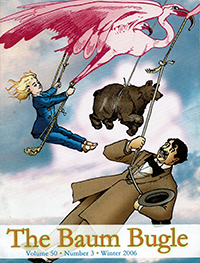
Originally published in The Baum Bugle, vol. 50, no. 3 (Winter 2006), pgs. 27–30
Citations
Chicago 17th ed.:
Gannaway, Atticus. “Flying Off the Shelves: A Brief, Highly Selective History of the Flying Pig in Literature.” Baum Bugle 50, no. 3 (2006): 27–30.
MLA 9th ed.:
Gannaway, Atticus. “Flying Off the Shelves: A Brief, Highly Selective History of the Flying Pig in Literature.” The Baum Bugle, vol. 50, no. 3, 2006, pp. 27–30.
(Note: In print, this article was supplemented with images that have not been reproduced here. However, typographical errors have been left in place to accurately reflect the printed version.)
A crucial difference between the Oz books of L. Frank Baum and those of Ruth Plumly Thompson is that, while Baum’s novels often introduced distinctively American elements into traditional fantasy settings to create something wholly original, Thompson’s Oz stories drew more heavily on such traditional trappings as Arthurian romance and Arabian intrigue (notwithstanding the fact that those who criticize Thompson’s work for being derivative usually overlook the frequently subversive aspects of her reinterpreted fairy-tale tropes). Just as notably, Thompson took Baum’s proclivity for punning and turned up the dial several notches, introducing to Oz instances of wordplay that occasionally approach the level of the absurd.
It was natural, therefore, that the old retort “When pigs fly!” would spark something in Thompson’s wry imagination. The phrase itself is a variation on a Scottish proverb that dates back at least to the sixteenth century, first occurring in print in a 1586 edition of an English-Latin children’s dictionary: “Pigs flie in the ayre with their tails forward.” (The gist of the phrase is that any pig that could fly at all could easily fly backward.)[1] The fanciful specter of the flying pig endured, with its mention as an abstract absurdity in both of Lewis Carroll’s Alice books constituting perhaps its most prominent literary allusion.
The first recorded instance of an actual flying pig dates to 1909, when an Englishman, Lord John Theodore Cuthbert Moore-Brabazon, strapped a wicker basket containing a pig to his custom-built French airplane, the Voisin, and flew several hundred yards at Leysdown in Kent; attached to the basket’s front was a sign that said, “I am the first pig to fly.”[2] But when Ruth Plumly Thompson introduced a winged pig as a character more than twenty years later in Pirates in Oz (1931), it may well have been the first pig in the history of literature to fly under its own porcine power.
Thompson’s Pigasus was a pun within a pun: the author took a literal embodiment of “when pigs fly” and combined it with a play on the name of Pegasus, the winged horse of Greek mythology. Like his mythological predecessor, Pigasus is a source of poetic inspiration, though Thompson uses it to comic effect: Peter Brown, the athletic American boy who rides on Pigasus’s back, quickly tires of speaking in rhyme.
Pigasus is a curious mix of the earthy and the ethereal. A magical winged creature presented to the Duke of Dork by the powerful Red Jinn, Pigasus is, nevertheless, a pig. When Peter expresses astonishment at his unusual appearance, Pigasus says his first recorded words matter-of-factly: “Of course I have wings.”[3] Later, he “r[ises] like an animated pink sausage into the air,” his movement described in a simple phrase evoking both wizardry and standard breakfast fare.[4]
The Nobel- and Pulitzer-winning author John Steinbeck seems to have had a similar blend of loftiness and humility in mind when he chose a winged pig named Pigasus as his personal symbol. Steinbeck drew a winged pig on his correspondence, along with the Latin phrase Ad astra per alia porci, meant to translate as “To the stars on the wings of a pig.” (Apparently, Steinbeck got the Latin slightly wrong; the correct phrase is Ad astra per alas porci.) His third wife, Elaine, explained Steinbeck’s use of Pigasus as follows: “John would never have been so vain or presumptuous as to use the winged horse as his symbol; the little pig said that man must try to attain the heavens even though his equipment be meager. Man must aspire though he be earth-bound.” Steinback had used the Pigasus symbol for some time—throughout his life, according to Elaine Steinbeck—before an Italian nobleman with artistic ability drew a winged pig, supposedly in the style of Raphael, that Steinbeck had made into a stamp in the 1950s.[5]
It is impossible to say whether Thompson’s Pigasus influenced or even predated that of Steinbeck, who loved magic and fairytales, because Steinbeck preferred to burn his correspondence (going so far as to visit friends to incinerate letters he had written them). The earliest surviving instance of Steinbeck’s Pigasus is in a letter from Steinbeck to his Swedish friend Bo Beskow dated December 16, 1946. (In a somewhat Ozzy sidebar, Steinbeck tried, in the mid-1940s, to create a play, The Wizard of Maine, about a snake-oil salesman. The project was eventually abandoned.)[6]
One of the only books other than Thompson’s to concern itself at much length with a “flying pig” is Dick King-Smith’s juvenile novel Daggie Dogfoot (1980, later retitled Pigs Might Fly), in which the title character, a pig, tries his best to take to the air. More relevantly, Diana Wynne Jones’s novel Dark Lord of Derkholm (1998) features a group of actual flying pigs that play a significant role in the book, but Jones does not individuate them.
Outside of the literary world, the idea of a flying pig as the embodiment of the impossible made possible has captured many imaginations. Cincinnati, Ohio, which earned the nickname “Porkpolis” in the nineteenth century when it stood at the forefront of the pork processing industry, hosts an annual Flying Pig Marathon and is full of images of winged hogs. While he had no wings, a pig named Pigasus the Immortal was nominated for the U.S. presidency by radical activists Abbie Hoffman and Jerry Rubin and their Youth International Party during the tumultuous 1968 Democratic National Convention in Chicago. All three were arrested at the press conference announcing the nomination.[7] James Randi, the famous skeptic, gives Pigasus Awards every year to those he deems the most egregious pseudoscientists and pseudoscience supporters; the awards are trophies shaped like winged pigs.
But is in the realm of books, apart from jokey cameo appearances in modern fantasy novels, that the implausible idea of the flying pig appears to have found its most fully developed and respectful incarnation. Ruth Plumly Thompson’s winged pig helps both Peter and Dorothy to save Oz from dire peril in the two novels that feature Pigasus in a major role, and Thompson grants him the kind of prickly yet endearing animal personality that helped bring earlier figures like Kabumpo and Grumpy to such vivid life. It’s impossible for Thompson to pay a higher compliment when she writes of Pigasus that, “except for his jingles, a more cheerful, loyal little fellow could not be found in the length or breadth of the country.”[8]
Pigs might not simply fly, but help rescue entire kingdoms. A character that began as a living pun had proven his chops.
The author gratefully acknowledges Ruth Berman’s helpful input about Diana Wynne Jones’s flying pigs and certain bibliographic information, and Dan Schultz’s assistance with pig esoterica.
Notes
[1] See www.worldwidewords.org/qa/qa-pig1.htm
[2] See www.geocities.com/TheTropics/Shores/7484/fir/firstfly.htm (obsolete)
[3] Ruth Plumly Thompson, Pirates in Oz (Chicago: Reilly & Lee, 1931), 190.
[4] Thompson, Pirates in Oz, 229.
[5] See http://steinbeck.sjsu.edu/biography/pigasus.jsp (obsolete)
[6] This information comes from a very knowledgeable Steinbeck expert who, for privacy reasons, wishes to remain unnamed. Keeping my word, I’m not going to squeal.
[7] See www.geocities.com/TheTropics/Shores/7484/fir/pigasus.htm (obsolete)
[8] Ruth Plumly Thompson, The Wishing Horse of Oz (Chicago: Reilly & Lee, 1935), 127.
Authors of articles from The Baum Bugle that are reprinted on the Oz Club’s website retain all rights. All other website contents Copyright © 2025 The International Wizard of Oz Club, Inc. All Rights Reserved.
AN INTERVIEW WITH PAUL TAYLOR
by Barbara Arnstein
Originally published in The Baum Bugle, vol. 37, no. 1 (Spring 1993), pgs. 15–16
Citations
Chicago 17th ed.:
Arnstein, Barbara. “An Interview with Paul Taylor.” Baum Bugle 37, no. 1 (1993): 15–16.
MLA 9th ed.:
Arnstein, Barbara. “An Interview with Paul Taylor.” The Baum Bugle, vol. 37, no. 1, 1993, pp. 15–16.
(Note: In print, this article was supplemented with photographs that have not been reproduced here. However, typographical errors have been left in place to accurately reflect the printed version.)
With
Authors of articles from The Baum Bugle that are reprinted on the Oz Club’s website retain all rights. All other website contents Copyright © 2025 The International Wizard of Oz Club, Inc. All Rights Reserved.