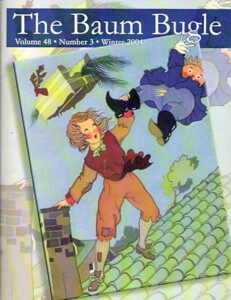
Originally published in The Baum Bugle, vol. 48, no. 3 (Winter 2004), pgs. 37–40
Citations
Chicago 17th ed.:
Shepherd, Kenneth R. “Imperial Oz: The Ozian Empire.” Baum Bugle 48, no. 3 (2004): 37–40.
MLA 9th ed.:
Shepherd, Kenneth R. “Imperial Oz: The Ozian Empire.” The Baum Bugle, vol. 48, no. 3, 2004, pp. 37–40.
(Note: In print, this article was supplemented with illustrations that have not been reproduced here. However, typographical errors have been left in place to accurately reflect the printed version.)
Relations between Oz and its neighboring states were cordial for the first few years of Ozma’s reign. By the time of The Road to Oz (1909), Ozma had made overtures to every major head of state near Oz, and had invited most of them to her birthday celebration. That first great period of Ozian foreign policy ended with the establishment of Glinda’s invisible barrier, which was supposed to cut off Oz from contact with the outside world.
But the dropping of the invisible barrier did not, in fact, entirely isolate Oz. A few years later, the royal historian established radio contact with Princess Dorothy in the Emerald City. It soon became apparent that matter could penetrate the shield as easily as could the radio waves: Ozian travelers still visited the surrounding countries, and birds flew through the barrier without apparent mishap. Just four years after the good sorceress activated the spell, visitors from Oz played a crucial role in the overthrowing of Roquat/Ruggedo, the Nome King. The destabilization of the Nome King’s government marked the beginning of a new and different Ozian foreign policy, in which Ozma played a different role: that of empire builder. The events that led to the undermining of the independent Nomian government were the first steps in the establishment of an imperial Oz.
The genesis of imperial thought in Oz began some time before Ozma claimed the throne. Nick Chopper, the Tin Woodman, became ruler of the Winkies at the people’s request shortly after Dorothy ‘s first visit to Oz. By the time the army of revolt entered the Emerald City, he was the self-styled “Emperor of the Winkies,” even though, as Tip observed, the country of the Winkies was at most only a kingdom.[1] What reasons did Nick Chopper have for claiming a title of such great dignity?
We can find one basis for the Tin Woodman’s claim in the words etymology. The word “emperor” comes from the Latin “imperator,” a title given to a successful Roman general. Nick Chopper is indeed a fighter: by the time he first arrived in the land of the Winkies, he had already killed the wildcat that was chasing the Queen of the Field Mice, as well as the forty wolves sent by the Wicked Witch of the West. Later, on the way to Glinda’s palace, he attacked the fighting trees. When the Scarecrow, Tip, Jack Pumpkinhead, and the Sawhorse come to him for help in The Marvelous Land of Oz, it is his fighting qualities and generalship that they seek.
Another origin of the Tin Woodman’s title might come from his political role in the West. The Wicked Witch reduced the Winkies to slavery, and, after Dorothy liquidated her, Nick Chopper took the Witch’s place. Of course, he was much more considerate than the Witch had ever been, but he himself stated that “I have called myself an Emperor because I am an Absolute Monarch, and no one interferes in any way with my conduct of public or private affairs.” This interpretation is supported by the imperial splendor in which he lives, both before and after the construction of his tin palace.[2]
It is also possible that Nick Chopper assumed the title of Emperor simply to satisfy his ego. The scarecrow remarks at one point in The Marvelous Land of Oz that his friend “calls himself” the Emperor of the Winkies, and, when Tip responds that the ruler of the Winkies should be only a king at most, says, “He is a proud man, as he has every reason to be, and it pleases him to be termed Emperor rather than king.”[3] The implication is that the Tin Woodman is an emperor by courtesy only, although sometime after Ozma’s accession he was officially granted the title.
This imperial idea existed in Oz in the person of Nick Chopper before Ozma came to the throne, but we do not know how far his example influenced his young queen. After Ozma’s accession he was made commander of her army, and had the dubious honor of leading it in its first and only battle against the Nome King.[4] Ozma showed an imperious pride which she refused to plead with the Nome King for admittance to his kingdom. She also stated that she was prepared to conquer him and to force him to do her bidding.[5] It is possible that Ozman’s behavior was based on the Tim Woodman’s concept of how the ruler of all Oz should act. But the Nome Kingdom cannot truly be called part of the Ozian empire. Ozma never tried to annex the Nomes, despite Ruggedo’s numerous attempts to conquer her country. In fact, Oz became openly imperialistic only after Samuel Salt was named Royal Explorer and Discoverer of Oz.
Salt received his title as report rescuing Ozma from Ruggedo in Pirates in Oz (1931). The former buccaneer’s arrival was fortuitous in several ways: not only did he capture the ex-king of the Nomes and restore the Magic Belt to Ozma, but he also had the experience needed to spread Ozma’s imperial policy. His life as a pirate, and especially the events which led to Ruggedo’s whirlwind invasion, Made salt the ideal man for the job. It was no accident that Ozma specified that he must “give up piracy and become our royal discoverer and explorer, take possession of new countries and set the flag of Oz on far islands and mountain tops.”[6]
This appointment marked the first public declaration of a distinctly imperialistic Ozian foreign policy. Ozma’s excuse for expanding her power beyond the deserts was that her country was becoming overpopulated (an understandable state of affairs in a land where no one ever dies): “Each of the four kingdoms of Oz shown on Samuel’s map was so dotted with smaller kingdoms, cities, towns, villages and the holdings of ancient knights and barons there was scarcely room for another castle. With young princes growing up on every hand, Roger could well sympathize with the need of Ozma for more territory.”[7]
It seems likely that Ozma’s landless population was agitating (quietly) for new worlds to conquer. Rulers had become so numerous and aggressive that in some cases they threatened the throne itself. (Mogodore’s invasion of the Emerald City chronicled in Jack Pumpkinhead of Oz is a case in point.)[8] Colonization might well have appeared to be a safe and convenient way of reducing Ozma’s problems: it provided young men and women, both ruling and ruled, with a way to win lands of their own, and relieved the national government of the need to find work for them.
If such an effort were to prove successful, however, it would require the wholehearted support of the queen and her advisers. Ozma’s slow approach to imperial conquest implies a certain reluctance. Four years had passed since she had made salt the royal discoverer and explorer when, at the time of the celebration chronicled in The Wishing Horse of Oz, Ozma publicly assumed the title of “Imperial Highness.” [9] Certainly the dignity of our position, ruling not only the separate kings and Queens of the four countries of Oz but also the individual kingdoms within those countries, supported her right to the title. Indeed, Scamperoo, who briefly replaced her, was instantly hailed as Emperor of Oz. But Ozma may have had reasons of her own for not taking the grander designation.
One of her reasons may have stemmed from the Queen’s reluctance to offend nations where settlers might be placed. She specified in her instructions to captain salt that no country was to be conquered against its will. Instead, she recommended persuasion, emphasizing “all the advantages of coming under the flag and protection of a powerful country like Oz.” These advantages were 1) political (“Ozma is so clever at governing”); 2) military (living under the protection of the Ozian flag); and 3) economic. Salt said to Alberif, the Prince of Peakenspire Island: “In time, fruit, foodstuffs, books and merchandise will arrive from Oz, and in return you may send some of the sparkling crystals composing these mountains. You might even invite a band of settlers from Oz to come and live as your loyal subjects here.”[10] No doubt Ozma felt that such treatment would ensure the stability of pro-Ozian governments and help establish colonists more securely in their new homes.
Indeed, as long as Ozma’s subjects followed her directions, the Ozian empire spread rapidly. Within a few weeks after he began his first voyage of discovery, salt had annexed 4 new lands, three of which already had it native governments: Lavaland, Peakenspire Island, and Ozamaland. The fourth country, Patrippany Island, was uninhabited but colonizable. These territories might have solved Oz’s surplus population problems by themselves: Alberif, ruler of Peakenspire Island (easily the smallest of the inhabitable lands), stated that he could accommodate a thousand settlers. Ozamaland was said to be twice as large as any land bordering the Nonestic Ocean, including the continent of which Oz is a part.[11] Samuel Salt proved a great success as royal discoverer, negotiating the annexations with the diplomacy unexpected in a former pirate.
But Salt’s initial successes indirectly undermined the empire he was trying to expand. When Roger brought up the question of how the settlers were to be transported to their new homes, Samuel announced that the “Wizard is working on a new fleet of airships.” These appear about two years later as the Ozoplanes of Ozoplaning with the Wizard of Oz. The wizard introduced his Ozoplanes as prototypes, “pleasure planes for traveling and exploring,” and indeed the Ozpril and the Oztober were too small to hold significant numbers of colonists. But the events surrounding their first appearance marked the end of this successful period of imperial expansion that began with salts appointment, for they attempted less experienced and less diplomatic people to try conquering for Oz.[12]
The misplaced efforts of Nick Chopper—perhaps the progenitor of Ozian imperialism—ended the growth of the Ozian empire. The Tin Woodman was aboard the Oztober when it was accidentally launched. His first thought after gaining control of the vessel was to try his hand at exploring and conquering like Samuel Salt.[13] Unfortunately, he lacked Salt’s native diplomacy, and seriously offended the first ruler he met, Strutoovious the Seventh of Stratovania. Strut, himself and emperor, did not take kindly to Nick Chopper’s casual attempts to annex his realm. He responded violently, launching an immediate invasion of Oz itself and forcing the Tin Woodman to fly him there. Only the efforts of the Wizard and his fellow Ozians saved the tin man from betraying the Emerald City to an invading army.[14]
The Wizard’s actions ended Strut’s invasion, but he could not undo the blow dealt to the empire by the Woodman’s carelessness. The Stratovanian incident proved that irresponsible Ozian explorers could cause crises that directly affected the security of Oz itself–and the Ozoplanes made contact between Oz and potential enemies too easy. The Wizard realized this. It was probably the motivation for his dragging Nick Chopper away to look for the Ozpril immediately after Strut was defeated, even though Ozma could easily have wished the vehicle back.[15]
It was only after Ozma announced her intention to make Nick Chopper her official pilot and to present him with a medal for his performance that the Wizard suddenly decided that the two of them must leave at once. It seems likely that he wanted to get the Tin Woodman away from the court before the emperor of the winkies became convinced that his method of claiming countries was just as good as Samuel Salt’s. No doubt the Wizard hoped that, by isolating the only other experienced Ozoplane pilot, he could prevent the situation from happening again.
Whether through the Wizard’s urging or for some other reason, the scheme for Ozian imperialism was abandoned. A year after Strut’s invasion, the Ozoplanes had been scrapped. Jack Pumpkinhead was using a fully functional one as a residence in The Wonder City of Oz.[16] We do not know if the colonies Salt tried to create were ever founded, or, if they were, whether they continued under Ozian oversight or were left to their own devices. When we see Salt again, he is in residence at Ozma’s court—and he never again appears on board the Crescent Moon. The heyday of Imperial Oz had passed.
Notes
[1] L. Frank Baum, The Marvelous Land of Oz (Chicago: The Reilly & Britton Co., 1904), p. 115. All citations from the Oz canon refer to first edition, first state copies.
[2] See L. Frank Baum, The Road to Oz (Chicago: The Reilly & Britton Co., 1909), pp. 110-19, for a description of the Emperor’s Tin Castle. However, the Emperor was surrounded by finery long before he moved; See Land, p. 118, and Neill’s illustration of the meeting of the Scarecrow and the Tin Woodman, p. 119.
[3] Baum, Land, pp. 88-91, 116.
[4] L. Frank Baum, The Wonderful Wizard of Oz (Chicago: The George M. Hill Co., 1900), pp. 91-92, 110, 205-07; Land, pp. 123-25; L. Frank Baum, Ozma of Oz (Chicago: The Reilly & Britton Co., 1907), p. 117; Land, pp. 279-80. Here it seems Nick Chopper considers himself and his land independent of Ozma, for he implies that he is responsible to no one. Later he must have sworn fealty to her; perhaps he was rewarded with the command of her army.
[5] Baum, Ozma of Oz, pp. 144, 159.
[6] Ruth Plumly Thompson, Pirates in Oz (Chicago: The Reilly & Lee Co., 1931), p. 275.
[7] Ruth Plumly Thompson, Captain Salt in Oz (Chicago: The Reilly & Lee Co., 1936), pp. 76-77.
[8] Ruth Plumly Thompson, Jack Pumpkinhead of Oz (Chicago: The Reilly & Lee Co., 1929), pp. 178-200.
[9] Thompson, Wishing Horse, p. 58.
[10] Thompson, Captain Salt, pp. 46, 189.
[11] These statistics are taken from Thompson, Captain Salt, pp. 127 (Patrippany), 169 (Peakenspire), and 113 (Ozamaland).
[12] Thomson, Captain Salt, p. 77; Ruth Plumly Thompson, Ozoplaning with the Wizard of Oz (Chicago: The Reilly & Lee Co., 1939), pp. 130-44.
[13] Thompson, Ozoplaning, pp. 65-70.
[14] Thompson, Ozoplaning, pp. 82, 92-97, 130-34.
[15] Thompson, Ozoplaning, pp. 238. 264-66.
[16] John R. Neill, The Wonder City of Oz (Chicago: The Reilly & Lee Co., 1940), pp. 150-61.
Authors of articles from The Baum Bugle that are reprinted on the Oz Club’s website retain all rights. All other website contents Copyright © 2026 The International Wizard of Oz Club, Inc. All Rights Reserved.