L. FRANK BAUM: SUCCESS AND FRUSTRATION
by Peter E. Hanff
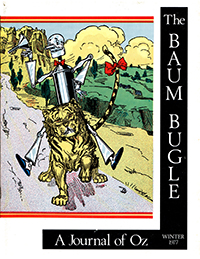
Originally published in The Baum Bugle, vol. 21, no. 3 (Winter 1977), pgs. 25–30
Citations
Chicago 17th ed.:
Hanff, Peter E. “L. Frank Baum: Success and Frustration.” Baum Bugle 21, no. 3 (1977): 25–30.
MLA 9th ed.:
Hanff, Peter E. “L. Frank Baum: Success and Frustration.” The Baum Bugle, vol. 21, no. 3, 1977, pp. 25–30.
(Note: In print, this article was supplemented with illustrations and photographs that have not been reproduced here.)
L. Frank Baum achieved success in his life through writing. His first major accomplishment was as a playwright in the 1880s when his Irish melodrama, The Maid of Arran, enjoyed considerable popularity on a well-publicized tour in New York, Pennsylvania, Connecticut, the mid-west, and even Canada. But family obligations caused Baum to leave the theater, and the ventures he undertook over the next fifteen years were repeatedly disappointing. Only in 1897, with his first children’s book, Mother Goose in Prose, did he again find his stride. His extraordinary output during the next several years included the best-selling novelty, Father Goose: His Book (1899), and America’s most important children’s fantasy, The Wonderful Wizard of Oz (1900).
In a sense, it is unfortunate that the 1902 stage play version (a very distant version at that) of The Wizard of Oz was so successful. The stage was always Baum’s first love, and the 1902 success convinced him that he had an instinct for what would be most popular, and he spent much of his life frustratingly trying to convince producers that he was correct. In fact, most of his dramatic fairy tales were primarily repetitions of devices added to the Wizard extravaganza by the director, Julian Mitchell. It is hard to take Baum’s surviving plays seriously, just as it is impossible to ignore his finest fantasies.
“The Faltering Flight of Prince Silverwings” (Michael Patrick Hearn, David L. Greene, and Peter E. Hanff, The Baum Bugle, Autumn 1974) recounts Baum’s experience with the dramatization of Edith Ogden Harrison’s Prince Silverwings in 1903. That article made reference to a small file of letters written by L. Frank Baum to Emerson Hough preserved in the Emerson Hough Papers at the Iowa State Department of History and Archives, in Des Moines.
Emerson Hough (1857–1923) was one of America’s most popular novelists when he and Baum began to collaborate in 1903. Hough was born in Iowa and became a lawyer in New Mexico, before he began his writing career with descriptive articles about the southwest. He eventually became well-known for a series of historical romances. His novel, The Mississippi Bubble (1902), was a best-seller and went into numerous printings. It was published by the Bowen-Merrill Company of Indianapolis, the publisher of Baum’s The Master Key (1901) and The Life and Adventures of Santa Claus (1902).
The Baum letters to Hough reveal just how active Baum was during the years immediately following the staging of The Wizard. But more important, the letters document just what success meant to Baum and his family, and how he coped with a series of theatrical frustrations. A final reason to give the Hough file close scrutiny is that Baum’s letters are rare (his own files were destroyed by his widow in the 1930s) and the letters reveal his own concepts of the significance of his writing.
The earliest of Baum’s letters in the file, July 2, 1903, comments on an agent’s activity in trying to place the Baum-Hough drama, Montezuma, in New York and London. Montezuma was based on Madre d’Oro, an Aztec play copyrighted by Hough in 1889. The letter is written on “Sign of the Goose” stationery and in the final paragraph extols the comforts of summering in Macatawa Park, Michigan, and urges that the Houghs run over “and get a dose of Ozone.”[1] The next letter (July 22) gives Hough instructions about arranging the crossing from Chicago to Michigan. The clear description of the arrangements for first-class passage on the nighttime steamer now evokes nostalgia for the leisurely luxury of first-class travel in the early part of the century. But such comforts must certainly have seemed compromised by the final instruction: “When you board the boat tell Mr. McCabe, the porter, that you want to get off at Ottawa Beach, and leave a call for 5 o’clock in the morning. We will meet you with a row-boat at Five-Thirty, and get you up to the cottage for a six o’clock breakfast (if the hired girl wakes up).”
In some instances, the datelines of Baum’s letters are almost as interesting as the contents. For instance, his letter of March 15, 1904, was written from The Potter, a sumptuous resort hotel in Santa Barbara. The Baums were sampling the winter climate in various parts of California. Indeed the letter makes clear that they had already spent time at the Hotel del Coronado (their regular winter retreat and one of the most luxurious accommodations in the state) and were soon to spend two weeks at the lavish Hotel del Monte in Monterey before staying a week in San Francisco. The Baums were clearly enjoying success, even though the examiner in the bankruptcy of Baum’s publishers, the George M. Hill Co., considered him insolvent.
The same letter reveals the impressive writing schedule Baum was maintaining: “Since I came out here I have written the new book for this year [he refers to The Marvelous Land of Oz] and got it into the pub’s hands. It was sketched before. And I have revised and prepared for St. Nicholas a serial called “The Magic Cloak” [Queen Zixi of Ix] . . . . Also I have written five ‘Animal Fairy Tales’ for The Delineator, so you can see I have kept busy. Yet I play a half of every day.”
However, there is a hint of frustration in the letter, as well. Baum indicates that Nathaniel D. Mann, composer-collaborator for Baum’s proposed extravaganza, King Jonah XIII, was unable to arrange production of the play in San Francisco because the theater was held up by the extended run of the greatly popular Silver Slipper. Baum comments wryly on his competition: “The coast’s shows are simply rotten as a class.” Considering the poor public response to Baum’s musical, The Woggle-Bug, in Chicago the next year, we may wonder at the validity of Baum’s assessment of popular taste.
In mid-July (the month The Marvelous Land of Oz was published) Baum wrote with alarm to Emerson Hough about the announcement of a new play by George Ade, the Chicago dramatist and humorist remembered today for his wry Fables in Slang (1900). Because the description of Ade’s play indicated that it had a college setting, Baum believed The Maid of Athens, the play he and Hough had recently copyrighted in 1903, was being compromised.[2] Baum was writing from The Sign of the Goose and doubtless was feeling the frustration of being so distant from Chicago at the moment. He advised Hough to “see at once to getting all the publicity we can through newspapers on ‘The Maid of Athens’ or ‘Spartacus’ or whatever you choose to call it. State the plot concisely, and add that ‘the libretto was published and copyrighted in its printed form nearly a year ago, since which time it has been widely discussed in theatrical circles, where it was considered a distinct novelty.’” The novelty was that part of the play takes places in a modern college town and part in ancient Athens.
Fortunately about a week later he had calmed down somewhat and could assume that Ade’s play, a comedy drama, would not ruin the possibility of success for the Baum-Hough musical comedy. He even imagined the possibility that success for Ade’s play might create a ready market for a musical comedy with a college setting. The cause of Baum’s anxiety was the title of Ade’s play, The College Widow, the name of a character in The Maid of Athens. Because Hough had indicated to Baum his interest in offering to sell to Ade some aspects of the collaborators’ work, Baum, who did not agree with such an approach, concluded, “The more I look at the matter calmly, the more I am convinced we have been more scared than hurt. Moreover, I value my interest in the piece of 10,000$ and I doubt if Ade would pay us 20,000$ for a plot that can have little bearing on his own play. So let us fight it through. What say?”
The next letter in the file, dated January 13, 1905, at the Hotel del Coronado, referred to still other Baum projects for the stage. Montezuma, the project he two men had worked on at least two years earlier, and Father Goose, a Baum-Denslow collaboration, which he indicated had been accepted for production by Klaw and Erlanger.[3] He made clear, too, that the next play he and Hough had worked on, The King of Gee-Whiz, a south-sea island farce, was under consideration in Chicago.[4] The King of Gee-Whiz, also called The Son of the Sun, seems to have been an outgrowth of Montezuma, in which Nathaniel Mann, as composer, had an interest. Baum and Hough saw the similarity between the two plays but saw them as different works and did not involve Mann in Gee-Whiz.
On February 22, 1905, Baum again wrote from Coronado to Hough to indicate his approval of Hough’s negotiations with possible producers of The King of Gee-Whiz. He mentioned the difficulty he was having with his own work, The Woggle-Bug: although the producer could not raise sufficient funds to produce the play, he would not release the play to Baum so that a different producer could be found. Baum’s comments on financing major musical extravaganzas give a clear picture of the stakes involved: “The production [of Gee-Whiz] ought to be made for $20,000, I think, and if we can do no better I’ll go in with you and take (between us) a third interest. That would cost us only from $3,000. to $5,000. each, and it would be a good investment if we make a hit. Think that over. I’ll not go into it unless you have the same interest I do.” Obviously Baum preferred to have the play produced completely by a third party, but if full financing could not be found he was willing to ante up one-sixth of the costs of production in equal partnership with his co-author.
Baum’s level of frustration increased for the next several months, and with good reason. His health failed at Coronado and he became very uncomfortable with what he described as acute indigestion. Montezuma failed to secure a producer, The Woggle-Bug tangle forced Baum to go to court, no producer could be found for The King of Gee-Whiz, and King Jonah remained “on the waiting list.” The final blow, at least to Baum’s ego, was the very small royalties earned by the Bobbs-Merrill reprints of his earlier children’s books; even The Wiard of Oz performed poorly when its sales were compared to the aggressively promoted book, The Marvelous Land of Oz, published by the new firm, The Reilly and Britton Company.
Emerson Hough’s letter of March 28, 1905, to Baum is far less pessimistic than the latter’s letters. He reveals that the two men had approached Reilly and Britton with a proposal to publish a book version of The King Gee-Whiz. That firm had indicated that it could not produce the book quickly enough for publication in the fall. Hough had then had another thought: the story might be syndicated in the newspapers. His expectation was that if the character could be gotten into graphic form by an artist, there would be no difficulty syndicating the story. He concluded that such syndication would result in a demand for a comic opera version of the story.
By May, Baum’s misfortunate had reversed. His producer finally succeeded in finding the funds to stage The Woggle-Bug. Unfortunately, Hough’s health now broke when he contracted typhoid fever and then pneumonia. But with production of The Woggle-Bug at last realized, Baum faced a devastating frustration: the play was a dismal failure. The critics panned the production, the leading comedians of the play were fired, the public did not respond with the enthusiasm generated by The Wizard of Oz, and the play was finally forced to close because its producers ran out of funds. Baum’s health collapsed once again and he fled to Macatawa to seek rest.
Both men recovered from their ailments and disappointments fairly quickly. By June 28, Hough could write to console Baum over the stings of the critics’ remarks and could also tell him that Hough’s short story “The King of Gee-Whiz” had been published in the July Everybody’s Magazine. Hough also continued to believe that the two men would succeed in using that work in some form of collaborative effort. And by August Baum seemed convinced: “I think it would be a most excellent idea to get out a Gee Whiz book, and I’ll join you in the preparation of it gladly. Also I believe we should carry out our old idea of making a book of the Montezuma story. It would be a novelty and I think between us we can make it something to attract attention.”
Baum’s hopeful comments apparently came to nothing, for in January of 1906, Hough wrote to suggest that since there had been so little activity on either Montezuma or Gee-Whiz he would prefer that Baum agree to relinquish his interest in both. In that way Hough could continue to consider making use of the ideas in whatever way seemed appropriate.
Baum responded promptly on January 8, 1906 (he misdated his letter 1905). He was reluctant to transfer his interest in the two story concepts, but was willing to do so, so long as Hough returned to him exclusive use of the ideas Baum had contributed. But Baum went on to explain that he had been far more active trying to sell the two works to theatrical producers than Hough realized. Indeed, Baum claimed to have appointments in New York to present the material to Mr. Dillingham. He also indicated that he had prepared the way for Hough to approach Mr. Askins in Chicago on the proposed plays. But time was short, for the Baums were scheduled to sail from New York on January 27, for an extended trip to Egypt and Europe. There may have been disappointments with regard to his various theatrical projects, but Baum continued to enjoy the results of his outstanding successes.
Hough was pleased to learn that Baum continued to be interested in their joint projects. He was hopeful that Baum might find a producer in New York, but he had found Askins unresponsive in Chicago. Hough also had proceeded to work on his own book version of The King of Gee-Whiz and asked Baum to agree to give him unrestricted use of the material. Hough, in turn, agreed to omit anything from the book that Baum considered his own contribution to the scenario they had jointly copyrighted. Baum responded from Syracuse on January 18, spelling out in considerable detail which ideas he felt Hough could use freely and which were either his or had been the product of their close association so that close authorship could not be distinguished. Hough thought that several of the ideas Baum claimed were his own but apparently succeeded in separating ideas to Baum’s satisfaction, for The King of Gee-Whiz was finally published by Bobbs-Merrill in 1906 under Hough’s name.
As one might have predicted, Baum was not successful in finding a producer in New York. His last letter to Hough, dated March 8, 1906, from aboard the steamship Rameses in Upper Egypt, revealed the disappointing response of several producers Baum had talked with in New York. He also indicated that Mann had at last withdrawn from the partnership for Montezuma, intending to use his music independently.
The extended trip to the old world apparently brought about the quiet dissolution of the collaboration between L. Frank Baum and Emerson Hough. In 1906, Hough was still going forward with plans for dramatizing Gee-Which without Baum. Each continued to find great success by writing books. But Baum was slow to learn a lesson from the frustration and disappointment of theatrical ventures. His interest in the theater was undoubtedly genuine, having begun when he was a young man, but the enormous success of The Wizard of Oz may have worked like a large win for a gambler; he continued to expend a large amount of energy on theatrical projects and in 1908 also wagered a considerable amount of money in his innovative Fairylogue and Radio-Plays, a multi-media production of Oz stories and John Dough and the Cherub. Despite the novelty of combining hand-colored motion pictures, magic lantern slides, and competent lecturing by Baum himself, the venture lost so much money that he was finally forced to declare bankruptcy in 1911. Hough renewed their acquaintance, at least to the extent of sending Baum a sympathetic letter.
The bankruptcy was undoubtedly a terrible blow to Baum emotionally, but he had hundreds of friends, and many thousands of readers to sustain him. His financial situation was actually far more stable than the bankruptcy indicated. Maud Gage Baum, his wife, had for many years held title to and managed the family finances. She permitted Baum to engage in his many interests, but she succeeded in keeping the family properly safe. The bitterest settlement had come the previous year: the assignment to his creditors of all the Bobbs-Merrill titles (including The Wizard of Oz). But those titles were never so successful as the Reilly and Britton list, which had become Baum’s mainstay. So in the face of serious frustration, Baum continued to have enormous success as an author.
His interest in the theater was not abated, but he wisely refrained from investing any more of his own funds in dramatic projects. In 1913, The Tik-Tok Man of Oz with book and lyrics by Baum and charming music by Louis F. Gottschalk was produced in Los Angeles and then traveled, with considerable enthusiasm from its audiences, as far east as Chicago. It was a final theatrical success for Baum. The next year his Oz Film Manufacturing Company produced a series of movies based on Baum’s books. Again, Baum had no financial investment (he merely assigned theatrical rights to the firm), and when the films failed to enter general distribution. Baum was spared the frustration of a financial loss. From then on Baum contented himself with his many social activities and his writing of books.
In the last analysis, there is no doubt that Baum’s successes far outweighed his frustrations. Baum responded with amazing enthusiasm to success. It took him years to discover the best outlet for his talents, writing books for children, but once the discovery was made, he applied himself with almost boundless enthusiasm. That he had the great good fortune to produce the major extravaganza of 1902 was a tribute to his abilities, and it tarnishes his reputation very little that he underestimated the public response to his invention of the marvelous Land of Oz. Fortunately, his theatrical ventures have faded from memory while his major contributions, his books, survive to entertain succeeding generations.
NOTES
[1] All quotations from the Hough-Baum correspondence are used with the permission of the Iowa State Department of History and Archives.
[2] The printed synopsis prepared for copyright is reprinted in Alla T. Ford and Dick Martin, The Musical Fantasies of L. Frank Baum (Chicago: The Wizard Press, 1958), pp. 27–36.
[3] See Douglas G. Greene and Michael Patrick Hearn, W. W. Denslow (Mount Pleasant, Mich.: Clarke Historical Library, Central Michigan University, 1976), p. 129.
[4] The copyright synopsis is reprinted in The Musical Fantasies of L. Frank Baum, pp. 39–46. I leave it for others to sort out the complex relationships between Madre d’Oro; Montezuma; The King of Gee-Whiz as play, magazine story, and novel; and Hough’s later novel, Mother of Gold.
Authors of articles from The Baum Bugle that are reprinted on the Oz Club’s website retain all rights. All other website contents Copyright © 2025 The International Wizard of Oz Club, Inc. All Rights Reserved.