LURLINE’S SOURCE
by Ruth Berman
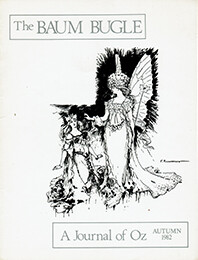
Originally published in The Baum Bugle, vol. 26, no. 2 (Autumn 1982), pgs. 2–3
Citations
Chicago 17th ed.:
Berman, Ruth. “Lurline’s Source.” Baum Bugle 26, no. 2 (1982): 2–3.
MLA 9th ed.:
Berman, Ruth. “Lurline’s Source.” The Baum Bugle, vol. 26, no. 2, 1982, pp. 2–3.
(Note: In print, this article was supplemented with illustrations that have not been reproduced here.)
In L. Frank Baum’s The Life and Adventures of Santa Claus (1902), Queen Zurline figured as leader of a band of forest nymphs in the Forest of Burzee whose chief amusement is dancing; the chief female character (Claus’ foster mother) is one of Zurline’s band, Necile, who is bored with dancing and with the seasonal holidays that mark her work as a nature-diety. The women on the Council of Immortals which bestows immortality on Claus are the Queen of the Water Sprites “whose beautiful form was as clear as crystal but continually dripped water on the bank of moss where she sat” (p. 179, Chapter 1), the Fairy Queen (who also lives in Burzee, but whose band have as their duty the care of humanity), and Zurline.
In Queen Zixi of Ix (1904), Burzee is inhabited by the fairy band of Queen Lulea, who presumably is meant to be the same person as the Fairy Queen. Her followers are also given to dancing as their chief amusement; it is Lulea herself who grows bored and wishes for more.
In The Land of Oz (1904), Baum gave a little early history of Oz—before the Wizard’s time, it was ruled by Pastoria and ought to have gone to his daughter Ozma, except that the Wizard took the throne and hid the child.[1] (This sequence incorporated some of the action from the 1902 play of The Wizard of Oz). By the time of The Tin Woodman of Oz (1918), however, he had changed his mind somewhat about this early history, in favor of yet another fairy band: Oz became a fairyland when Queen Lurline put it under enchantment, leaving one of her fairies to rule it (p. 156, Chapter 12). That this fairy was Ozma is made explicit in Glinda of Oz (p. 78, Chapter 6).[2]
Clearly, Zurline, Lulea, and Lurline are basically the same individual. Not only are their names similar, but they share similar characteristics—leaders of fairy/nymph bands in Burzee who, in two of the cases, spend much of their time dancing. By whatever name she’s called, Lurline as well as Necile and the Water Queen seem to derive from the water-sprite Lurline who is the heroine of “Lurline”, an opera by the Irish composer William Vincent Wallace (first performed in 1860) with libretto by Edward Fitzball.[3] The opera was part of a vogue in England for fairy-opera, stemming from the popularity there of a German opera, Weber’s Oberon (1826). The groups of all-female dancing fairies in Baum’s stories suggest the corps-de-ballet used in such operas.
A recent article on Wallace summarizes the general plot: “The opera is based on the lugubrious but immensely popular legend of Loreley[4] the romantic mermaid who bewitches her half-demented lovers but whose lives she is doomed never to share.”[5] The characteristics of Wallace’s Lurline show up in multiple forms in Santa Claus and Zixi: the discontent of Necile and Lulea, transformed to beneficent maternal impulses instead of the doom-laden sexuality of Victorian opera;[6] the combined names of Zurline and Lulea and their attendant ballet-troupes.[7] Examination of the libretto reveals other resemblances, such as the gnome Zulieck, a spirit of earth like the Gnome King of Santa Claus, with a malicious nature reminiscent of the Nome King of the Oz books. Lurline is also the Water Queen, like Baum’s Queen of the Water Sprites. The opera’s nymphs, water spirits, and storm spirits bring to mind Baum’s cloud fairies and mist maidens.[8]
“Lurline” remained intermittently popular after its first production. George Bernard Shaw, in his period as the music critic Corno di Bassetto, saw a revival and thought it pleasant—not worth going to see twice but well worth going to see once. [9] One of its songs serves to illustrate the romanticism of the style:
Our barque in moonlight beaming
Lay still’d by the note of a fairy charm,
Her broad sail brightly gleaming
White as the moonlight and as calm.
Pale stars look down on the clear blue stream
As lovely eyes on the mirror beam,
While o’er the deck the naiad maid
Sweetly sad her wild harp play’d.
Our crew all lost in silent wonder
Their hearts spell-bound and awe dismay’d,
While she her wild notes deeply thrilling
Still sang Lurline.
By the time of The Tin Woodman of Oz, Baum perhaps thought that the original source of the name “Lurline” was forgotten—or he may have forgotten its origin himself by then—and used the name Lurline instead of any further variations. But the figure of the sad, song-loving water spirit had given birth in his imagination to a variety of fairies, with only their music, grace, and longing to do more in common with each other. In turn, these figures combined in the character of Lurline, the mightiest of them all and apparently the most effective in finding something to do with her restless gifts. Like Baum himself, she created Oz. Perhaps Baum’s own restlessness and, toward the end of his career, a measure of satisfaction in what he had found to do with his gifts, are reflected in his mutations of the lorelei.
APPENDIX: Early Oz History. Ruth Plumly Thompson took up the discrepancy between Ozma as Pastoria’s heir and Ozma as member of Lurline’s band in The Lost King of Oz (1925), in which Ozma is both the daughter of Pastoria and the godchild of Lurline, “the queen of the fairy band we are all descended from” (p. 121, Chapter 9). This explanation isn’t quite clear, but perhaps “we” is intended to mean the rulers of Oz with Lurline the mother of the fairy left behind to rule Oz, and that fairy the mother of Pastoria (or of Pastoria’s father?). If this is the sequence Thompson intended to suggest, it’s intriguing to wonder what became of that first ruler—did she go back to Burzee after her son grew up? Jack Snow, in turn, altered Thompson’s version slightly to reconcile it with both of Baum’s: Pastoria had no child, and Lurline left with him a “tiny, baby fairy” to be his foster-child and heir (Magical Mimics of Oz, p. 20, Chapter 1). It was this child who grew up to be Ozma. Mimics also provided the only drawing of Lurline, in Frank Kramer’s portrait of her flying over Pastoria’s castle (p. 19). Ironically, although he had taken such care to resolve her role in Oz history, Snow forgot to include Lurline in his Who’s Who in Oz (1954). Eloise Jarvis McGraw and Lauren McGraw Wagner followed the version of events from The Tin Woodman of Oz in Merry Go Round in Oz (1963), where the Unicorn and Ozma remember each other from the time when they were both with Lurline, and Ozma has not aged since that time (pp. 288–90, Chapter 21). Unless one assumes that fairies can change into infant-shape and grow up again, it is hard to reconcile this version with the versions outside the Tin Woodman. (See also Note 1 for Hugh Pendexter’s sequence of events—Ed.)
- In Oz and the Three Witches (Pen Press, 1977), Hugh Pendexter III explores this event and argues that the fairy Ozma was reborn as a baby princess.
- Baum gave yet another set of events in Dorothy and the Wizard In Oz (1908): Ozma says that both her grandfather and her father, Pastoria, were plagued by Mombi and other witches (pp. 196–7, Chapter 15). If she is correct, then either Lurline’s enchantment of the happy land took place before Pastoria was king, or what Lurline saw as a peaceful kingdom was already under magical attack when she placed it under enchantment. The late Robert R. Pattrick suggested that the discrepancy of timing could be reconciled by assuming that Lurline’s enchantment of Oz took place long before her decision to put Ozma there to become ruler (“The Early History of Oz” in Unexplored Territory in Oz, 1963, pp. 9–13).
- Libretto of “Lurline” by William Vincent Wallace, words by Edward Fitzball, N.Y.: William Hall and Son, 1860.
- The name “Lurline” is Wallace’s variant of “loreley” or “lorelei,” the legendary spirit of the river Rhine.
- John W. Klein, “Vincent Wallace (1812–1865): A reassessment,” Opera, XVI (1965), 712. For a general discussion of the vogue for fairy operas, see also Nicholas Temperley, “The English Romantic Opera,” Victorian Studies, IX (1956/66), 283–301.
- Or of the German legends and Märchen underlying “Lurline” in particular. See, for example, Heine’s poem “Die Lorelei” or de la Motte Fouquet’s story “Undine.”
- For other influences of German opera on Baum see Daniel P. Mannix’s article, “Ozma, Tik-Tok, and the Rheingold,” The Baum Bugle Spring 1978.
- See also “The Faltering Flight of Prince Silverwings” by Michael Patrick Hearn, David L. Greene and Peter E. Hanff, The Baum Bugle, Autumn 1974 for other possible sources.
- Shaw, London Music in 1888–89 as heard by Corno di Bassetto, London, 1937, p. 351.
Authors of articles from The Baum Bugle that are reprinted on the Oz Club’s website retain all rights. All other website contents Copyright © 2025 The International Wizard of Oz Club, Inc. All Rights Reserved.