MERMAIDS OF OZ
by Ruth Berman
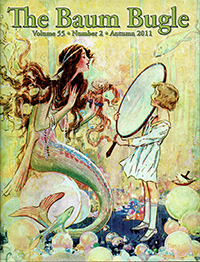
Originally published in The Baum Bugle, vol. 55, no. 2 (Autumn 2011), pgs. 10–14
Citations
Chicago 17th ed.:
Berman, Ruth. “Mermaids of Oz.” Baum Bugle 55, no. 2 (2011): 10–14.
MLA 9th ed.:
Berman, Ruth. “Mermaids of Oz.” The Baum Bugle, vol. 55, no. 2, 2011, pp. 10–14.
(Note: In print, this article was supplemented with illustrations that have not been reproduced here.)
“How does anybody know about mermaids if those who have seen them never lived to tell about them?” —Trot, in The Sea Fairies
Mermaids jumped into literature as major characters in Baron de la Motte Fouque’s Undine (1911), the story of a water sprite’s love for a faithless human. Before that, although there were brief references to mermaids in many works and mermaids in folktales and mermaid-like figures in ancient myth (the Sirens, for instance), mermaids had not appeared in literature much. As suggested by the name “Undine,” de la Motte Fouque was drawing on Parcelsus’s mythology of elemental spirits, the essences of the four Aristotelian elements of earth, air, fire, and water: gnomes, sylphs, salamanders, and undines.[1] Paracelsus had claimed that the elementals longed to marry humans in order to receive a soul from the union. In folktales, by contrast, there were many stories of fairies or mermaids who married mortals, and some of fairies or nixes who long for souls, but the combination of the two motifs was something new.
Fouque’s Undine captured readers’ imaginations at once, and melancholy, marriageable mermaids started showing up everywhere: Hans Christian Andersen’s “The Little Mermaid” (1836); James Hogg’s Mermaid of the Loch in “Mary Burnet” (1828); Heinrich Heine’s “Lorelei” (1827); Alexander Pushkin’s “Rusalka” (1819); the mermaid of Oscar Wilde’s “The Fisherman and His Soul” (1891); and, with a change of gender, in Matthew Arnold’s “Forsaken Merman” (1860). Less melancholy but still enticing were Alfred Tennyson’s mermaids in his poem “The Sea-Fairies” (1830, revised 1853).
Thematically, these nineteenth-century merfolk usually represented the ambivalence of emotions felt about sexuality (especially women’s sexuality), at once fascinating and frightening to writers. By the end of the century, when sexual tensions came to be less feared, the notion of the mermaid-bride became less popular. The writers who have written of mermaid-brides in the twentieth century have mostly played the idea for comedy, as in H. G. Wells’ The Sea Lady: a Tissue of Moonshine (1902), Lord Dunsany’s “Mrs. Jorkens” (1931), or the movie Splash (1984). The theme was getting stale. One way to find new meanings in the idea of mermaids was to ignore their marriageability and concentrate instead on their wateriness—to use them as symbols of the power (and, usually, the benevolence) of Nature. Charles Kingsley’s water-world and his new kind of water-spirits in The Water Babies (1863) may have been a model for this way of writing about merfolks.[2]
L. Frank Baum was one of those who portrayed mermaids as benevolent water-spirits in The Sea Fairies (1911).[3] Despite the name, the sea fairies of Baum’s invention are quite unlike Tennyson’s dangerous, Siren-like sea fairies. In fact, Baum’s tale is set going by Cap’n Bill’s superstitious fear of Siren-like mermaids, and Trot’s wiser confidence that supernatural powers couldn’t possibly be like that. In the preface, Baum commented: “The ocean has always appealed to me as a veritable wonderland, and this story has been suggested to me many times by my young correspondents in their letters. Indeed, a good many children have implored me to ‘write something about the mermaids,’ and I have willingly granted the request.” At the opening of the story, the narrative describes the beauty of the lights and colors of the sea, as Trot and Cap’n Bill row into Giant’s Cave, which glows like a sapphire, and this natural splendor is echoed in the mermaids’ magical kingdom with its brilliantly colored sea-shrubs, coral walls, and mother-of-pearl paneling.
John R. Neill evidently delighted in the curving, fluid mermaid shapes and did some of his best work for The Sea Fairies, especially in the color plates, which he embellished with ornamental borders printed in metallic green (as used in The Emerald City of Oz)[4] or gold inks. The bright green was as appropriate to a water-world as it had been for a city of emeralds, and he also enjoyed playing on the mixed beauty and comedy of such scenes as Trot, in her plain jacket and cap, swimming with Princess Clia, both of them curling their tails as they glide into the fishy waves; or Cap’n Bill, braced on his side-fins and the curve of his tail as he lights his pipe.
Baum’s earlier illustrator, W. W. Denslow, had enjoyed mermaids, too. He slipped in one—watching the Ancient Mariner’s ship—in his Roycroft edition (1899) of Coleridge’s poem. When he brought the Ancient Mariner back as a character in The Pearl and the Pumpkin (1904), Denslow and his co-author Paul West gave the Mariner a number of companions in Davy Jones’ Locker, including an Irish mermaid cook and several mermaid maids to help her (one shown here).[5]
The goddess-like mermaids such as Baum and E. Nesbit portrayed have not been widely used. Figures so powerful are often difficult to handle in a story, and that difficulty may explain why few such stories have been written. In the twentieth century, mermaids have most often appeared as minor figures within a world of many different supernatural beings. Some writers, such as Jane Yolen in The Mermaid’s Three Wisdoms (1978) and Poul Anderson in The Merman’s Children (1979), have used merpeople as leading characters to present a theme of tolerance for differences. But other kinds of non-humans are as useful as merfolk for such a theme—for instance, in Oz, such characters as the Scarecrow and the Tin Woodman are friends despite their differences in body and spirit.
After The Sea Fairies, Baum did not use mermaids again as major characters, nor did his successors in the Oz books. There were several minor mermaids: in his movie of His Majesty, The Scarecrow of Oz (1914), a loose adaptation of The Wizard of Oz, Baum had the Scarecrow meet an umbrella-carrying mermaid briefly beneath the waves of the River Rubicon; in Rinkitink in Oz (1916) Prince Inga’s magic pearls were a gift of the Mermaid Queen;[6] and when Baum brought Trot and Cap’n Bill to Oz in the novelized version of The Scarecrow of Oz (1915), he mentioned briefly the role of the mermaids in starting them on their sea journey and had Trot briefly mention them again in The Lost Princess of Oz (1917).
Ruth Plumly Thompson extended Trot’s friendship with merfolk in The Giant Horse of Oz (1928) by introducing her to Orpah, the merman who is the guardian of Cheeriobed’s seahorses in Lake Orizon, a salt-water lake in the Munchkin Country. She did not explain how it happened that one merperson—and only one, apparently—inhabited the lake.[7] More often, she invented original kinds of water people, such as the Scooters on the river in The Lost King of Oz (1925), or the stiff and jellied Seeweegians in Captain Salt of Oz (1936). She presented a being more mermaid-like (except for having legs instead of a tail) in Water Lily, the Lady of the Lake from The Enchanted Island of Oz (1976).
Neill put Dollfins, creatures like mermaids but made of wood, into the Nonentic Ocean (as he called it) in Lucky Bucky in Oz (1942). He implied that there were mermaids in the ocean, too, but did not bring any into the story. He also put a band of tiny water fairies and larger kelpies into the Singing Brook by the Lollypop Village in Oz, in Scalawagons of Oz (1941).
Dick Martin drew a Nonestic mermaid and merman for the 1961 abridged version of Ozma of Oz and presented Melody, the Water Elemental of the Winkie River (her sisters are Elementals of the other main Oz rivers) in his own The Ozmapolitan of Oz (1986). Rachel Cosgrove Payes used a Water Nymph, living in a Quadling brook, in The Wicked Witch of Oz (1993).
On the level of Oz-as-if-real, it is intriguing to speculate on possible connections between Orpah and the Nonestic mermaids he apparently never encountered, and that waterway from the ocean to the Munchkin Country, and whether the Nonestic mermaids are the same as the ones in Baum’s Sea Fairies. Finding fresh thematic uses for mermaids as major characters might be a problem, but if solutions are found, perhaps such mer-stories may yet be written.
This article first appeared in Dunkiton Press #3, Mermaid Tales December 1994.
Notes
- See my essay “A Brief History of Gnomes” in Dunkiton Press #2.
- For a longer discussion of mermaid background, see my articles on “Mermaids and Sirens” in Mythical and Fabulous Creatures, ed. Malcolm South (Greenwood Press, 1987).
- Nesbit also portrayed mermaids as benevolent water spirits in Wet Magic (1913). The dates are probably too close for her to have been influenced by The Sea Fairies. I don’t know if she knew Baum’s work at all, but it is pleasant to note Baum’s praise of her “clever stories” in his essay on “Modern Fairy Stories,” originally printed in 1909, and reprinted in The Wizard of Oz (The Critical Heritage Series), ed. Michael Patrick Hearn (Schocken Press, 1983).
- See Peter Hanff’s “How the Story of Oz (Almost) Came to an End: The Emerald City of Oz at One Hundred” in the Winter 2010 Baum Bugle.
- I own a two-tailed watercolor mermaid Denslow drew in the traditional mermaid pose of looking at her face in a hand-mirror, while Denslow’s signature seahorse looks on, but I have never been able to learn how Denslow came to draw it. It was once part of Jack Snow’s collection and was printed as the back cover to the Snow issue of the Autumn 1988 Baum Bugle.
- The late Fred M. Meyer reminded me of this upon seeing an earlier draft of this article.
- Ruth Plumly Thompson also mentioned mermaids briefly in The Royal Book (1921), where the A-B-Sea Serpent and the Rattlesnake find a way from the ocean to the Munchkin River while taking a vacation from tending the mer-children (thanks, Fred); and in Gnome King (1927), where Peter glimpses a mermaid and her coral castle. In Captain Salt, the Captain has an aquarium large enough to hold a mermaid, evidently hoping to meet one (thanks, Fred). She occasionally used mermaids in the poems and stories she wrote for the Philadelphia Public Ledger, too. Two examples have been reprinted by the Oz Club: the mermaid loved by “The Amiable Old Dragon” (July 6, 1919) on the back cover of the Baum Bugle, 35, 2 (Autumn 1991); and the brief mention of the good little mermaids expecting presents from “The Sea Santa” (December 22, 1918) in The Wizard of Way-Up and Other Wonders (ed. James E. Haff and Douglas G. Greene, 1985). Her stories, “The Mermaid’s Necklace” and “The Good Little Mermaid,” appeared in the Ledger (August 5, 1917, and May 11, 1919), one of “The Perhappsy Chaps” poems (May 30, 1915) went undersea to the Mer King’s realm.
Authors of articles from The Baum Bugle that are reprinted on the Oz Club’s website retain all rights. All other website contents Copyright © 2025 The International Wizard of Oz Club, Inc. All Rights Reserved.