OZ EDITORIAL CARTOONS REVISITED
by Carl Rexroad
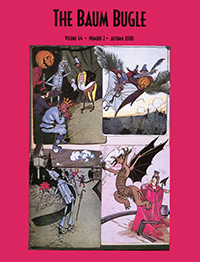
Originally published in The Baum Bugle, vol. 44, no. 2 (Autumn 2000), pgs. 19–23, 26
Citations
Chicago 17th ed.:
Rexroad, Carl. “Oz Editorial Cartoons Revisited.” Baum Bugle 44, no. 2 (2000): 19–26.
MLA 9th ed.:
Rexroad, Carl. “Oz Editorial Cartoons Revisited.” The Baum Bugle, vol. 44, no. 2, 2000, pp. 19–26.
(Note: In print, this article was supplemented with images of editorial cartoons that have not been reproduced here.)
Editor’s Note: Carl Rexroad’s original article examining Oz political cartoons was published in the Spring 1997 Baum Bugle. It was very popular with Oz Club members, and in this update Carl provides insights into the Ozzy editorial cartoons that have appeared since. [Since its publication, Carl has returned again to update his overview—in the Spring 2025 and Autumn 2025 issues.]
If there was ever a doubt that the campaign for presidency in 2000 is well under way, it was dispelled in April 1999 when Al Gore appeared as the Tin Man in an editorial cartoon.
Since 1906, when publishing magnate and presidential hopeful William Randolph Hearst was portrayed as the Scarecrow in a cartoon titled, “The Wizard of Ooze,” editorial cartoonists have been using Oz as metaphor for politics and society. In the 1960s, candidates for public office became regularly cast as lacking the requisite brains, heart or courage to lead. Using “The Wizard of Oz” as a visual image in editorial cartoonery seemingly reached its peak in 1996, with Robert Dole’s Kansas ties giving double duty to political metaphors. (The Baum Bugle, Spring 1997.)
But after Dole was sent home to Kansas (often by a Clintonesque Glinda), the popularity of Oz-themed metaphors did not fade away. Indeed, it can be argued that the image is as strong as ever, even though the summer 1999 release of Star Wars: Episode I has given cartoonists new popular culture images to sink their pens into.
Gore’s portrayal of the Tin Man was penned by Jimmy Margulies of the Hackensack, N. J. Record. Gore’s seen leaning stiffly to one side singing, “I’d be leading Bush and Dole, In the opinion polls. If I only had a pulse!”
Since the Bugle overview on editorial cartoons appeared in 1997, numerous major national and international events have been cast with Ozian themes by editorial cartoonists who comment daily with their art on society’s shortcomings. The themes continue to be familiar: The melting witch and the humbug behind the curtain are the two most enduring images. But the Flying Monkeys have appeared more often of late as well. Major events of the past several years with Oz-themed commentary include:
- President Clinton’s woes with Paul Jones, his sex scandal and Whitewater. A June 1997 cartoon by Steve Kelley of the San Diego Union-Tribune shows Jones as Dorothy, pulling back the curtain to reveal Clinton with his pants around his ankles, while the virtuous image is cast on the screen. A November 1997 cartoon by Marshall Ramsey of Copley News Service shows a car with its trunk full of Whitewater documents falling on Clinton, while Glinda and the Munchkins look on. A cartoon in March 1998 by Mike Thompson of the Springfield (Ill.) Journal-Register shows Clinton on the White House Balcony sending pin-striped clad “spin doctors” flying off to trash Katherine Willey. Clinton’s exhorting the men with wings to “Fly! Fly! My Pretties!”
- The death of Princess Diana also led to a September 1997 cartoon by Steve Breen, who won the Pulitzer Prize for cartooning that year with the Asbury Park (N. J.) Press. Breen cast the witch’s castle to represent tabloids, and the Flying Monkeys carried cameras in flight to represent the paparazzi.
- The tragic shootings at Columbine High School also brought a Flying Monkey theme. Pulitzer Prize-winning cartoonist Pat Oliphant of Universal Press Syndicate in April 1999 portrayed the NRA’s Charlton Heston holding a newspaper headline of the Littleton, Colo., school massacre and telling the monkeys to get out there and “put a positive spin on this.” The Princess Di and school shooting metaphors certainly were the darkest use of Oz.
- The melting witch metaphor continued its popularity, and Breen used it in April 1999 to show Clinton prosecutor Kenneth Starr as the witch, turning the hose on himself and declaring, “What a world, what a world!” The witch’s robe is labeled “Independent Counsel Law.” Starr was also cast as the giant head in March 1998 telling Dorothy—labeled “The Press”—“You DARE to criticize the great and powerful Starr?” That was created by Ed Stein of the Rocky Mountain News in Denver. The melting witch was used several other times as well, including at least twice in comments on tax codes.
- The continuing crisis in Iraq also turned Ozian. Herbert Block, who in his 90s still draws sharp commentary for the Washington Post, recreated the visual image that was the grandfather of the pop culture metaphor. (In August 1939, concurrent with the classic movie’s release, the young Block showed Hitler as the Wicked Witch and the four main characters as countries in Europe.) In December 1997, Block showed France as the Tin Man, The U.S.-U.N. as the Cowardly Lion, Russia as the Scarecrow and U.N. inspectors as Dorothy. They were all staring at a stack of missiles arranged to look like spires of a palace. A sign out front says, “Saddam Presidential Palace #37 Keep Out!” Dorothy is commenting, “That’s a funny looking palace.”
- And in a traditional film setting of the four main characters and their quest, Margulies again used the Oz theme in November 1998. The Tin Man is asking for a heart, the Scarecrow a brain, the Lion courage and Dorothy for home. The Wizard, who is labeled “HMO,” says, “We can send Dorothy home in 48 hours . . . the others we don’t cover.”
- Finally, the movie itself was the subject of a November 1998 editorial cartoon by Dana Summers of the Orlando Sentinel. A man watching TV declares, “Reruns, Reruns, Reruns! I’m going to the movies!” He’s next seen outside the local Cineplex, where playing are “The Big Chill, The Wizard of Oz and Gone With The Wind.”
Since the Spring 1997 Bugle article on Oz editorial cartoons, there have been at least 25 more uses of Oz as a metaphor for societal issues. The Oz theme has been developed into at least two book covers, Wizards of Media Oz: Behind the Curtain of Mainstream News in 1997 and If I Only Had a Brain, a compilation of editorial cartoons by Dick Wright of the Columbus (Ohio) Dispatch.
Wright’s book featured a forward by Dan Quayle. With the former vice president running for president in 2000, one can only surmise that sooner or later he’ll be seen on some editorial page in America as the brainless Scarecrow.
Authors of articles from The Baum Bugle that are reprinted on the Oz Club’s website retain all rights. All other website contents Copyright © 2025 The International Wizard of Oz Club, Inc. All Rights Reserved.