OZ IN AMERICA
or
A FUNNY THING HAPPENED ON THE WAY TO THE EMERALD CITY
by Barbara S. Koelle
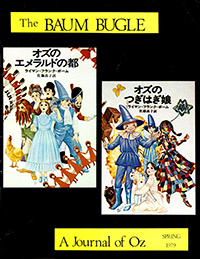
Originally published in The Baum Bugle, vol. 23, no. 1 (Spring 1979), pgs. 20–22.
Citations
Chicago 17th ed.:
Koelle, Barbara S. “Oz in America or A Funny Thing Happened on the Way to the Emerald City.” Baum Bugle 23, no. 1 (1979): 20–22.
MLA 9th ed.:
Koelle, Barbara S. “Oz in America or A Funny Thing Happened on the Way to the Emerald City.” The Baum Bugle, vol. 23, no. 1, 1979, pp. 20–22.
(Note: In print, this article was supplemented with illustrations that have not been reproduced here. However, typographical errors have been left in place to accurately reflect the printed version.)
The absorption of Oz into American culture is a phenomenon worthy of attention. So deeply has the concept permeated national consciousness that it is no longer necessary to explain the original referent. Consider: The Yellow Brick Road is both a song and rock album title[1]; a disco place, opening in New Jersey, terms itself “The Emerald City”; a popular columnist heads his diatribe against political junketing with, “They Went Everywhere But the Land of Oz.”[2] Hippie communes have adopted the name by scores. In an elevator I recently heard this conversational summing-up: “Who does she think she is—the Wicked Witch of the West?”!
“We crossed Lake Champlain on the nicest ferry in the world, a regular Oz ferry,” wrote a friend to Roger Sale, author of a book on fairy tales which devotes a chapter to Baum.[3] Such a statement conjures up reverberating suggestions of a magical journey, as Sale points out. Oz similes have so insinuated themselves into popular writing that is difficult to avoid them in casual reading: as a synonym to naivete author Ivan Lyons (“Someone Is Killing the Great Chefs of Europe”) writes, “We were like two Dorothys going down the Yellow Brick Road.”[4] Says Jill Robinson of her first exposure to Key West, “It is like opening the door onto Oz,”[5] referring, of course to the color-flooded moment in the MGM movie. In a more unusual and thought-provoking context the poet W. H. Auden refers to Oz in an introduction to a book by Loren Eisely:[6] “. . . the serious part of prayer begins when we have got our begging over with and listen for the Voice of what I could call the Holy Spirit, though if others prefer to say the Voice of Oz or the Dreamer of Conscience, I shan’t quarrel . . . the Voice I am talking about always says something new and unpredictable . . .” Is Baum’s charlatan Wizard recognizable here?
Nor are depictions of Oz lacking in the graphic arts. Any or all of the four travelers to the Emerald City have appeared as satiric and social commentary in such magazines as Esquire and Mad. In one cartoon George and Lurline Wallace, Ronald Reagan, and Lester Maddox travel down the reactionary Yellow Brick Road. In another the Scarecrow and Tin Woodman appear in a jibe at turnpikes—one that Baum, with his love for the pastoral, might have appreciated. “The Wizard of Id” comic strip draws Dorothy and a Munchkin without feeling the need for further identification. The Kansas tornado pops up as an advertisement for radar and ITT.
It was hard to escape from Oz in the New York City theater district, I found in a recent visit. Visual reminders were everywhere. A gigantic advertisement for the movie, “The Wiz,” dominated Broadway, while around the corner were billboards for the stage show, still going strong. I suspect that Baum, infatuated as he was with the performing arts, would have reveled in all this.
On a smaller scale but more evocative is James Aukland’s painting on china[7] of Judy Garland as Dorothy in the 1939 movie. It sits on a bookcase in my study, and I was looking at it recently, instead of doing other things that should have been done. It occurred to me that Dorothy, in the U.S., as well as in her Oz depictions, has certainly been getting older.
In 1900 W. W. Denslow’s original pigtailed little girl appears no more than 7 or 8 years of age. John R. Neill’s early drawings of Dorothy are consistent with this image, but, as is intriguingly apparent in Dick Martin and David Greene’s three-page Neill spread in The Oz Scrapbook,[8] the child ages considerably between 1906 and 1935. In The Wishing Horse of Oz Dorothy could easily pass for a 12-year-old. While people do not usually grow older in Oz, perhaps Dorothy has taken advantage of the permissive situation outlined by Robert R. Pattrick[9] to add on several years. There is, of course, one exception to the sedate pace of her growth—and it is logically consistent with what we know of rules of Oz magic. Suddenly whisked away in the United States by the sands of the Wish Way, Dorothy, in The Lost King of Oz, changes dramatically and painfully to the adult she would have been had she not settled in Oz so many years ago. Ruth Plumly Thompson does not give her exact age, but describes her as “tall” and as “quite a young lady.” Fortunately for our heroine the return to Oz accomplished a return to the status of childhood.
Equally startling and painful—at least to the Oz purist—has been the overnight metamorphosis of the little Kansas farm girl to the 24-year-old New York City school teacher in the movie version of “The Wiz.” Not that it is without precedent in the American entertainment scene. Early Dorothys in both stage and screen, ranging from he1902 stage show of “The Wizard of Oz” to the 1925 Larry Semon film of the same name, were portrayed by adult actresses. However, they are of interest strictly to the Oz or show-business buff. National consciousness of Baum’s Dorothy—the cultural image—is that of Judy Garland’s 1939 adolescent, reinforced for later generations by the annual television showing of the MGM movie. So fused has this become with the literary Dorothy that Oz games, pop-ups, and other novelties[10] are about equally likely to contain a Denslow or a Garland interpretation of the heroine.
It this likely to occur with “The Wiz”? The creators of the award-winning Broadway musical were careful to keep their Dorothy in the adolescent range: Stephanie Mill’s official age was announced as 15. The real break with tradition came with the casting of 32-year-old Diana Ross as a 24-year-old Dorothy for the movie version. Combined with the change of locale from rural Kansas to urban New York City, this novelty represents a far more radical transition of the classic American fairy tale than does a black cast, black idiom, and rock music.
Sidney Lumet, “The Wiz”’s director, is aware of this. In an introduction to The Wiz Book[11] he acknowledges the age differences of the literary vs. the screen and stage Dorothys, but claims that this makes no difference since all revolve around a concept of self-knowledge. Is this heresy? Here is Margaret Hamilton, the archtypal Wicked Witch, on the ’39 film:[12] “We get out of it what we need. You’re seeing your own experiences” . . . Roger Sale says that Oz, as a guide to life, is as “naive as it is essential.” Its magic lies in “the child’s wonderful acceptance of self, situation, and journey.” Such a description is not far removed from one critic’s reaction to the movie:[13] “’The Wiz’ is fine entertainment which allows itself to encourage effort, self-confidence, and faith in the future.”
The votes are not yet all in on “The Wiz.” There will be those of us who will not agree with its theme, and who will not care for Diana Ross’ interpretation of Dorothy. Yet I think we must accept it as yet another appreciation of Baum’s enduring masterpiece—initially, perhaps, as disconcerting as some of the illustrations in foreign editions of The Wizard of Oz. It is, however, native Americana—Manhattan skyline, lion from the Public Library, World Trade Center and all.
A funny thing happened on the way to the Emerald City. . . .
[1] Elton John, “Goodbye, Yellow Brick Road” in the album of the same name.
[2] Mike Royko, The (Philadelphia) Bulletin, Jan. 14, 1979.
[3] Roger Sale, Fairy Tales and After: From Snow White to E. B. White, Harvard University Press, 1978.
[4] People Weekly, Nov. 20, 1978.
[5] Vogue, Feb. 1979.
[6] The Star Thrower, New York Times Books, 1978.
[7] Knowles China, 1977.
[8] Random House, 1977, pp. 106–108.
[9] Unexplored Territory in Oz, 1963, p. 11.
[10] See Robin Olderman’s article in the Autumn, 1978 Bugle.
[11] The Wiz Book, Berkley Publishing Group, 1978.
[12] Interview in The Philadelphia Inquirer, Feb. 1974.
[13] Ernest Schler, The (Philadelphia) Bulletin, 1978.
Authors of articles from The Baum Bugle that are reprinted on the Oz Club’s website retain all rights. All other website contents Copyright © 2025 The International Wizard of Oz Club, Inc. All Rights Reserved.