THE CORONADO FAIRYLAND
by Scott Olsen
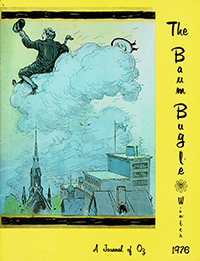
Originally published in The Baum Bugle, vol. 20, no. 3 (Winter 1976), pgs. 2–5
Citations
Chicago 17th ed.:
Olsen, Scott. “The Coronado Fairyland.” Baum Bugle 20, no. 3 (1976): 2–5.
MLA 9th ed.:
Olsen, Scott. “The Coronado Fairyland.” The Baum Bugle, vol. 20, no. 3, 1976, pp. 2–5.
(Note: In print, this article was supplemented with photographs that have not been reproduced here. However, typographical errors have been left in place to accurately reflect the printed version.)
Because L. Frank Baum and his family were spending a few months each year at Lake Macatawa, Michigan, to escape the hot Chicago summers, it was natural for them to look for a place where they could go to escape the cold Chicago winters.[1] They first considered Florida but didn’t like it there. Then, in 1904, the Baums took a trip to California. In a letter to her sister-in-law Sophie Gage, Mrs. Baum wrote about the stop they made at Coronado:
[February 19, 1904] We leave [Coronado] Saturday morning for Pasadena. . . . We will stay there a couple of weeks and then go to Santa Barbara for a time. We hate to leave here-we like it so much. . . .
In fact, the Baums went back every winter (except 1906 when they were in Egypt and Europe) through 1910. They would arrive by train early in January and stay until late March or early April.
Coronado, a small tourist town across the bay from San Diego, is one of the most beautiful places on the west coast. Baum described the area in his pseudonymous Aunt Jane’s Nieces and Uncle John (1911): “the broad stretch of orange and lemon groves, hedged with towering palm trees; Santa Catalina and the Coronado Islands; the blue Pacific rolling in front and rugged Loma with its rocky cliffs behind. . . .” In an interview for the February 7, 1904, San Diego Union, he said it a little differently:
Just as every dog, from the commonest to a thoroughbred, is liable to have its fond master . . . so is every section of the world liable to have its admirers. But those who do not find Coronado a paradise have doubtless brought with them the same conditions that would ren-der heaven unpleasant to them did they chance to gain admittance. . . .
Coronado was a tourist center not only because of its natural beauty, but also because of its “Tent City,” a kind of year-round carnival, and because of its world-famous Hotel de! Coronado. Chinese were imported from San Francisco to build it, and when it opened in 1888, it was with lighting that had been supervised by Thomas Edison. Its guests have included Presidents of the United States, important actors and actresses, and famous writers, including Baum, who must have been charmed both by the comforts and by the design. In AJN and Uncle John (p. 234), he wrote:
Some erratic architect certainly concocted the plan of the Hotel de! Coronado. It is a very labyrinth of passages connecting its nine hundred rooms and one has to have a good bump of location to avoid getting lost in its mazes.
During his first stay at the hotel, Baum produced several great fantasies. He noted when he wrote his friend and fellow author, Emerson Hough from Santa Barbara on March 15, 1904:
Since I same out here I have written the new book for this year [The Marvelous Land of Oz] and got it into the pub’s hands.[2] It was sketched before. And I have revised and pre-pared for St. Nicholas a serial called “The Magic Cloak,”[3] which I send to Mrs. Dodge today. Mr. Ellsworth, the Sec’y of the Century Co. has a house here this winter and he has read the Ms. and is enthusiastic. His little girl approves it, too. He wants me to take all my future wares to the Century Co. Also I have written five “Animal Fairy Tales” for The Delineator, so you can see I have been kept busy. Yet I play a half of every day. Made the 9 holes in Coronado one day in 39. If that keeps up I’ll no longer be the worst golfist in America. . . .
Not only was Baum becoming an enthusiastic golfer, but he took up archery as well. The sport so intrigued him that, years later in Hollywood, he set up an archery range in the backyard.
During his 1905 stay at the hotel, Baum helped a local Presbyterian church by giving a public reading from several of his fairy tales. The San Diego Union for March 6 announced the event:
Reading by Mr. L. Frank Baum from his book of Fairy Tales, will be given under the auspices of the ladies of the Presbyterian church.
Mr. Baum’s programme is as follows:
Part I
“The King’s Head and the Purple Dragon” from The Magical Monarch of Mo.
Part II
(a) “The Awakening of the Sawhorse” (b) “The Highly-Magnified Woggle Bug,” from The Marvelous Land of Oz. (The Marvelous Land of Oz was written at the Hotel de! Coronado during the winter of 1904, and is one of Mr. Baum’s most successful books.)
The entertainment will take place at the residence of Mr. and Mrs. James Gardner. . . . No admission will be charged, but envelopes will be supplied those in attendance in which they may place whatever they choose. . . . There will also be music.
The reading was a success, as a newspaper article the following morning reported:
Last evening, L. Frank Baum, the author of fairy stories, read from his own books to as large an audience as the Gardner residence could accommodate. Mr. Baum’s large circle of friends and admirers at the hotel turned out inmasse . . . and all were delighted.
It is also needless to say that scores of children were present, happy to meet the man they know as a friend. (The San Diego Union, March 8, 1905)
When he gave the reading, Baum was not well. On March 7, he wrote to Emerson Hough: “Have been laid up for a week with acute indigestion—stomach all gone to pieces. Better now.” And on the same day, he wrote to Nat D. Mann (a composer who had worked with Baum on The Wizard of Oz stage play): “I have not written you before because I have been in such miserable health that I could write no one, and even now I am not able to attend to much business. . . . The weather is, as usual, delightful out here, but I have not had the health to enjoy it as I did last year.”
As Baum began to feel better, he and his family entered into a great variety of activities, as newspaper reports in The San Diego Union indicate: they gave a “Red Riding Hood Party” for Kenneth (the only son with them in California that winter) and some of his friends (March 12, 1905); Mrs. Baum and Kenneth spent the day at La Jolla (March 19, 1905); they celebrated Kenneth’s thirteenth birthday (March 29, 1905); they attended the theater (March 29, 1905); and Baum gave a lecture to the “San Diego Club” on the “Origin of the Fairy Tale” (March 31, 1905).
The Baums vacationed in Europe and the Middle East in 1906, but in 1907 they returned to Coronado for their longest visit thus far—about four months. By this time, they had become friends with the manager of the Hotel de! Coronado, Morgan Ross, “a cheery faced, fat little man who had at one time managed a famous New York hotel and had brought his talents and experience to far California,” as Baum wrote in AJN and Uncle John (p. 224). In 1907, L. Frank Baum and some of the other guests decided to honor him with a gold watch. Baum’s “Witty Presentation Speech” was published in The San Diego Union for Febrary 10:
Ladies and Gentlemen—the guests of this hotel are very indignant. It is scarcely necessary to call your attention to our cramped and confined quarters: to the lack of consideration on the part of the management; to the dust and dirt everywhere prevalent or the fact that the spoons are plated and the ladies cannot carry them away as souvenirs.
It is unnecessary to call your attention to these things because they do not exist. And the guests are indignant because Manager Ross having shown them how to do it, the other big hotels of America do not come into the same class as the Hotel de! Coronado. When Colum-bus showed his people how to stand an egg on end, they did it easily, but when Morgan Ross shows his brother bonifaces how to make people happy they do not seem to catch on as well as they might. . . .
Recognizing this, and feeling a desire to convey to Mr. Ross a token of appreciation of many kindnesses that cannot be settled in the weekly bill, the guests of this hotel have re-quested me, in their behalf, to crown Morgan Ross the Prince of Good Fellows and the King of Landlords.
The watch was in the shape of “Coronado” crown, worked in gold, and set with diamonds. It was said to be one of the most expensive pieces of jewelry made on the west coast.
The introductions to three Oz books are signed from Coronado: Dorothy and the Wizard in Oz (1908), The Road to Oz (1909), and The Emerald City of Oz (1910), and it is safe to assume that most of Baum’s books from 1904 to 1910 were written there, at least in part. Coronado probably influenced Baum’s writing more than any other city, most obviously in Dorothy and the Wizard in Oz, Aunt Jane’s Nieces and Uncle John, The Sea Fairies (1911), and Sky Island (1912). Dorothy and the Wizard is the first Oz book with a California setting, and Aunt Jane’s Nieces and Uncle John is about the nieces’ trip to California and Coronado. Baum used places from nearby San Diego in The Sea Fairies and Sky Island. Along the coast-line of La Jolla, a section of northwest San Diego, are the caves that Baum described in Sea Fairies. In Sky Island, the other Trot book, Trot, Cap. Bill, and But-ton Bright visit a place called “Smugglers Cove.” Baum may have been thinking of “The Cove,” which is part of La Jolla, or he may have had in mind an actual “Smugglers Cove,” which is part of one of the Coronado Islands, about ten miles off the coast of Coronado. The Islands, when viewed from Coronado, actually look as if they are “half in the sky” as Trot said in Sky Island (p. 44).
Coronado was Baurn’s inspiration for at least one important Oz character—the Wogglebug. Baum told the story to the Philadelphia North American (October 3, 1904), syndicator of the Queer Visitors comic page:
WOGGLEBUG’S CREATOR TELLS OF INSPIRATION
“I was out on a California beach,” said L. Frank Baum. “There was a pretty little girl I was very much interested in beside me. She was making sand pies and enjoying herself immensely, when suddenly she saw one of those little sand crabs, fiddler crabs I suppose they are.
“‘Oh, what is it?’ she said.
“‘A Wogglebug,’ I said, unthinkingly, using the first term that popped into my head.
“The child was delighted and ran to her parents shouting: ‘Oh, see what I’ve got! It’s a Wogglebug. Mr Baum says it’s a Wogglebug.’
“The name was so catchy that the same evening my wife told me I should put the Wogglebug in The Marvelous Land of Oz. The book was one-third written and Jack Pumpkinhead was the hero, but I brought in the Wogglebug right away. After that H. M. Wogglebug, T. E. was the hero and has become my most popular character.”[4]
In 1905, Baum wrote a short story entirely about Coronado and called it “Nelebel’s Fairyland.” It appeared in the June 1905 issue of The Russ, a publication of San Diego’s Russ High School. The story tells of Nelebel’s banishment from the forest of Burzee and her exile in a barren land. But soon, the Ryls and Knooks she had taken with her made the place into a paradise. Long afterward, the paradise was called “Coronado.” (The story can be found in the Christmas 1962 Baum Bugle.)
When the Baums went to Coronado in 1909, they rented a house instead of staying at the hotel, probably because they had brought one or two of their sons along and needed more space. A picture of the house (which is very close to the Hotel de! Coronado) appeared in The Theatre Magazine for August 1909 (reproduced in the Christmas 1971 Baum Bugle). The house is at 1101 Star Park Circle and is the only house still standing in which Baum wrote an Oz book. In his later years at Coronado, Baum designed lights for the hotel’s Crown Dining Room, where the crown-shaped fixtures can still be seen. His interest in the hotel remained strong.
Even after the Baums moved to Hollywood in 1911, they continued to visit Coronado frequently. In 1915, the Baums and Matilda Gage drove to San Diego to see the Pan-American Exposition and to have lunch at the Hotel de! Coronado. Baum’s last known visit to Coronado occurred in 1917 when he went to the Uplifter’s Convention where, among other activities, he appeared in Sim Crabill’s Circus, which was “Endorsed alike by the Clergy and the Public I Instructive, Elevating and Strictly Moral.” In his playlet, Baum acted the part of the trainer of the “Educated Frog,” who in turn was played by fellow Uplifter Teddy Pierce.
Coronado held no “Sign of the Goose” or “Ozcot,'” but the newspaper articles and Baum’s own comments about the town show how high it was in his affections. Speaking through Nelebel, he said:
“Here is a new fairyland, my friends! and to me it is far more lovely than the dark and stately groves of old Burzee: What matters our exile, when the beauties of this earthly paradise are ours to enjoy?”
And Baum added for himself, “Is it not, indeed, a new fairyland?”
I wish to thank Matilda J. Gage, Robert A. Baum, Jr., David L. Greene, and Dick Martin for allowing me to see their almost endless supplies of letters, newspaper articles, and other Baum memorabilia, without which this article wouldn’t have been possible. I would also like to thank the Iowa Historical Library in Des Moines for allowing me to quote from the Baum-Hough/Mann letters in their collection of Emerson Hough papers, the Coronado Historical Association for its help and interest, and Fred M. Meyer for the suggestion that I write this report.
Notes
[1] In 1903, the examiner in the George M. Hill Company’s bankruptcy agreed that Baum was insolvent. Somehow, though, he did manage to make major trips to the south and west in 1903 and 1904. In fact, in 1904, the bankruptcy material indicates that some delays in testimony were occasioned by Baum’s being in California.
[2] Baum’s letter disproves at least part of the statement in To Please a Child (p. 190) that “Both The Marvelous Land of Oz and Ozma of Oz were written in Baum’s study on the back porch of the summer cottage at Macatawa Park.” The announcement in The San Diego Union, March 6, 1905, for Baum’s public reading from his books states that Marvelous Land was written at the Hotel del Coronado, as does another article in The San Diego Union (January 13, 1905): “It was while at the hotel that L. Frank Baum began and completed, what, not a few consider, his very best story, The Marvelous Land of Oz, and it is brim full of the sunshine of California.”
[3] “Queen Zixi of Ix, or, The Story of the Magic Cloak” was serialized in Nicholas from November 1904 through October 1905. St. Nicholas was edited by Mary Mapes Dodge and published by the Century Company.
[4] As recounted in To Please a Child (p. 186), this incident is mistakenly placed at Macatawa.
Authors of articles from The Baum Bugle that are reprinted on the Oz Club’s website retain all rights. All other website contents Copyright © 2026 The International Wizard of Oz Club, Inc. All Rights Reserved.