THE GREAT CITY OF OZ
L. Frank Baum at the 1893 World’s Fair
by Michael Riley
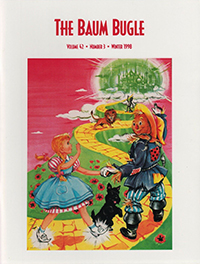
Originally published in The Baum Bugle, vol. 42, no. 3 (Winter 1998), pgs. 32–38
Citations
Chicago 17th ed.:
Riley, Michael. “The Great City of Oz: L. Frank Baum at the 1893 World’s Fair.” Baum Bugle 42, no. 3 (1998): 32–38.
MLA 9th ed.:
Riley, Michael. “The Great City of Oz: L. Frank Baum at the 1893 World’s Fair.” The Baum Bugle, vol. 42, no. 3, 1998, pp. 32–38.
(Note: This article’s endnotes have been reproduced exactly as they originally appeared in print. They do not reflect the current citation style of the journal.)
The contradictions and mysteries that exist in L. Frank Baum’s Oz series provide an endlessly fascinating source of conjecture and speculation, as do investigations into possible sources for his ideas and plots. It is clear that the incidents and experiences of Baum’s life had a great deal to do with just what and how he wrote. In fact, one of the greatest difficulties I encountered while writing my book Oz and Beyond: The Fantasy World of L. Frank Baum was in resisting the temptations to be led down tantalizing avenues of speculation about how certain experiences in his life may have provided the material for his stories. I was not always able to resist the temptation, although little of my work in those areas made it into the final version of the book. Most of the time I did not regret having to cut these sections, but in one instance, I felt that my speculations had something potentially important to say about Baum and a possible insight into the interpretation of his masterpiece The Wonderful Wizard of Oz. That area of conjecture concerned the extent of the influence of the 1893 World’s Columbian Exposition in Chicago on the initial creation of the story. While the lack of documentary evidence directly connecting the two was one of the reasons for leaving most of these speculations out of my book, another, more important, reason was that extensive use of such investigations into sources did not fit in with what I was trying to accomplish.
My goal was to trace the development of Baum’s whole fantasy world over the course of his writing career, and to do that, I tried to limit myself to what was actually there—to find out exactly what he had written about his fantasy creations. I went back to his first published works of fantasy and then examined all the others in the order in which he wrote or published them. I also tried to understand and present how all the developing layers of his fantasy world did or did not fit together.
Therefore, while focusing on what actually appears on the printed page, speculation about sources and influences had, by necessity, to be kept to a minimum. That does not mean, however, that I did not speculate, or that some of my conclusions and statements were not the result of conjecture. For example, while my discussion of the Chicago World’s Fair and The Wonderful Wizard of Oz takes up only two paragraphs of my book, the statement that “it is entirely possible to read the story as the surreal adventure of a child lost at the exposition”[1] was based on a great deal of reading and thinking about Baum’s possible experiences at the Exposition.
According to Michael Gessel, Baum’s granddaughter Ozma Baum Mantele “is confident that Baum developed The Wizard from stories he told over a period of time to Baum’s four sons and neighborhood children.”[2] And it is not inconceivable that those stories began around the time of the great Exposition. The influence of the Fair did not dissipate immediately after it closed down. A modern editor of a book about the Exposition wrote:
Nowadays it is hard to realize what a dramatic event the Chicago World’s Fair was and what an impact it had, especially on Mid-America. The Fair proclaimed Chicago’s coming of age. It introduced so many wonders of the new era, and so many splendors from foreign lands, that it caused a turning point in many lives. . . . [T]he trip to Chicago was a tremendous adventure, one of discovery and promise, leading to visions of the “City Beautiful.”[3]
For many Americans, this “City Beautiful” became the object of pilgrimage, the sought for end of the journey, and it may be that the City of Emeralds, at some point during the development of Baum’s story, played a more central role than it does in the published version. Severa of the early titles Baum considered for The Wizard seem to support this idea: The City of Oz, The Great City of Oz, The Emerald City.[4]
In his article “From Vanity Fair to Emerald City: Baum’s Debt to Bunyan,”[5] J. Karl Franson has argued that John Bunyan’s Pilgrim’s Progress had an important influence on the creation of The Wizard. It is true that Baum, like most nineteenth century children, would have been far more familiar with that book than his twentieth century counterparts are. Louisa May Acott could take this for granted when she used Bunyan as the structural basis for the first part of Little Women, and the allegory could have played its part in Baum’s story. Baum, however, had seen a real “City Beautiful” to help spark his imagination, and the connection between Bunyan’s classic and the 1893 Exposition had already been made in Frances Hodgson Burnett’s 1895 book Two Little Pilgrims’ Progress, a book with which Baum and his children most certainly were familiar. Coincidentally, Burnett’s book is the story of two orphans, a boy and a girl, who live a bleak existence on a midwestern farm with their aunt. To them the newly rising “White City” in Chicago begins to represent the “Celestial City,” the end of the journey and the place where wishes can come true. So strongly do they become convinced that the solutions to all their problems lie there that they run away from home to journey to the great city.
For many Americans of the 1890s, the great White City, as well as the hardships and expense of the journey to it, took on special significance. It would have been almost impossible for Baum not to have been influenced by one of the most momentous events of the last decade of the century, especially since it was taking place right in his own city. With that in mind, two avenues of speculation seemed pertinent: (1) how involved Baum was with the Exposition and (2) what he would have seen and experienced there that could have inspired elements of The Wonderful Wizard of Oz.
How Involved Was Baum with the Exposition?
From the standpoint of material for his books, L. Frank Baum was either very perceptive or singularly lucky in his choices of places to live in his long trek across America. He often seemed to be in just the right place at the right time to experience some event, discovery, or innovation that was to have a great influence on America or on the formation of the American character. Of course, it was his family that was in the right place to take advantage of the discovery of oil, and while the importance that gasoline would have for the world was not then known, the growing new industry served as the basis of the family fortune that allowed Frank to grow up in a relatively untroubled environment. However, when in the 1880s financial reverses demanded that he find some other way to make a living, the decision was Frank and his wife Maud’s to do something radical and experience the American frontier—even then, rapidly disappearing. Although he was not able to make a commercial success of his life there, the hardships, the struggle, and the frontier experience itself had great effects on his later writings. Without this experience of the frontier, it is possible that his most famous story would not have opened with the evocative and, to people in the more settled parts of the country, exotic line, “Dorothy lived in the midst of the great Kansas prairies. . . .”
It is also quite possible that The Wonderful Wizard of Oz would not have been written without his next, and probably most important, move. After the failure of two businesses, he and Maud needed to make a fresh start somewhere ese, but they chose not to move back east where they had family and ties. Instead, they settled in the bustling Midwestern city of Chicago. They arrived there just as the attention of the world was beginning to be focused on the city as the site of the World’s Columbian Exposition, the celebration of the four hundredth anniversary of Columbus’s discovery of the New World.
Chicago was only one of the cities being considered to host the Exposition, and it had not been a certainty that Chicago would be the city chosen. Philadelphia, New York, Washington, D.C., Cincinnati, and St. Louis also wanted it,[6] and New York and Washington were in the running until the final decision. It was not until April 25, 1890 that Chicago became “the official site of the World’s Columbian Exposition.”[7]
A Fair to celebrate this important anniversary had been discussed by various groups for years, and early talks had also planned it for 1892, but by the time the city had been chosen, that earlier date became impractical, and “President Harrison issued a proclamation on December 24, 1890, announcing that a world’s fair would be opened on May 1, 1893, in the city of Chicago and would not close before the last Thursday in October of that year.”[8] Even with putting the date off a year, this still left only two and a half years in which to choose the location within Chicago, plan the fairgrounds and all the buildings, and build it—all of this for an event that was to last only five months.
While the location and plans had been under consideration since April 1890 when the choice of the city became official, it was not until early spring 1891 that the site along the lake had been agreed upon and the architectural plans had been largely completed.[9] It was only then that work could begin on preparing the land, building the complex infrastructure, and constructing the buildings themselves. The time then was only about two years until the Fair was to open, but the amazing thing about this is that the new Exposition City had to be completed, except for the decoration and final touches, not by the opening date of May 1893 but by October 1892! The earlier date was necessary for the artists to do their work on the buildings and grounds and for there to be time for the exhibits to arrive and be set up.[10] Therefore, the time available for major construction was only a year and three-quarters—barely 20 months to prepare the 633 acre area[11] and to build more than 50 major structures.[12]
There was a frenzy of construction at the Fair grounds during that time, and every detail of it was of vital interest to the citizens of the city. It was in the midst of this that Baum moved his family to Chicago in 1891, just in time to watch this great fantasy city being created.

The Administration Building: an example of the architecture of the White City that probably inspired Baum and Denslow’s conception of the Emerald City.
Baum could not have avoided following the progress of the construction of the White City, as it came to be called, even if he had wanted to. Newspapers all over the country detailed its progress, and it was daily news in Chicago. It is known that Baum usually involved himself in community activities wherever he lived, often becoming something of a booster for his community. As a new resident of Chicago and with hopes of success there, he could not help but be interested in the progress of the Exposition.
And progress was rapidly being made on it. By late summer 1891, “the skyline of Jackson Park became silhouetted by the framework of the other great buildings, giving the appearance of a city slowly emerging from the swampy meeting of the plains and the great lake.”[13] The building of this Exposition city of fantasy and illusion would also have fascinated Baum because of his lifelong interest in the theater and in stage illusions. This new city could be built so quickly because it was not real. “It was specifically the need of the world’s fair’s planners to produce large, temporary and removable or convertible buildings in a limited space of time which made it possible to attempt a bold and artificial effect of harmony and balance.”[14] What was this White city, then, but a stage set, or even more accurately, the first movie set before such things were invented? It was a creation of fantasy to inspire visions and dreams.
Baum could have remembered the speed at which this beautiful city had been built and its illusory nature when he wrote the following exchange between the Wizard and Dorothy in Chapter 15 of The Wonderful Wizard of Oz:
“Just to amuse myself, and keep the good people busy, I ordered them to build this City, and my Palace; and they did it all willingly and well. Then I thought, as the country was so green and beautiful, I would call it the Emerald City, and to make the name fit better I put green spectacles on all the people, so that everything they saw was green.”
“But isn’t everything here green?” asked Dorothy.
“No more than in any other city,” replied Oz, “but when you wear green spectacles, why of course everything you see looks green to you.”
There is also the very good possibility that L. Frank Baum would have had a more personal interest in this World’s Fair, an interest that would have come through his mother-in-law, Matilda Gage, a longtime worker for the rights of women. The Woman’s Building was to be one of the primary structures at the Chicago Fair.
The first exposition building designed by and devoted to the achievements of women had appeared at the Philadelphia Centennial of 1876. This Woman’s Pavilion, while a beginning, had proved something of a disappointment. The women had encountered so much obstruction while carrying the project through that they considered the end result too little and not representative. Elizabeth Stanton said that it “was no true exhibit of women’s art.” They wanted a better showing in the future, and in New York on the day the Pavilion opened. Matilda Gage gave a speech in which she said: “Let us take as our credo for the centennial year the words of Abigail Adams. ‘We are determined to foment a rebellion, and will not hold ourselves bound by laws in which we have had no voice or representation.’”[15]
The women were determined to have adequate representation at the Columbian Exposition, at least, and the result was the impressive Woman’s Building that showcased the achievements of women as well as the history of the women’s movement. One can be certain that Matilda Gage followed every step of the planning and execution of this project, especially as friends and colleagues such as Susan B. Anthony and Elizabeth Cady Stanton were to be honored there. Mrs. Gage probably also kept her daughter and son-in-law informed of the progress of the building and the Exposition even while they were still living in the Dakota Territory. Could Mrs. Gage and the excitement of the coming Fair have had anything to do with Frank and Maud’s decision to settle in Chicago?
When the Fair opened and the Baums visited, they must have felt that they had more connection with it than the common run of visitors, especially when they toured the harmonious and classically symmetrical Woman’s Building. They would have felt a proprietary interest in it.
What Would Baum Have Seen at the Fair?
By the time L. Frank Baum arrived in Chicago, he was already in possession of several of the main elements he would later make use of in The Wonderful Wizard of Oz. He knew the harsh life on the great prairie, and he had even reported cyclones in his newspaper The Aberdeen Saturday Pioneer. He probably also had read the true story, “Fifteen Minutes With a Cyclone,” in the March 1890 issue of St. Nicholas Magazine.[16] That account told of a tornado in Iowa that, among other things, moved a house off its foundation; therefore, the materials he would need for the beginning of his story were in place. (He had even written in his “Our Landlady” column for May 3, 1890 about the magical effects of “green goggles”—how they could make horses think that wood shavings were nutritious grass.)[17] However, he still needed the fantasy world. He was soon to find it.
Is it possible that Baum viewed his move to Chicago from the Dakota Territory as a transition to a wonderful new place like Dorothy’s journey to Oz? Probably not. Baum was already familiar with large cities, and he never romanticized them. It is more probable that the new White City of the Exposition triggered the idea of a transition to a wonderful world of fantasy and illusion. The question is, then, what would Baum have seen at the Fair that he might later adapt for his story. He may have needed only the experience of this vision of what the world could be to get his imagination moving, but there were some specific things at the Fair that seem to be echoed in his book.
Although Baum does not describe the Emerald City in great detail in The Wonderful Wizard of Oz, it has often been noted that Denslow’s illustrations of the city seem to be patterned on the classically inspired architecture of the White City. It is not surprising that Denslow would have used the White City as a model; it would, perhaps, have been more surprising had a Chicago artist of this time not been influenced by the buildings of the Exposition when called upon to picture a marvelous fantasy city. Baum does say that the City of Emeralds was surrounded by a high wall and that the travelers had to pass through a portal, overseen by the Guardian of the Gate, to enter the City. The Columbian Exposition was, of course, closed off from the surrounding areas, and all visitors had to pass through an entrance portal to gain the grounds. One of the most popular entrances was through the Midway Plaisance, that long avenue that stretched over a mile from Washington Park and led to the Exposition City proper.
The Midway was a jumbled combination of popular, carnival-like entertainment, exhibits, and performers from all over the world, and it formed quite a contrast to all the stateliness and more serious purpose of the White City. A guide book prepared before the opening of the Fair optimistically reported that “no side shows are permitted within the Exposition grounds,”[18] but the Midway was not finished on time and the original plans for it were altered quite a bit by the time it did open. It ended up as, a later account would remark, “probably the greatest collection of fakes in the world.”[19] But this gala approach to the real Exposition area was enormously popular: “Millions of Americans came and enjoyed themselves at the Midway and, for many of them, it was the memory of their experiences there that they most cherished. . . . The Midway, some observers thought, taught America to be joyously merry.”[20]
Baum, the natural born showman, would have enjoyed this part of the Fair. “The heavy messages, so inescapable in the main section of the exposition, gave way in the confusing hodge-podge of peoples, races, languages, entertainments, shops, restaurants, and architecture of the Midway to a more spontaneous kind of amusement.”[21] Along this avenue were, among others, German, Indian, Dahomey, Chinese, Roman, Dutch, and Irish villages as well as a street in Cairo and exotic animal exhibits. The Midway took days to explore fully, and the visitor could get the impression of taking a very long journey and visiting a variety of different places in a short space of time. Could the Dainty China Country have originated here? Or Baum’s later successions of small countries that his characters visit while exploring Oz?

The Ferris Wheel where the cars were as big as houses.
The White City could be seen rising beyond the Midway, but what dominated this entertainment area, and the entire Fair, was the Ferris Wheel. This was the first Ferris Wheel ever built and bears little relation to those we know today. It was gigantic in size, “250 feet in diameter, with 36 cars that held 60 persons each. Today’s Ferris wheels are 40 to 45 feet in diameter, and have 12 to 16 two-person cars.”[22] This first Ferris Wheel would carry 2160 people at a time! Baum would have been fascinated by the inventiveness and sheer fantasy of it, and he surely would have tried it out. The wheel could also have contributed something to his later story. The large cars were very like little houses, and Baum would have experienced firsthand a house lifting into the sky and returning back to earth. In fact, his description of Dorothy as “being rocked gently, like a baby in a cradle” (Chapter 1) in her house in the cyclone more accurately describes the way the house-sized cars on a slowly revolving wheel would sway than the way a real house would behave in a violent storm. And finally, while it was probably pure coincidence since Baum did not give Dorothy a last name in The Wonderful Wizard of Oz, it should also be noted that this first Ferris wheel was invented by G. W. Gale Ferris of Galesburg.[23]

The Captive Balloon that may have been the inspiration for the Wizard and his occupation.
There is, however, a more direct connection between Baum’s experiences on the Midway and The Wonderful Wizard of Oz. Along with the Ferris wheel, the other most popular attraction there was “the captive balloon ride . . . that carried passengers 1,500 feet above the fairgrounds.”[24] A ride in this balloon would also have given him the experience of lifting off and returning to earth, and it surely has to be the main source for the Wizard’s occupation and the way he travels to and from Oz.
Just the contrast between the chaotic profusion of cultures, colors, sights, and experiences of the Midway and the planned harmony and chaste whiteness of the White City must have been startling enough in itself, but what exactly would be the sensations of the pilgrim after a journey through the Midway avenue? At the approach to the City of Emeralds, Baum tells us that “even the painted eyes of the Scarecrow were dazzled.” (Chapter 10) Much the same thing was true for the visitor to the White City as is demonstrated in this contemporary account of the first sight of the City after coming out of the Midway:
The white walls of the Court of Honor, with their heroic statues, and allegories in plaster, shone in the sun in blinding glory. Just below in the lagoon was the most beautiful fountain on earth. At the end of the lagoon rose the golden-hued Statue of liberty, and beyond it the most beautiful and majestic structure in all the world, called the Peristyle, white as glistening marble, and surmounted by the Quadriga. Through the white arches of the Peristyle and its procession of heroic statues lay the lake, blue as a June sky, and covered with boats, vessels, and steamers. Multiform and many-colored flags bloomed like flowers over and against all these colossal walls of white. Congresses of statued heroes were here and there assembled in the niches of immortality. Overhead rose the white allegories of the elements, controlled and uncontrolled. Bands played. Tens of thousands of people darkened the walks and avenues. There was happiness everywhere. . . . The trio stood there amazed, bewildered, and unable for a time to speak.[25]
This could be a description of the City of Emeralds. Just by touring the Fair, Baum had the model for a fantasy city—a fantasy city he could walk through and touch, but that was not real. There was not anything else like it on earth.

The Court of Honor.
Even though there were critics who disliked the architecture of the Fair, they almost all noted, and usually admired, the unity of the concept. Some even gave it credit for promoting the idea of planned cities. The White City was a chance for the world to see a city planned from the ground up and planned for people and for beauty. “Altogether, the fair in microcosm added up to what the bright new city of the future might be.”[26] The feeling the reader gets about the City of Emeralds in The Wonderful Wizard of Oz is of a city built all at one time and all of a piece, just as the Wizard describes it—in other words, a planned city.
The following description is probably representative of the impression that most visitors took away with them at the end of a visit to the Exposition: “The sun filled the sky with living light, and under it shone the White City, the most beautiful city on which the sun ever shone,—the city of all the ideals of the past and the hopes of the future, the first city of the new order of the world.”[27]

The Peristyle and Statue of the Republic.
What did Baum feel? The last account does fit the Emerald City as it would become later in the Oz series when the nature of Oz had undergone some major changes, but it does not really fit the City of Emeralds of The Wonderful Wizard of Oz. The Celestial City was the goal and reward for Bunyan’s Christian, Burnett’s two little pilgrims found the new life they were seeking in the White City, but the City in The Wizard does not supply the solution to Dorothy’s problem. It is not even a magical place. It turns out to be only a city of illusion, built by a humbug; even its glorious green color is not real. Was Baum too much the stage magician himself not to see the White City as a stage illusion, knowing that the impressive buildings were only temporary structures comprised of a mix of plaster and cement over wood and steel frames?
Or was the problem that after Baum had experienced the great, gleaming city, he was not able to go away like most of the visitors and keep it alive and fresh in his memory. He lived in Chicago, and he would have seen or, at least, known about the quick disintegration of this once glorious place. He would have been saddened when in July 1894 during “the first serious clash between federal troops . . . and striking railway workers, incendiaries set fire to the great buildings.”[28] The great fantasy city—the vision of the future—was destroyed by the realities of the world.
If Baum’s story developed in the years following the Fair, did the fate of the White City influence his conception of his fantasy city? Did it start out more as the center of magic and wonder in his story and change like the White City did? In The Wonderful Wizard of Oz as published, the City of Emeralds that Dorothy so diligently sought did not turn out to be her journey’s end. The city that promised so much magic had none, and she had to leave it again in order to find what she wanted. It was a beautiful place, though, and she saw sights that she could never have imagined, but it was not a real place. She wanted the familiarity and the security of those who loved her. She wanted to go home; she had been lost at the Exposition long enough.
The great White City had been a movie set before such things came into being—it had been a place of illusion created to be viewed for an instant, then to disappear. The White City did fade into memory, but Baum’s City of Emeralds was transformed in the Oz books that followed The Wizard. From a city of illusion, it became a magical place of wonder and promise, the real journey’s end. It became the more real of the two.
(For their help and suggestions, I want to thank William Stillman, David Maxine, and Eric Shanower.)
Notes
[1] Michael O. Riley, Oz and Beyond: The Fantasy World of L. Frank Baum (Lawrence: University Press of Kansas, 1997), 57.
[2] Michael Gessel, “Tale of a Parable,” The Baum Bugle 36 (Spring 1992): 23.
[3] C. A. P., editor, Two Little Pilgrims’ Progress: A Story of the City Beautiful, by Frances Hodgson Burnett, Illustrated by Reginald Birch as originally published by Charles Scribner’s Sons, New York, 1895. A Legacy Library Facsimile (Ann Arbor, Michigan: University Microfilms, Inc., 1966), (v).
[4] David L. Greene and Peter E. Hanff, “Baum and Denslow: Their Books, Part One,” The Baum Bugle 19 (Spring 1975): 7–11.
[5] Karl Franson, “From Vanity Fair to Emerald City: Baum’s Debt to Bunyan,” Children’s Literature 23 (1995): 91–114.
[6] Jeanne Madeline Weimann, The Fair Women, Introduction by Anita Miller (Chicago: Academy Chicago, 1981), 21.
[7] Ibid., 33.
[8] Reid Badger, The Great American Fair: The World’s Columbian Exposition & American Culture (Chicago: Nelson Hall, 1979), 65.
[9] Ibid., 69.
[10] Ibid., 70.
[11] Hezekiah Butterworth, Zigzag Journeys to the White City with Visits to the Neighboring Metropolis (Boston: Estes and Lauriat, 1894), 92.
[12] Badger, The Great American Fair, 69.
[13] Ibid., 71.
[14] Ibid.
[15] Weimann, The Fair Women, 4 & 3.
[16] Louise Ford, “Fifteen Minutes with a Cyclone,” St. Nicholas XVII (March 1890): 429–431.
[17] L. Frank Baum, Our Landlady, edited and annotated by Nancy Tystad Koupal (Lincoln & London: University of Nebraska Press, 1996). 61.
[18] James Wilson Pierce, Photographic History of the World’s Fair and Sketch of the city of Chicago. Also A Guide to the World’s Fair and Chicago (Baltimore: R. H. Woodward and Company, 1893), 297.
[19] Lois Wille, Forever Open, Clear and Free: The struggle for Chicago’s Lakefront (Chicago: The University of Chicago Press, 1972), 68.
[20] Badger, The Great American Fair, 109.
[21] Ibid., 107.
[22] Wille, Forever Open, 69.
[23] Ibid.
[24] Badger, The Great American Fair, 108.
[25] Butterworth, Zigzag Journeys in the White City¸132–135.
[26] Wille, Forever Open, 69.
[27] Butterworth, Zigzag Journeys in the Windy City, 118.
[28] Badger, The Great American Fair, 130.
Authors of articles from The Baum Bugle that are reprinted on the Oz Club’s website retain all rights. All other website contents Copyright © 2025 The International Wizard of Oz Club, Inc. All Rights Reserved.