THE OTHER OZ
Oz Apocrypha Beyond The Forty Books
by Stephen J. Teller
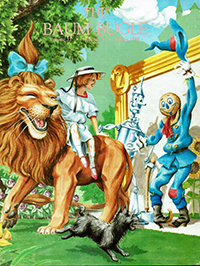
Originally published in The Baum Bugle, vol. 33, no. 1 (Spring 1989), pgs. 10–13
Citations
Chicago 17th ed.:
Teller, Stephen J. “The Other Oz: Oz Apocrypha Beyond The Forty Books.” Baum Bugle 33, no. 1 (1989): 10–13.
MLA 9th ed.:
Teller, Stephen J. “The Other Oz: Oz Apocrypha Beyond The Forty Books.” The Baum Bugle, vol. 33, no. 1, 1989, pp. 10–13.
(Note: Typographical errors have been left in place to accurately reflect the printed version. However, please be aware that the mailing addresses provided by the author are no longer relevant.)
There comes a time when every Oz fan realizes that the canon has been exhausted. At this point one of the alternatives open to the enthusiast is to write new books based on the characters and the events of the originals, sometimes called pastiches, especially when they imitate the style of the originals. Another alternative is to collect such books. However, unlike the Sherlock Holmes stories, the Oz books are not noted for a distinctive style, but for their imaginative characterization and plotting. It is therefore reasonable to refer to these new Oz stories as apocrypha (singular apocryphon) rather than pastiches. The following article will be in two parts: the first will provide methods of classification of the apocrypha, and the second will describe unpublished apocryphal books in by collection.
Before attempting a study of the Oz apocrypha it is necessary to define the canon; this is a matter of much disagreement. To some Ozophiles (such as Jack Snow) only the fourteen books by L. Frank Baum deserve to be considered canonical. Some would go further; James Thurber thought only the first two books worthy of consideration. However, most Oz Club members would take a wider view and include all the Oz books published and kept in print by the Reilly & Britton Co. or its successor, the Reilly & Lee Co. These are the forty books given Roman numerals in Bibliographia Oziana.
Using this as a basis, I have devised a fourfold division of all Oz books:
- The Canon, the forty books.
- Deutreo-Canonical works, those additional Oz books and stories written by authors of the canonical books. This would include the “Queer Visitors” stories, the “Little Wizard” stories, Yankee in Oz, The Enchanted Island of Oz and The Forbidden Fountain of Oz as well as the fragmentary Oz story by Baum, “An Oz Book” (The Baum Bugle, Christmas 1965): Ruth Plumly Thompson’s “The Enchanted Tree of Oz” (The Baum Bugle, Christmas 1969) and Jack Snow’s “A Murder in Oz” (The Baum Bugle, 1958-1960). John R. Neill’s “Runaway in Oz” and Rachel Cosgrove’s “Percy in Oz”, both unpublished.
- Apocrypha (orthodox), Oz stories written by others that do not contradict in significant ways the canonical books. Most of the works in this study fall in this category.
- Heretical Apocrypha, original stories that contradict the The best known works in this category are the novels of Russian author Alexander Volkov and Philip Jose Farmer’s A Barnstormer in Oz. The nightmare vision of Doc Phoenix: The Oz Encounter must also be considered heretical.
The apocrypha can be alternately divided into published and unpublished works, the latter only known in private circulation. Another division is into “major” and “minor” apocrypha. Minor apocrypha are short stories, many of which appear in Oziana. This article is devoted to the major apocrypha, works long enough to be issued as books.
One of the chief motivations of many apocryphists is the desire to reconcile apparent discrepancies found in canonical works, to clear up mysteries. How can the wise and good Wizard of the later books have given the infant Ozma to the wicked Mombi? Hugh Poindexter’s Oz and the Three Witches provides an answer. Why is the Munchkin Country sometimes in the East and sometimes in the West? Read March Laumer’s The Magic Mirror of Oz and find an explanation.
A closely related motivation of apocryphists is to fill in the gaps left by the stores. “Onyx Madden” (Jim Nitch) wrote The Mysterious Chronicles of Oz to tell what Ozma did between The Land of Oz and Ozma of Oz. Jack Snow’s “A Murder in Oz” and Melody Grandy’s The Seven Blue Mountains of Oz give two different explanations of what happened to Tip after Ozma was disenchanted. Henry Blossom’s The Blue Emperor of Oz examines what happened to Ozma’s grandfather, Ozroar; while Ray Powell’s Mister Flint in Oz restores Ozma’s mother, Ozette. Eric Shanower’s The Enchanted Apples of Oz introduces the barely mentioned (but symmetrically necessary) Wicked Witch of the South.
Some Oz writers wish to combine favorite characters from the non-Oz books into Oz, although this could render the book unpublishable. Ray Powell was so fond of Johnny Gruelle’s stories that he wrote The Raggedys in Oz even though he knew only a few would read it. Richard Smyers brought Peter Pan, Merlin and Captain Nemo into An Ozian Odyssey, and the title of his Muppets in Oz is self-explanatory. W. Randy Hoffman’s work-in-progress, The Fairylands of the Sea will combine Milo from Norman Juster’s The Phantom Tollbooth with Oz characters. Several of March Laumer’s books bring Volkov characters into Baum’s Oz, and Don Levenson’s unfinished Cinderella in Oz was intended to bring characters from traditional fairy tales to Oz.
Similarly, some writers introduce real people, often friends and relations, into Oz, Ruth Waara uses her grandchildren as characters in her four books. The title character of Acinad Goes to the Emerald City of Oz takes his name from Danica (Libutti), one of the writers, spelled backwards.
More common is the desire of apocryphists to write more about characters they feel have been unjustly neglected. The titles of Chris Dulabone’s Toto in Oz, Harry Mongold’s Button Bright of Oz and The Sawhorse of Oz, and Rufus K. Lionel’s The Braided Man of Oz are examples. (March Laumer’s The Frogman of Oz is ambiguous as there is more than one type of frog man in the book. Henry Blossom’s Blue Emperor brings back the Gump and Jam. Phyllis Ann Karr’s Maybe the Miffin tells the later adventures of Snif the Iffin, and her The Gardener’s Boy of Oz reprises Pon, but he is no more prepossessing than he was in The Scarecrow of Oz. Ruggedo, the former Nome King, is a major character in The Raggedys in Oz and Greg Hunter’s The Enchanted Gnome [sic] of Oz
Finally, special interests or expertise of apocryphists often play important parts in their works. Richard Smyer’s interest in naval history is reflected in An Ozian Odyssey; Chris Dulabone partly wrote A Viking in Oz to provide material in Scandinavian history and culture; and Dick Martin’s inside knowledge of the publishing industry adds to the authentic feel of The Ozmapolitan of Oz.
* * *
Description of Selected Unpublished Oz Apocrypha:
Published Oz apocryphons have been and will be reviewed in The Baum Bugle, but descriptions of some of the unpublished Oz books may be of interest, since these are not generally available. Oz enthusiasts who wish to see the manuscripts can sometimes get copies from their authors. Oz manuscripts by March Laumer are available from Peter B. Clarke, Arcus Company, 1665 Greenleaf Avenue, Des Plaines, Illinois 60018-3832.
Probably the earlies unpublished apocrypha in my possession is Don Levenson’s Cinderella in Oz. In 1949, the fifteen year old Levenson planned and wrote the beginning of a book in which Dorothy and the Scarecrow would make a journey to Fairyland, The portal to which was the Imagi Nation (near The Illumi Nation) in the Gillikin Country. The journey takes them to the Soup Sea (from Kabumpo in Oz), a very Thompsonesque Town of Nuts, and finally the almost surreal Imagi Nation, where they meet Dade Reams. Unfortunately the manuscript breaks off in mid-sentence before they can get to Fairyland. Perhaps someday Mr. Levenson will finish the story.
The earliest completed Oz manuscript I have is Ray Powell’s The Raggedys in Oz, inspired in part by Powell’s love for the Raggedy Ann and Raggedy Andy stories. The Oz portion of the story begins when Percy the Rat (a character Powell disliked) disenchants the cactus that was Ruggedo, and another cactus that becomes the totally evil Black Magician (whose secret name is Cell-U-Loid), who immediately destroys Percy. The Black Magician uses his evil powers to conquer Oz and other magical lands with Ruggedo as his henchman. Meanwhile, the Raggedys, who had been blown to Oz, meet the Scarecrow, the Woozy, and Mr. Hardas Flint (Powell’s most memorable character), a good-hearted man of rock. In their quest to defeat the Black Magician and restore Oz, they are joined by Ak, the Master Woodsman of the World (from The Life and Adventures of Santa Claus), the Black Magician’s old nemesis. All the characters meet in the Nome King’s domains, where the evil magician would have conquered everyone had not the quick-thinking Raggedy Andy, learning the magician’s secret name, found a way to destroy him. At the end of the story, Ak, surprisingly, reinstates Ruggedo as King of the Nomes.
Without doubt, the most active of Oz apocryphist is March Laumer, who has already written nine Oz books, only two of which have been printed. The first of these, The Green Dolphin of Oz, only becomes an Oz book on page 141 (of 175 pages) when it incorporates Baum’s fragmentary Oz story “An Oz Book.” The book contains allusions to works as diverse as Gone with the Wind and Clarissa; indeed esoteric literary and historic allusions are a characteristic of Laumer’s work.
Laumer’s next two books make a curious pair: Aunt Em and Uncle Henry in Oz and Uncle Henry and Aunt Em in Oz. Written somewhat concurrently, they are not so much complementary works as the same basic story seen through distorting mirrors. In both books Aunt Em feels compelled to return to Dorothy’s old house to recover a long-lost keepsake. In both cases Aunt Em becomes infected by the spirit of the Wicked Witch of the East (who had been crushed by the house) so that she becomes the Wicked Witch until the end of the books. But here the resemblance ends. Aunt Em is a rather heretical book, closer to Volkov than Baum. Uncle Henry’s last name is Mankato, the Wicked Witch is named Gingemma (Ging-Emma!) and Oorfene Deuce is a major character. The story clearly suggests that Nick Chopper was a total klutz. The book is set 81 years after the cyclone. Uncle Henry is more orthodox (however none of Laumer’s books are completely orthodox). Uncle Henry’s name is Gale, and there are no Volkov references. At the end of the book (set in 1911), Dorothy manages to restore Aunt Em by destroying the Wicked Witch within her, but accidentally destroys the Good Witch of the North in the process.
Laumer’s next book, The Good Witch of Oz, is paradoxically a sequel to both of the preceding books (Laumer, who cross-references his books with footnotes has footnotes to both (though not in chronological order). This is the complete life story of the good Witch of the North/Tattypoo/Orin/Diane, Countess of Gillequin (Laumer’s addition to her multiple identities). Typically for Laumer, there is a strong revisionist quality to this book: Queen Orin gets a divorce from King Cheeriobed, who is presented as a gormless duffer, and later marries Robert, Count of Gillequin. (Adult romance is another Laumer characteristic.) A secondary plot concerns Elma the Big Wig (from The Hungry Tiger of Oz), who sometimes thinks she is Cheeriobed’s father.
In Laumer’s The Magic Mirror of Oz, Till Orangespiegel sends a mirror into space that reverses right and left and thus puts the Winkie country in the East of Oz. This was part of an unsuccessful scheme to turn the entire land of Oz orange; however one slice of land, between the Winkie and Quadling Countries, did become permanently orange. The Royal Historian comes to Oz in this book. The Frogman of Oz (The Oz book for 1947) concerns the experiences of Fritz DesPlessis d’Arc, a navy frogman with a surprising secret identity; Fred Fruakx, the Frogman from The Lost Princess of Oz; and Quelala, Gaylette’s husband, who spends most of the book as a frog. The book also contains the Abominable No-Man, “the most terrible thing in the world.”
The Ten Woodman of Oz (The Oz Book for 1999) is the longest and most topical of Laumer’s books. In the future Oz is endangered by pollution from the outer world, and the Tin Woodman is infected by EYDS (Electroplated Yeoman’s Disease of the Skin). Dorothy, is now married and a mother, is sent as a messenger to the outer world looking like Judy Garland in the 1939 film. However she is treated as a mere publicity gimmick, and a delegation of ten woodmen assisted by Kaggi-Karr the crow (from Volkov’s books) is sent to try and rescue her. At the end, Ozma, in a spirit of soft-hearted generosity, decides to open Oz to unlimited immigration—with disastrous consequences.
Laumer’s The Careless Kangaroo of Oz has the most complex plot of any Oz book. After the opening chapter (taken verbatim from The Emerald City of Oz, Chapter 12), it develops seven intertwined plot threads: Mar the Kangaroo is seeking her mittens; the Shaggy Man, in love with Dorothy, wants to return to America to recover Eureka the kitten; Polychrome, in love with the Shaggy Man, wants to get an education so she will be worthy of him; Eureka wants to find a way back to Oz and Dorothy; H. M. Wogglebug T. E. becomes lost in the invisibility surrounding Oz; Almira Gulch (from the 1939 movie) wants to learn how to be a witch; finally, Ozma tries to keep everything in order. Into this melange sails Sky Island helping to bring about a satisfactory ending.
Laumer’s latest Oz book is Charmed Gardens of Oz, a book partly written in the second person so that the reader is the protagonist of the book. The book takes part of its inspiration from the “Garden of Meats” chapter deleted from The Patchwork Girl of Oz, (see The Baum Bugle, Christmas 1966).
The four Oz books by Ruth Waara are considerably more orthodox. The first of them, Umbrella Island in Oz, was begun when Waara was fifteen but completed for her grandchildren. The story is a sequel to Speedy in Oz and begins when a carnival bunco man named Ivan Mountebank, fleeing the police, climbs the dangling rope ladder from Umbrella Island. Using magic stolen from Waddy, Ivan convinces Sizeroo that he (Ivan) is King of the United States and a good husband for Gureeda. Allen John Konkel and his sister Lynn (Ms. Waara’s grandchildren), also climb the ladder but fail to convince the Umbrella Islanders that Ivan is a fraud. Only some magic popcorn enables them to stop Ivan’s plans to conquer Oz.
The Magic Cryptogram of Oz, the second (and probably best) of Waara’s Oz books, is the story of Giles, son of Belfaygor and Shirley Sunshine (from Jack Pumpkinhead of Oz). When Ivan becomes the leader of a band of evil white Chessmen, they conquer Belfaygor and threaten Oz. Johnny and Lynn (transported back to Oz by a wishbone) meet up with Giles who has found a paper that tells in eight steps how the white chessmen may be defeated—unfortunately it is written in cryptographic code. Like Randy in The Purple Prince of Oz, Giles accomplishes the tasks without knowing what they are, while the characters (and the readers) try to break the code.
Ms. Waara’s two other books concern an animal circus owner, Whiplash. In Kidnapped in Oz he abducts the Cowardly Lion, the Hungry Tiger, the Woozy and other of the most famous animals in Oz as well as Tara and Charmin, pets of Megin, Eric, Robbie and Randy (other of Waara’s grandchildren). The children try to rescue their pets with the aid of Barney Backhoe, a talking road machine, while Ozma and her friends try to rescue their animal friends. Whiplash is finally defeated and banished to a desert island, but in Barney Backhoe in Oz he tries to get revenge on the children. Barney, now a television star, comes to the aid of his friends, and their adventures take them through Safety Land, Chute and Ladder Land and Rootland before they reach Oz proper. A second plot concerns the results of the Wogglebug’s attempt, when left in temporary control of Oz to enforce absolutely the law against practicing magic.
Richard Paul Smyers has often said that inside every Oz fan is an Oz book waiting to be written: with An Ozian Odyssey he has released his. The odyssey begins when the Crescent Moon, with Captain Salt, Dorothy and Toto, Trot and Cap’n Bill, Jellia Jamb, Ato, Tandy, and Roger aboard, hits a mine and is transported (through a dimensional warp?) into a different universe, where it sinks. As the travelers are no longer in the Oz world or the “real” world, they know no way to return to Oz. They strike out in the long boat and eventually reach an island inhabited by storybook Indians (who mistake them for pirates) and by Peter Pan, Wendy and the Lost Boys. They have been transported to Neverland. It turns out that Merlin and Captain Nemo are also there. Meanwhile neither Ozma’s Magic Picture nor Glinda’s Great Book of Records can give any clue to the location of the missing ones, so the Wizard summons all the major magic workers in the area to help in the search. The Red Jinn, Waddy, Gloma, and later Aquareine and the Big Lavender Bear (with the Little Pink Bear) come to assist. A search-screen that can scan other universes is built, and the magic workers examine worlds where their friends might be. (One of the pleasures of this book is to try and identify the worlds viewed in the search-screen—Volkov’s Oz, Middle Earth, Star Wars and many others.) Finally Merlin’s magic is able to bridge the worlds.
The newest and longest (460 single-spaced pages) complete apocryphon in my collection is Melody Grandy’s The Seven Blue Mountains of Oz. Book I, “Tippetarius” covers a period of 77 years. The central character, first seen as Princess Amalea of Lostland, suddenly finds herself transformed into a boy. (In time the reader comes to realize that this is Ozma’s alter-ego whose form had been switched in infancy by Mombi and who reverted to his proper form when Ozma was disenchanted.) Calling himself Dinny (his real name, unknown to him, is Tippetarius), he finds the secret garden of Zim, quite possibly the most powerful magic worker in Oz. Zim, who has a large number of disguises and who only uses his magic for good, takes on Dinny as an apprentice (gardener—not sorcerer). Over the next three-quarters of a century Dinn and Zim have a variety of adventures with the Withy Girl, Lorna the Wood Nymph, Wunchie the Witch, Himself the Elf, the Mangaboos and other underground dwellers (forty years after Dorothy and the Wizard in Oz), and Aquareine, among others.
In Book II, “The Flying Sorcerer of Oz,” a North Carolina girl named Aleda comes to Oz by hang glider; Ozma is kidnapped by the nine princes of Lostland seeking their lost sibling (who looked just like Ozma the last time they saw her—eighty years before), Ozma comes face-to-face with Tippetarius, and Zim undergoes a series of tests to determine if he should be permitted to practice magic—culminating in a magic contest with Glinda. We also finally learn the truth about Zim’s origins.
The opening chapters of W. Randy Hoffman’s The Fairylands of the Sea might be entitled “the ones they left behind them.” In 1910, after Dorothy, Uncle Henry and Aunt Em have gone to Oz, the Hugsons, including Zeb and Jim the cabhorse, come to Kansas to see about the Gale property. Then they all disappear. In 1915, Mr. and Mrs. Griffiths, after receiving a message from their daughter Trot, are taken on a wild ride by a magician which ends disastrously. In the same year Button Bright’s relatives in Philadelphia are spirited away by “an Arabian Knight.” In chapter 7 Ozma tries to bring the families of Dorothy, Trot, and Button Bright to Oz without success, and entries in Glinda’s Book of Records cryptically suggest they no longer exist.
At this point my manuscript of Mr. Hoffman’s book breaks off with the date 1962—the year after Juster’s The Phantom Tollbooth. I hope in the near future I will be able to read the rest of this book, and many other examples of the great Oz Apocrypha.
Author’s note: This article is partly in preparation of an extended annotated check-list of Oz apocrypha to be published next year. Therefore I would like to acquire as many such Oz books as I can. If you are the author or possessor of an unpublished Oz book, please contact me: Stephen J. Teller, English Department, Pittsburg State University, Pittsburg, Kansas 66762. I will be happy to pay the reproduction and shipping costs of such books.
Authors of articles from The Baum Bugle that are reprinted on the Oz Club’s website retain all rights. All other website contents Copyright © 2025 The International Wizard of Oz Club, Inc. All Rights Reserved.