THE RAINBOW’S SON
by Patty Tobias
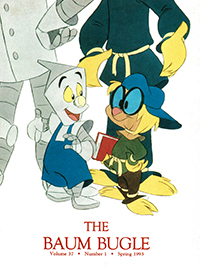
Originally published in The Baum Bugle, vol. 37, no. 1 (Spring 1993), pgs. 8–9
Citations
Chicago 17th ed.:
Tobias, Patty. “The Rainbow’s Son.” Baum Bugle 37, no. 1 (1993): 8–9.
MLA 9th ed.:
Tobias, Patty. “The Rainbow’s Son.” The Baum Bugle, vol. 37, no. 1, 1993, pp. 8–9.
(Note: In print, this article was supplemented with illustrations that have not been reproduced here. However, typographical errors have been left in place to accurately reflect the printed version.)
Wherever you saw Rob Roy MacVeigh, you also saw paper and pens and watercolors. Whether he was at dinner, attending a convention event or even riding in a car, Rob was constantly drawing and painting, bringing to life the Oz characters in his own fanciful way. Rob’s drawings were an extension of him, and he often used them to express his emotions when words just wouldn’t do. Once, when an Oz friend was feeling particularly blue, Rob spent the entire two-and-a-half hour car ride from Monterey to San Francisco quietly sketching a dozen pictures to give to the friend in the hopes of cheering him up.
No one in the Oz Club has ever been more deserving of the L. Frank Baum Memorial Award than Rob. Not only did he spend virtually his entire professional life working on one project—his Oz movie—, he also gave countless hours of his time and extraordinary talent to making Oz conventions grand, whether performing, planning, giving talks, or exhibiting his artwork. When he won the Baum Award last year in Chicago, Rob, although already quite ill, gave a spontaneous and charming speech in his own modest and informal manner, bringing the audience to its feet. “Real unexpected,” he said, “I want to thank you very much. It’s all been real fun.” And then he went on: “One of the best things we can do is to live through the courtesies and the kindnesses that the Oz books and all the Oz stories have to teach us.”
When he was first diagnosed with AIDS, Rob told several people that when the time came, he would like to be remembered with laughter and song and that he wouldn’t mind too much if a few tears were shed—but only a few. Certainly tears have been shed over the loss of this unique friend of the Oz Club (probably more than Rob would have liked), but it’s impossible to remember him without the gentle laughter and song he generated wherever he went.
An elfin, whimsical, generous spirit inhabited Rob; he truly epitomized Baum’s magical vision. Chris Sterling had a special memory of Rob that typified Rob’s essence: “He had come out to perform in the Radio Show at the Munchkin Convention,” Chris recalls. “We had made decorations that were giant cutouts—enlargements of Rob’s Oz Cut-Out Book. The Scarecrow was eight feet tall, including his hat. Rob rode down with me in the van, loaded with all these cutouts. On the way down to Delaware, we got very lost and wound up driving through dozens of corn fields. Rob kept asking where the Yellow Brick Road was. Finally, he suggested that we take the Scarecrow out and put him in one of the corn fields and wait until someone came by so they could see us asking the Scarecrow for directions.”
Winkies often saw Rob out on the Pacific beach at Asilomar in his black wetsuit, frolicking in the waves. Late night partygoers will not forget Rob’s witty and slightly wicked imitations of Ray Bolger talking about The Wizard of Oz. When he wasn’t sketching, he was likely to burst into spontaneous clog dancing or song. In addition to his Oz collection, Rob loved old musicals and could quote the lyrics to some of the most obscure Oz and Hollywood songs. It was Rob who discovered that if you sang “There’s No Place Like Home” as a counterpoint to “Over the Rainbow”, the effect was chilling and moving and somehow right.
Even when sending a simple note to a friend, Rob couldn’t help adding a pep talk at the end. “Be good,” it would say. “Follow your heart’s desire. The usual. You know.”
Of course, Rob’s one big dream was to make a complete and accurate animated movie of L. Frank Baum’s The Wonderful Wizard of Oz. He spent his entire adult professional life on this project, completed all the storyboards and brief portions of the actual film before he died. In his own way, Rob recorded his dream for all of us, in an engaging and now poignant story he wrote for the 1989 Oziana. Written under the pseudonym Leroy Fleming (after Mervyn Leroy and Victor Fleming, producer and director of MGM’s The Wizard of Oz), the story is a conversation between Dorothy and Glinda about Oz movies. At one point, Glinda says:
“Remember, nobody in the outside world knew as much about us as Frank [Baum]. And we allowed him access to Oz in order to write out the histories to please and teach the children. This was allowed in hope that our peaceful and positive ways would set good examples for the young people. But as the children in the outside world grow up, they tend to lose that innocence.”
As Dorothy and Glinda converse, they talk about why none of the films about Oz has ever shown the real Oz. To protect the land of Oz, Rob postulated, Glinda used her magic:
“I cast another spell over our domain. From that moment on, no moviemaker would ever be able to photograph a movie about us that was completely, or even very accurate. Something in the process would get fuddled, whether the costumes or characters or plots—especially the plots . . . Anyone trying to film what goes on here winds up with peculiar results. That’s why none of the Oz movies have been true to our way of life here . . .”
In her own optimistic way, Dorothy disagrees with Glinda’s decision to fuddle Oz movies:
“Maybe if you released the spell, undid the scrambler on Oz, I mean so that a really accurate and true movie was made about us, a very big movie, and one that was important . . . millions of people all over the world could see how well we get along here by sharing, and behaving ourselves. And then maybe . . . maybe they wouldn’t have . . . any more wars.”
In the end, Glinda sees the wisdom in the little Kansas girl’s words and reverses her spell. Rob’s lifelong dream was to make that movie, the real Oz movie. He hinted at it in his cover illustration showing the Wizard with reels of film—the movies that have been made so far about Oz. But the last can of film, only partially shown in the lower right corner of the illustration, gave away his true desire. It says, “Rob Roy’s ‘Th . . .”
Rob’s hope, at the end, was that someone else would pick up the torch, take his storyboards and sketches and musical score and finish his movie for him. Perhaps that last fond wish was why a certain song was Rob’s favorite—it includes these hopeful lines:
“Somewhere over the rainbow, skies are blue. And the dreams that you dare to dream really do come true . . .”
Authors of articles from The Baum Bugle that are reprinted on the Oz Club’s website retain all rights. All other website contents Copyright © 2025 The International Wizard of Oz Club, Inc. All Rights Reserved.