THE ROADS OF OZ
by Barbara S. Koelle
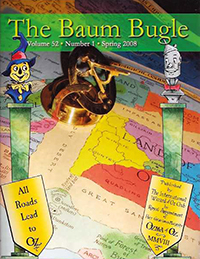
Originally published in The Baum Bugle, vol. 52, no. 1 (Spring 2008), pgs. 7–11
Citations
Chicago 17th ed.:
Koelle, Barbara S. “The Roads of Oz.” Baum Bugle 52, no. 1 (2008): 7–11.
MLA 9th ed.:
Koelle, Barbara S. “The Roads of Oz.” The Baum Bugle, vol. 52, no. 1, 2008, pp. 7–11.
(Note: In print, this article was supplemented with photographs that have not been reproduced here. However, typographical errors have been left in place to accurately reflect the printed version.)
Many and varied are the ways of getting to and around the Land of Oz. Whether by cyclone, earthquake, or whirlpool, by jinrikisha, balloon, or pirate ship, via rainbow, magic pills, or winged creatures, the possibilities are limited solely by the imaginings of its creators. Yet the most obvious and pedestrian mode of transport— the humble road—also has its uses in the many stories of Oz.
“Roads,” as the shaggy man tells Dorothy in the book of that title, “don’t go anywhere. They stay in one place, so folks can walk on them.”[1] This is generally true of L. Frank Baum’s highways and byways, but in The Patchwork Girl of Oz (1913), he flouts his own character’s description. Ojo, Scraps the Patchwork Girl, the Shaggy Man, the Woozy, and the Glass Cat encounter a very tricky road with the bad habit of sliding backward, and in order to progress they have to turn around and walk backward themselves.[2]
The roads of Ruth Plumly Thompson’s Oz books are highly unpredictable. They roll up and unroll, turn into rivers, drop off into space, run away wildly, kidnap their passengers, and have minds of their own. The frenetic activity of these magical avenues contrasts with the calmer roads of Baum, which meander and wander gently through the countryside, eliciting philosophical comments from those who venture on them. Consider this picture of the road of yellow brick:[3]
It was a broad road, but not straight, for it wandered over hill and dale and picked out the easiest places to go. All its length and breadth was paved with smooth bricks of a bright yellow color, so it was smooth and level except in a few places where the bricks had crumbled or been removed, leaving holes that might cause the unwary to stumble. (Patchwork Girl, 115)
Although the above description seems to imply that there is only one such road, later in Patchwork Girl the Shaggy Man declares “[t]here are two roads of yellow bricks through the Munchkin country, but the one we followed is the best of the two. Dorothy once traveled the other way, and met with more dangers than we did” (163).[4] There is also confusion about where in Oz the roads actually run. The Shaggy Man locates both
in the Munchkin country. However, in The Marvelous Land of Oz (1904), Tip and Jack follow a “road of yellow brick” through the Gillikin Country on their way to the Emerald City.[5] And in The Tin Woodman of Oz (1918), Ozma and Dorothy ride the Red Wagon from the Gillikin Country back to the Emerald City along the now-capitalized “Road of Yellow Bricks.”[6] In addition, in The Gnome King of Oz (1927), Scraps spots a “road of yellow brick” in Winkie territory.[7] And in artist Dick Martin’s “Wonderful World of Oz Panorama” pictorial map, there are four such roads—running through the lands of the Munchkins, Quadlings, Winkies, and Gillikins of Oz![8]
“Please, miss,” says the shaggy man, “can you tell me the road to Butterfield?” (Road, 13). Thus begins The Road to Oz (1909), the story of a lengthy trip through eccentrically populated countries that takes Dorothy from the state of Kansas to the Emerald City of Oz, stymied only temporarily by the sands of the Deadly Desert. It is included in this discussion, though much of the action takes places in Ev or other borderland countries, because its characters eventually arrive in Oz. We are introduced to Dorothy and the shaggy man (about whom we learn little, except that he does not feel loved and cared for). They must choose among five roads, which soon expand to seventeen, supposedly leading to a highway. “[I]f we travel long enough, my dear, we will come to some place or other in the end” (33), he assures Dorothy, who is troubled by the explosion of pathways. And the seventh road they take was a good road, “winding through green meadows and fields covered with daisies and buttercups and past groups of shady trees” (27). This road, though hardly straight, seems reassuring to the travelers who soon pick up the feckless Button-Bright[9] and the lovely Polychrome. They succumb to the lure of adventures, nor is Dorothy too concerned about Aunt Em (“I guess Aunt Em won’t be very much worried; that is, if I don’t stay away too long” [44]). Though they must pass by the dangerous Scoodlers, the road leads them eventually to Ozma’s palace and a warm welcome.
Baum continues this theme in the intriguing character of Woot the Wanderer in The Tin Woodman of Oz. Though committed to no particular avenue of exploration within Oz, the boy is described as a “wanderer by profession” (288), by implication willing to follow any road. He exemplifies wanderlust (“I have come, through many travels and by roundabout ways, from my former home in the Gillikin Country of Oz” [16]) and seems indifferent to risk (though this may be assumed): “Dangers, when they cannot be avoided, are often quite interesting, and I am willing to go wherever you two [the Scarecrow and Tin Woodman] venture to go” (42). At the book’s end, the call of the road still beckons and Woot resumes his wandering ways.
I have to wonder if Woot in his journeys ever encountered Ruth Plumly Thompson’s dizzying array of wayward roads. In her first Oz book, The Royal Book of Oz (1921), Dorothy, Sir Hokus of Pokes, and the Cowardly Lion are directed by the king of Fix City to “[b]uy a piece of road and go where it takes you.”[10] They walk down a street which ends in a precipice over nothing but air, and become reluctant clients of the Road Shop. “Our roads go where they please, and you’ll have to go where they take you” (184), reiterates the Fix proprietor. Dorothy and friends choose five miles of road “with trees at both sides and water at the end” (185). This was not the best choice, as a huge roll engulfs the three and, unwinding at a terrifying speed, dumps them into a lot of water (186).
The Royal Book of Oz also features the first appearance of one of Thompson’s favorite byways—the narrow little Wish Ways. These routes are prone to granting impulsive wishes by those who wander onto them. The first one is located in the Winkie country, and enables Dorothy to wish the whole company to the Scarecrow’s palace in the Silver Islands (223–229). A Wish Way also appears in The Lost King of Oz (1925), described there as a lane of silver wishing sand located at the foot of Maybe Mountain.[11] It propels the unsuspecting Dorothy to Hollywood, California, and, when she discovers its secret, back to Oz along with Humpy, the dummy (140–144).
In one of Thompson’s last books, The Enchanted Island of Oz (1976), Davy and Humpty, the camel, come to a cross road which heaves up and hits Humpty with a mailbox.[12] “Roads here are not very reliable,” remarks Davy in a notable understatement (89). For the travelers come to a Winding Way: “A huge dusty roll rather like a small round mountain” (89), which unrolls into a narrow brown Highway. “All aboard,” it directs in a gruff and guttural voice, and proceeds to shoot up skyward, depositing boy and camel onto a flying island (89–90).
Another road in kidnapping vein is the Runaway Road, found in Grampa in Oz (1924). “Around a big rock shot the runaway itself, scooping up the travelers before they had time to wink a single eyelash.”[13] This road has personality; it talks in a gritty voice, stares with stony eyes and is determined to make pepper diggers of Dorothy and Percy Vere, the Forgetful Poet (121). They escape only by catching hold of the branches of trees as the road “fl[ings] itself recklessly through the forest” (122).
“This way to the river,” announces a sign in The Purple Prince of Oz (1932), and, later on, “River Road”—a sign that turns out to be disastrously literal.[14] When Randy and Kabumpo, the Elegant Elephant, turn into what seems to be a pleasant road on a Gilliken[15] hillside they are under the misapprehension that it will take them somewhere. Alas, the road suddenly becomes an actual river and tosses them over a waterfall before abandoning them in an underground cavern. Almost drowned, thoroughly soaked, and badly battered, they survive to continue their attempt to save the kingdom of Pumperdink.
A similar, though more propitious fate, befalls the Prime Piecer and Chief Scrapper of Patch in The Gnome King of Oz. While following the Royal Spool of Succession up and down crossroads and the Winkie yellow brick road, they come to rest on a short footpath. This footpath—actually a road in disguise—takes off on its hundred feet and dumps its stunned passengers at the gates of the Emerald City. Then, “coiling up like a serpent” (33), it goes to sleep under a lime drop tree, having deposited the two villains just where they wanted to be.
As you may have noticed, Thompson’s roads are highly deceptive. The Hungry Tiger of Oz (1926) features one that starts out as an innocent-looking footpath in the gardens of the Emerald City. Without warning, it reveals itself as a winding road, rips itself loose, and with Betsy Bobbin and the Vegetable Man, Carter Green, as unwilling passengers rushes along “like a top, round and round like a merry-go-round, in and out of trees, past lakes and forests, till the whole world tilted topsy-turvey.”[16] It then stops short and spills them off into a desert-like wilderness, from which there seems to be no exit.
Eloise Jarvis McGraw and Lauren McGraw extend the merry-go-round theme in their Oz book of that title. Here is a running road, paved with little round glass stones, “circling frantically around and around the Sphere at great speed, flashing blindingly in the sun.”[17] This Sphere, made of glass or other transparent stuff, houses the city of Roundabout where everything is round, including the inhabitants. To young Robin, the road looks dangerous, but it reminds Merry, the wooden ex-calliope horse, of her old home. Eventually she enables Robin, Dorothy, and the crowd from the kingdom of Halidom to escape from the Roundhead city by simply bounding along the spinning road, in proper merry-go-round style, until they find an opening and can exit.
It would probably be safe to summarize Thompson’s perverse roads as encouraging a spirit of stoicism, almost resignation, in those Oz travelers unfortunate enough—or, in a few cases, lucky enough—to encounter them. As Carter Green remarks, “They just come and go, these winding roads of Oz, pass themselves off as regular roads till they catch a few travelers and you never can tell where they will take you” (Hungry Tiger, 63). From a practical point of view they advance the plot by enabling their passengers to move quickly from one surprising site of Oz geography to another, thus demanding the reader’s attention.
Baum’s roads, by contrast, behave more like normal highways and byways, though they may lead to some highly unusual places. For those who travel them they evoke feelings of curiosity (they are “much interested in finding out what would happen next” [Road, 91]), a sense of adventure (“[t]here was the road again, leading far away into the unknown country beyond” [Road, 89]), and the appeal of wanderlust (“I believed that in other parts of the country I would find some strange people and see new sights, and so I set out upon my wandering journey”[Tin Woodman, 17]). So, too, they may tap into similar yearnings in the minds of readers. And, inevitably, over the years the shimmering rainbow road, from which Baum summoned the sky fairy Polychrome, has become an icon for all those who seek the Land of Oz.
Notes
[1] In The Road to Oz, the “shaggy man” is generally referred to in lower case letters, unless directly addressed by Dorothy. Baum, Road, 18 (hereafter cited in text). The name of the “Shaggy Man” becomes capitalized in The Emerald City of Oz (1910) and subsequent Oz books.
[2] Baum, The Patchwork Girl of Oz, 148-149 (hereafter cited in text).
[3] In The Wonderful Wizard of Oz, the Good Witch of the North informs Dorothy that “[t]he road to the City of Emeralds is paved with yellow brick” (27). Thereafter, the same volume generally refers to the “the road of yellow brick” (54-115 passim). In Ozma of Oz, the rescue party crosses the desert into the Munchkin Country, where they take a “road of yellow brick” from the palace of the Munchkin king straight to the gates of the Emerald City (256). It is unclear whether this is the same route followed by Dorothy in Wonderful Wizard. In Patchwork Girl, the Wise Donkey advises Ojo to take “the road of yellow bricks” (96) to reach the Emerald City. Ruth Plumly Thompson’s The Royal Book of Oz (1921) appears to be the first Oz book actually to employ the now-familiar designation (albeit in lowercase) “yellow brick road” (15).
[4] Despite this assertion, the earliest known map of Oz (reproduced as the front endpapers to Tik-Tok of Oz [1914]) indicates a single, decidedly straight, “Road of Yellow Brick” (note the resurrection of the singular) leading from the Munchkin Country to the capital.
[5] Baum, The Marvelous Land of Oz, 60.
[6] Baum, The Tin Woodman of Oz, 189 (hereafter cited in text).
[7] Thompson, The Gnome King of Oz, 225 (hereafter cited in text).
[8] In contrast, the explanatory notes accompanying the official maps of Oz prepared by James E. Haff and Dick Martin and published by the Oz Club indicate that there are at least four major highways leading to the Emerald City from various parts of Oz that are composed of yellow brick—two in the Munchkin Country and one each in the Gillikin and Winkie countries.
[9] Baum continued hyphenating the name “Button-Bright” until The Magic of Oz (1919), at which point the boy is referred to as “Button Bright.”
[10] Thompson, The Royal Book of Oz, 182 (hereafter cited in text).
[11] Thompson, The Lost King of Oz, 126-128 (hereafter cited in text).
[12] Thompson, The Enchanted Island of Oz, 84 (hereafter cited in text).
[13] Thompson, Grampa in Oz, 119 (hereafter cited in text).
[14] Thompson, The Purple Prince of Oz, 67, 69.
[15] Thompson uniformly spelled the name of the northern purple region of Oz Gilliken, whereas Baum had spelled it Gillikin.
[16] Thompson, The Hungry Tiger of Oz, 62-63 (hereafter cited in text).
[17] McGraw and Wagner, Merry Go Round in Oz, 167.
Authors of articles from The Baum Bugle that are reprinted on the Oz Club’s website retain all rights. All other website contents Copyright © 2026 The International Wizard of Oz Club, Inc. All Rights Reserved.