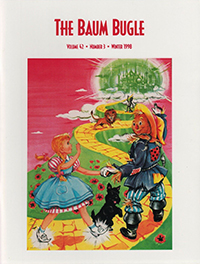
Originally published in The Baum Bugle, vol. 42, no. 3 (Winter 1998), pgs. 16–21, 26–27
Citations
Chicago 17th ed.:
Teller, Stephen J. “The (Samuel) French Connection: The Junior League Plays Plus.” Baum Bugle 42, no. 3 (1998): 16–21, 26–27.
MLA 9th ed.:
Teller, Stephen J. “The (Samuel) French Connection: The Junior League Plays Plus.” The Baum Bugle, vol. 42, no. 3, 1998, pp. 16–21, 26–27.
(Note: In print, this article was supplemented with images that have not been reproduced here. However, typographical errors have been left in place to accurately reflect the printed version.)
The history of the adaptations of L. Frank Baum’s fantasy novels for the stage has not been a happy one for purists. The pattern was set by the 1902 Wizard of Oz, as it was staged in Chicago, New York, and other locations to tremendous success. It bore little similarity to the original book: Toto was replaced by Imogene the cow; half the members of the cast (Cynthia Cynch, the Lady Lunatic, Sir Dashemoff Daily, Pastoria, Trixie Trifle etc.) had no equivalents in The Wonderful Wizard of Oz, and numerous sonds which had no relevance to the plot were interpolated. The success of this extravaganza led Baum to attempt to imitate it in his disastrous The Wogglebug, and the less than triumphant The Tik-Tok Man of Oz which was adapted from Ozma of Oz and was adapted into the book, Tik-Tok of Oz.
In recent times the situation is a little better. Most productions of The Wizard of Oz are based on the adaptation from the film, which already changes the book considerably, with such additional characters as Lord Growlie and Tibia, the Wicked Witch’s skeleton aide. There have also been adaptations of the books that have major changes such as Suzan Zeder’s Ozma of Oz: A Tale of Time, in which “Tic Toc” is a time machine and Uncle Henry accompanies Dorothy on her adventures in a wheelchair. Some Oz plays abandon Baum’s books entirely, for example The Wizard of Oz in the Wild West, by Willard Simms, A Recall to Oz by Michelle Van Loon, and The Scatterbrained Scarecrow of Oz by Alfred Bradley.
However, between the adaptations of Baum’s time and those of the present, there were a series of five adaptations of Baum’s works that were remarkably faithful to the original books. Four of these were based on Oz books, and the first three were “Junior League Plays,” adapted “by special arrangement with the owner Mrs. L. Frank Baum.” They were copyrighted between 1928 and 1937, and published by Samuel French, Inc. All five were adapted by women.
The Junior Leagues were founded in 1921 as service organizations for young women, age eighteen and above, that have programs for many groups including children. The back cover (inside and out) of The Patchwork Girl of Oz (1930) lists fourteen Junior League plays, all written by women and most based on children’s literature or fairy tales. It would seem that these plays were written by League members for performance for children.
The first of the Junior League Oz Plays was The Wizard of Oz dramatized by Elizabeth Fuller Goodspeed, copyright 1928. The play is in three acts of two scenes each. Almost all of the dialogue is taken directly from the book. The Kansas action of chapter one of the book is essentially omitted, the play beginning in the Munchkin Country. The opening stage direction contains one of the few additions to the book: “As the lights come on very slowly, three Munchkins are seen on stage doing an eccentric dance.” Other dances are included later in the play. The action of scene one incorporates chapters two and three of the book, the Scarecrow being on stage from the beginning. The Good Witch of the North directs Dorothy to “Oz, the Great Wizard” and then Dorothy frees the Scarecrow. Scene two covers chapters four through six, condensing the action, but omitting little; the Tin Woodman and Lion are added to the petitioners to Oz. Chapters seven, eight and nine are almost completely left out, there being no mentions of kalidahs, rivers, poppy fields or field mice.
The stage set for Act II, scene one shows how Ms. Goodspeed was able to condense chapters ten and eleven into a continuous action: “Room in Palace of Oz. Door right. Large window center back, through which can be seen domes of The Emerald City. Large screen left hides Throne of oz [sic, in the speech prefixes the wizard is always identified as “oz”]. Green lights over all.” Dorothy and Toto, who is apparently acted by a person, enter to the Guardian of the Gates and ask to see the Great Oz. As in the book Oz appears to each of the four petitioners separately and in a different guise. For the appearance to the Lion, the stage direction tells how the scene might be played: “He [Guardian of the Gates] removes screen. Only faint lights return to show ball of fire on throne. This may be an automobile spot light with red paint on glass. . . .” The second scene of Act II takes place in the Castle of the Wicked Witch of the West. Her opening speech replaces much of the action of chapter twelve:
I have torn the Scarecrow to pieces, broken and battered the Tin Woodman and starved the Lion. (Gnashing her teeth.) But in spite of it all they destroyed my bees, and my crows, and my wolves, and they are all lying in heaps and drying up. (Tearing her hair.)
When Dorothy throws the bucket of water on her, the stage directions give full details about how her shrinking is to be managed. She informs Dorothy (and the audience): “All my evil work is undone, now that my power is going. The Scarecrow and the Tin Woodman are their old selves again, and the Lion is sleek and fat, for, now that you have melted me, all my charms have gone.” This eliminates the need for the rescues in chapter thirteen, and although Dorothy takes the Golden Cap no mention is made in this scene of the Winged Monkeys.
Act III, scene one combines chapters fifteen and sixteen of the book, the Wizard giving the Scarecrow, the Tin Woodman and the Lion their rewards in the same scene in which he is discovered. It is the Wizard who directs Dorothy to seek Glinda to return her to Kansas, and no mention is made in this scene of his having come from America or his returning to it in a balloon.
The final scene of the play takes place at Glinda’s palace. Mention is made in this scene to the Hammerheads, and there are a few rather prepared for statements. The Scarecrow declares “. . . When Oz departed in a balloon, he left me ruler of his people, and they like me.” The Tin Woodman will be ruler of the Winkies, and the Lion will be ruler of the beast in the great forest. Glinda will use the power of the Golden Cap over the Winged Monkeys (now mentioned for the first time) to send each of them to his realm, and tells Dorothy that the Silver Shoes will take her home. The final stage direction is (“Lights out—curtain descends on darkness. Dorothy’s voice is heard calling.) Oh Aunt Em!” A note reads “If possible to have Dorothy pulled off stage on a wire this should be done.”
As this summary shows there is almost nothing added to the plot of Baum’s book, although much has been omitted.
The same is true of Ms Goodspeed’s second adaptation, The Land of Oz, which also bears a 1928 copyright. This play, unlike Wizard, is preceded by a DESCRIPTION OF CHARACTERS, based on “the 1904 illustrated edition of ‘The Marvelous Land of Oz’ . . . “ Indeed the descriptions are usually quoted from the book. In some cases they have citations to the illustrations in the text. Although this would be of some use to the costume designer, it does not tell how such characters as Jack Pumpkinhead, the Sawhorse, and the Gump are actually to be realized on stage. The only characters not from Baum’s Land are “Winged Monkeys.”
Like Goodspeed’s Wizard the play is in three Acts. The first scene of Act I takes place in Mombi’s Kitchen and covers the first three chapters of the book. It begins theatrically with a song and dance by Mombi which is not in the book.
Krickety—krickety—krickety—krack—
Ziggety—ziggety—ziggety—zack.
(1)
I am an old witch,
And I live in a hovel
And my object in life is
To make lots of trouble.
(2)
I stir up the dogs
To fight with the cats,
(Makes hissing sound, like cat-and-dog fight.)
And I frighten small children
With armies of bats.
(Flaps her hands)
Krickety—krickety—krickety—krack—
Ziggety—ziggety—ziggety—zack.
(Whistles.)
The action of scene 1 follows the book with changes for theatrical convenience. Tip hides Jack Pumpkinhead in a cupboard rather than on the road. This enables the dummy to be replaced by an actor. The scene ends with the escape of Tip and Jack from Mombi’s house.
Scene 2 takes place on the road and includes bringing the Sawhorse to life and its running off with Jack (right away, there is no river scene) and Tip’s meeting with General Jinjur and her army of revolt. Act I ends with a dance:
JINJUR
Ready about!
Powder your noses for our attack!
Fall in—in drill order! (She puts them through a dance drill after which, amidst much cheering, the curtain falls.)
Act II is in three scenes. The first takes place in the throne room of the palace of the Emerald City. It covers Jack’s arrival, the conquest of the Emerald City by Jinjur’s Army and the escape of the Scarecrow, Tip and Jack from the city, ending with Jinjur declaring: “The Throne is Mine!” The second scene is at the Tin Woodman’s castle, the action on the road being omitted. The Tin Woodman is discovered sleeping, something he does not do in the books, but from the arrival of the Scarecrow and company the dialogue follows the book closely, with condensation. However, at the end of the scene we have this stage direction:
(TIN WOODMAN puts them through an eccentric dance drill to music—each one doing a different thing and not minding the orders of the TIN WOODMAN. At the end while the TIN WOODMAN is giving orders facing the audience—the others behind his back march off stage. TIN WOODMAN turns and suddenly finds them gone. He calls.) My Army! Where is my Army! (He rushes about looking under tables, chairs and in the bed and turns to the audience.) Have you seen my army! (Seeing them off left he rushes after them waving good-bye to audience.)
This bit of stage business would probably be very funny to a children’s audience and allows audience participation.
The final scene of Act II is once more on the road. It opens with a dance of sunflowers. The Scarecrow and company enter and encounter the sunflowers which they escape by shutting their eyes.
(All walk up stage, groping—lights go out and on—sunflowers are gone—green light off right to indicate Emerald City.)
They then meet H. M. Woggle Bug T. E. with dialogue taken directly from the book but are captured by Jinjur’s Army in action (not in the book). There is no scene with the field mice.
Act III covers the last ten chapters of the book in only two scenes. Scene 1 is complicated: first the Scarecrow, Tin Woodman, Woggle Bug, Sawhorse, Tip, and Jack are brought before Jinjur. A mouse runs across stage “pulled with an invisible string.” Jinjur and her Army flee, leaving the Scarecrow et al to construct the Gump. The stage direction states:
The lights go out—a cloud machine spotlight flickers on back drop behind the GUMP giving an illusion of the sky passing by. The palm leaves or wings flap; a wind machine starts off stage the group sways back and forth in the GUMP.
Dr. Nikadik’s wishing pills are discovered (there is no Jackdaws’ nest) and the Woggle Bug counts seventeen by twos, wishing, “I wish the Gump to carry us safely to Glinda’s palace.”
The final scene takes place in Glinda’s throne room. Before the main action begins Glinda watches as “Two little winged monkeys are doing an eccentric dance.” The Scarecrow and crew arrive and ask Glinda’s help in restoring the Scarecrow to the throne of the Emerald City. As in the book Glinda informs them of the real history of the ruler of Oz. Glinda’s expedition to the Emerald city is eliminated, instead she sends the Monkeys to bring Mombi, the witch. Glinda interrogates Mombi, in language directly from the book, using her magic pearl. Reluctantly Mombi reveals the truth and Glinda coerces her to transform Tip into Ozma. The stage directions are explicit in how the transformation is to be done using a three yard square of soft black material:
The characters all crowd around TIP so that the audience cannot see him. Then Ozma, who is dressed and ready with another black cloth completely covering her, slips out from back stage and changes places with TIP.
Mombi removes the cloth revealing Ozma and the play quickly ends. There is no appearance of Jinjur in the final scene, which is a marvel of condensation.
It is clear that Goodspeed kept closely to the spirit and text of Baum’s books. Her most important additions were songs and dances, particularly eccentric dances. Many incidents in both books were eliminated, but nothing that changed the plots was added, except for having the Monkeys fetch Mombi.
The third of the Junior League Plays came two years later. This was The Patchwork Girl of Oz dramatized by Mrs. James Waller Marshall. Like Goodspeed, she closely followed the plot of the book; she also shared Goodspeed’s fondness for eccentric dancing.
The play of Patchwork Girl is in two acts of four scenes each. The play is noteworthy not only by what it leaves out of the book but also what it retains. It is preceded by a bare list of characters with no indication of their appearance. Since the Glass Cat and the Woozy are major characters in the play, it would be useful to know how Mrs. Marshall pictured them upon the stage. There is one jarring note in the list: “UNKIE NUNKIE.” He is consistently called “Unkie” rather than “Unc Nunkie.”
Act I begins in the crooked magician’s house. The incidents of Chapter 2 to 5 are covered in scene 1 with the omission of the Victor Columbia Edison, the phonograph. There is some condensation, but most of the dialogue is taken directly from the book. Scraps’ three poems are retained, although the last four lines of “Here’s a job for a boy of brains” are omitted. At the end Ojo, Scraps and the Glass Cat depart to find the charm that will free Unkie Nunkie and Margolotte from the Liquid of Petrifaction.
Scene 2 is on the road. It contains the scene with the Foolish Owl and the Wise Donkey almost complete, although it takes place outside their house rather than inside. This is one of the inclusions I find surprising, because this scene does not advance the action of the play. Without changing sets we have the finding of the Woozy scene and even the Woozy burning down the fence with fire from his eyes brought on by the repetition of “Krizzle-kroo.” A stage direction tells how this is to be done:
This is done by a clever catch and hinges on the lower fence boards on the Woozy’s side of the fence. He releases the catch, and the boards fall apart. Electric lights in his eyes, connected with a small storage battery in his head and manipulated by a small switch in his hand give the illusion of fire.
As they depart “they do a dance from right to left before the curtain.” This covers the transition to scene 3.
Scene 3 is at the “Place of Bending Trees.” Only Ojo is engulfed by the leaves but is rescued by the whistling Shaggy Man. After they explain the situation to Shaggy and he tells that picking a six-leaved clover is against the law, he declaims the first five quatrains of “I’ll sing a song of Ozland” “to the accompaniment of complementary magic lantern slides which are thrown on the curtain between the scenes.” Once again the transition of scenes is covered.
The final scene of Act I is still on the road. The characters (except the Shaggy Man) enter with their eyes closed. After they have passed through the optical illusion the Scarecrow enters singing accompanied by the Sawhorse. At meeting the scarecrow and Scraps “do a short eccentric dance.” Their dialogue comes directly from the book. After the Scarecrow’s departure, Ojo picks a six-leaved clover. Almost immediately a tall Green Soldier appears with a warrant to arrest Ojo the Unlucky. During the lamentations over his arrest and departure, the Act ends.
Act II begins with an elaborate stage direction for the entrance of Ozma’s court, including a NOTE FOR MUSIC. Dorothy, the Wizard, all the major characters from Act I and Ozma appear and Ojo’s trial takes place very much as in the book. While Oho is whispering his story to Ozma “SCRAPS and the SCARECROW do an eccentric dance down front stage.” Ozma gives the Wizard permission to send the party, now including Dorothy and the Scarecrow, on its way by magic. The Wizard’s final speech, with stage directions is worth giving whole:
“Then bring me my magic crystal, for I must see where I am sending them. (The GREEN SOLDIER exits to fetch crystal.) Guardians, this is a serious business, so arrest anyone who smiles. (SOLDIERS advance to footlights, and shake fingers at audience saying, “Stop smiling! Stop smiling!”) The GREEN SOLDIER now enters with the crystal. He takes it to the WIZARD who is centre stage. The TWO SOLDIERS turn from footlights, and kneel down in front of WIZARD, holding up their heads to hold the crystal, which the GREEN SOLDIER places in them.) Come now into my magic circle. (All group around WIZARD, those in front crouching down.) OZMA rises and stands on edge of dias watching the WIZARD make mysterious passes over the crystal with his hands and mutter a spell. Immediately weird music is heard, now high, now low, but increasing finally to a sound like wind, a tremendous crash. Everyone jumps to their feet, with a wild cry, pointing off right front. Another crash, then darkness.)
Scene 2 begins in Jack Pumpkinhead’s house. Scraps, Ojo, Woozy, Scarecrow, and Dorothy are discovered sprawled on the stage. Jack comes out of the house and the dialogue proceeds much as it did in chapter 19 of the book. The Woozy takes no part in the dialogue of scenes 2 or 3 of the play. There is a blackout, without closing the curtain, to remove Jack’s house and the scene changes to the Tottenhot village. The Tottenhots sing their song and toss the Scarecrow’s dummy double around. Dorothy, Ojo, and company enter a Tottenhot house and scene 2 ends with “Tottenhots advance front stage and do eccentric Tottenhot dance” which covers the transition to scene 3.
It is not altogether clear how the Yoop scene is to be played. The stage setting has a pile of rocks on one side of the stage and a fence surrounded by bushes on the other. An abridged version of the dialogue is presented (the large sign is omitted). In the rocks on the left of the stage Ojo finds a dark well; this eliminated the need for the entire Hopper/ Horner war plot and chapters 21-24. Then the characters race in front of Mr. Yoop’s cave:
SCARECROW goes first. YOOP grabs him while DOROTHY and OJO dash by. YOOP throws SCARECROW after them. The WOOZY and SCRAPS also have gone past.
The Lazy Quadling and the trick river are also omitted, and the final scene of the play takes place at the Tin Woodman’s castle. It follows chapters 27 and 28 of the book closely, except that Ozma, the Wizard, the Green Soldier, the two other soldiers, and the Glass Cat appear in a blackout, and the Crooked Magician and the statues of Margolotte and Unkie Nunkie are brought in. The Wizard straightens the Magician, unpetrifies the statues, and everything is brought to a satisfactory conclusion.
The Patchwork Girl of Oz is the longest of the five plays. (91 pages, compared to 72 pages each for the first two plays, and 52-53 pages for the last two.) It seems surprising that Mrs. Marshall included the Wise Donkey/Foolish Owl scene, and the scenes with Jack Pumpkinhead, the Tottenhots, and the Yoop, which do not advance the plot, but eliminates the Hoppers and Horners which were a major part of the plot. She continues the use of much eccentric dancing and spectacle. Nevertheless she stays close to the original book, and most of the dialogue comes from it.
The last two plays were both written by Mary Isabel Buchanan. Unlike the previous three they are not labeled Junior League Play. The first of these, Ozma of Oz, was copyright 1935, five years after Patchwork Girl.
Ms Buchanan provides more material to aide the designer and director than Goodspeed or Marshall had. She provides elaborate descriptions of the major characters, for example:
LANGWIDERE: Tall, slender, selfish; prefers to be lazy and languid but is fiery and quick of movement when aroused. Long white dress, flowing effect; black velvet ribbon around her throat; velvet ribbon at wrist with key attached. Page 93.
In the Cast of Characters she lists not only 14 speaking roles but the extras, some of which can be eliminated when necessary, heads of Langwidere, soldiers (of Langwidere, Ozma and the Nome King) and the Royal family of Ev. She also provides stage plans for the various sets, property and electrical plots, and thorough stage directions.
The play is in three acts with a Prologue and an Interlude. The Prologue takes place in Tiktok’s cave. The scenes on the ocean liner, the chicken coop, the shores of Ev and with the Wheelers are omitted. Dorothy and Billina discover and wind up Tiktok as in the book. He tells his story and Dorothy and Billina tell theirs. Buchanan is more willing to write new dialogue than Goodspeed or Marshall had been, but she makes no more changes in the plot of the story than they did. She is quite skillful at writing dialogue to bridge material that she does not present. She shows a greater knowledge of Baum’s later works; she identifies the Nome King as Ruggido [sic], but later has Ozma state: “King Ruggido is sometimes called Roquat of the Rocks.”
Act I takes place entirely in the reception room of the palace of Langwidere. In the open stage direction she provides more than facts:
On the stage are several cabinets about the back. . . . Here GIRLS pose, amid black-velvet, showing only their heads. This can be omitted if desired. It is not essential, but children, as a rule will like this, as it is so much a part of the story they love.
This shows she is giving the director information about how and why to modify the play. She provides much other information about the sets. The dialogue and action of the Act comes from four chapters of the book. It includes Langwidere’s attempt to gain Dorothy’s head, Ozma and her force’s coming to the rescue, the council with the decision to visit the Nome King and demand he restore the Royal family of Ev.
The Interlude follows: the Giant with the Hammer. The stage direction merely says: “The hammer is C. ; the GIANT’S foot L of it.” The scene design provides more detail. The action and dialogue is much as in the book.
Act II begins before the curtain where Ozma requests and then demands that the Nome King show himself to her, to the response of the laughter of the Nomes. But, when Dorothy pleads, “Please, Mr. Nome King, come here and see us,” there is a black out and the curtain rises to reveal the Throne room of the Nome King. It is here that the rest of Act II and all of Act III take place. The dialogue of this scene is almost word for word from the chapter “The Nome King” and the beginning of “The Eleven Guesses.” Buchanan was aware that the number of extras might be limited and in her cast list she has the note: “Vary the number of ‘guesses’ in Act II according to the number as royal children in the cast. OZMA is allowed one guess for each child, and one for the QUEEN.” Ozma’s guesses, which make up most of “The Eleven Guesses” are not shown, in their place there is dialogue in the throne room, some of which comes from the following chapter and some of which is Buchanan’s own, but based on the text. A black out leads to scene 2, which is the dialogue between the Nome King and Kaliko with Billina in the hollow under the throne.
Act III continues in the throne room the next morning. As before, the play follows the book but confines the action to the one room. We see none of the actual guessing. The dialogue between Dorothy and Prince Evring is intact, but occurs after they return to the room. The rest of the action in the Nome King’s domain follows in a condensed form, including the capture of the magic belt. The non-appearance of the Tin Woodman is, however, omitted. The last three and a half chapters of the book are reduced to three speeches:
OZMA. Dorothy—I make you a Princess of the Land of Oz, and if you will return with my subjects to the Emerald City, after we have taken the Queen of Ev and her children back to Ev, you may make your home with me in my palace.
DOROTHY. Oh, thank you, Princess Ozma. I am so happy to go to Oz again. But after a short visit I’m ‘fraid I will have to go to Australia to join Uncle Henry. I know he must be awfully worried about me. If I give you this magic [sic] belt, can you send me there?
OZMA. I think so my dear, if it is your wish to return. And if that is your plan, let us have feasting and merrymaking in the meantime and enjoy all the hours until you leave.
After a stage direction in which Billina has the final proud exit, the curtain falls.
In many ways, Ozma of Oz is the best constructed of the four plays, perhaps because the book is so tightly constructed, but also because of Buchanan’s skill in bridging omitted passages with original dialogue. She also did not see the need to include eccentric dances. Perhaps this reflects a change in taste in the intervening years.
Two years later, Mary Isabel Buchanan wrote a second Baum-based play, this one the only play I know based on one of Baum’s non-Oz books: The Enchanted Island of Yew. Unlike Ozma of Oz, Yew does not have a tightly constructed plot. The book is essentially episodic, therefore Buchanan was able to select several scenes from the book and omit the others without damaging the structure of the play.
As in Ozma, she provides the director (or the reader) with much material to help visualize the play. The detailed character descriptions, properties list, and scene designs. Her comments suggest an 11th century period for the design. One thing unique to this play is a suggested publicity release.
Yew is in five acts, all but Act III being single scenes. Act I takes place in the Forest of Lurla where the three damsels, Seseley, Helda, and Bertha, transform a discontented fairy into the form of a mortal youth, Prince Marvel, for the period of one year. The transformation takes place on stage behind Seseley’s cape.
The first episode of Prince Marvel’s year forms Act II, at the cave of Wul-Takim and his band of thieves. Buchanan reduced the band from fifty-nine to seven, thus limiting the number of extras needed. Marvel defeated the thieves and then released them after they reformed under threat of death. Prince Marvel also gained a squire, the masochistic Nerle, who he defeated in a duel.
In the book, the Wul-Takim episode was followed by a lengthy visit to King Terribus of Spor, but this is eliminated in the play. Act III, the longest act in the play, takes place in the hedged-in Kingdom of Twi where everyone is double. This episode took seven chapters and 64 pages in the book, but a mere 17 pages in the play. It is in three scenes, the first before the curtain (representing the hedge) and the next continuing immediately on it. This would be an extremely difficult part to stage, because the actors playing the Twis must act in perfect synchronization. The stage direction states: “Everything is an exact duplicate throughout the Act, in persons, chairs, benches, clothing, and set. All in pairs.” Marvel and Nerle are in great danger until Marvel separates the High Ki, creating chaos in Twi. Before the end of the Act, rescued by Wul-Takim and his men, Prince Marvel reunites the High Ki and invites her (them?) along with the Ki to accompany him on his journey. Although the action was considerably shortened, it was not essentially changed, and it even gave the elderly Ki a chance to perform a dance, “a kind of double shuffle, with funny, solemn faces.” However this dance is taken directly form the book (p. 170).
Act IV is the story of Kwytoffle the Tyrant, the fake sorcerer, who Prince Marvel overcame by the simple expedient of calling his bluff. The dialogue is taken directly from the book.
After this section in the book there is a visit to the Queen of Plenta and then the lengthy incident of the Red Rogue of Dawna, but these sections are removed without a seam from the play. The final Act returns to the Forest of Lurla, but it differs from the book in that Nerle is present with the three Damsels when Prince Marvel reverts to his/her original form. Most of the dialogue in this act is original with Bucanan although it covers some material that was treated earlier in the book, especially the marriage of Nerle to Seseley.
Although about half of the book is omitted in this adaptation, it is still quite faithful to the original. Most of the dialogue in the first four acts is taken directly from Baum. There is nothing added and little changed. This is the case of all five of these plays, which stand as models of careful adaptation (except for the eccentric dances). There seems no good reason why these plays could not be performed today.
Author’s Note: I would like to thank Fred Meyer who supplied me with copies of these plays.
Authors of articles from The Baum Bugle that are reprinted on the Oz Club’s website retain all rights. All other website contents Copyright © 2026 The International Wizard of Oz Club, Inc. All Rights Reserved.