THE SKIES OF ENCHANTMENT
by Barbara S. Koelle
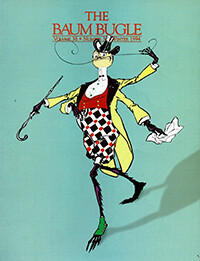
Originally published in The Baum Bugle, vol. 38, no. 3 (Winter 1994), pgs. 20–24
Citations
Chicago 17th ed.:
Koelle, Barbara S. “The Skies of Enchantment.” Baum Bugle 38, no. 3 (1994): 20–24.
MLA 9th ed.:
Koelle, Barbara S. “The Skies of Enchantment.” The Baum Bugle, vol. 38, no. 3, 1994, pp. 20–24.
(Note: In print, this article was supplemented with illustrations that have not been reproduced here. However, typographical errors have been left in place to accurately reflect the printed version.)
A few years ago, when I visited Skye Island off the west coast of Scotland, it seemed mundane to arrive via ferry rather than by magic umbrella. Hoping to find some connection, however tenuous, with L. Frank Baum’s Borderland of Oz story of the same name, I looked around the bleak island landscape for a souvenir. The best evocation I could find was in the shape of a postcard of shimmering blues and pinks, the names of the inhabitants of Baum’s magical country. For suspension of disbelief, however, it did not approach John R. Neill’s depiction of Trot and Button Bright standing on the edge of Sky Island, drifting lavender clouds at their feet and scarlet-tipped birds flying overhead. (This illustration originally appeared on the dust jacket of the first edition of Sky Island and was reproduced for the cover of the Spring 1970 Baum Bugle.)
Traditionally, an island represents a sense of serenity—an escape from worldly problems—and when that island is floating aloft, one might expect an even more heightened sense of well-being. Does this hold true for those Royal Histories of Oz—and its border countries—whose characters explore the heavens? In one sense, Baum’s Oz is itself an island—isolated by desert instead of water—and its creator simply extended the concept to an airborne island. Ruth Plumly Thompson was enamored of islands, be they in water or air, and wrote about them extensively. Probably her most ambitious attempt was Umbrella Island from Speedy in Oz, but also notable are the Skyle of Un (The Cowardly Lion of Oz), Stratovania (Ozoplaning with the Wizard of Oz) and Kapurta (The Enchanted Island of Oz). Later authors, including John R. Neill and Jack Snow, have mapped the Ozian heavens with various bodies, as well as with “beings who inhabit the air without necessarily having a home base” as Fred Meyer puts it.
Consider Sky Island, reputedly one of Baum’s own favorites. After plunging through a cloud belt of fanciful and “occasionally frightening” forms, the Magic Umbrella deposits the hapless earth passengers upon an airborne island of pink and blue, covered with a big cloud over the middle. Trot, Cap’n Bill, and Button Bright eventually learn that these two colors correspond to the humanoid inhabitants, their animals and vegetation, as well as marking the political boundaries of the two countries. In between lies the Great Fog Bank, home of the giant frogs and other peculiar creatures, the most interesting of which is Cancer, the crab constellation from the zodiac. At the foot of the mountain in the Blue Country is located the Great Blue Grotto, with its Arch of Phinis, where pass all those Blues who have reached the age of 600 years. (It is never clear if the Pinks pass through also.) Only the moon shines on the blue side of the island, the sun remaining hidden behind the Great Fog Bank. But it shines gloriously on the Pinks.
Patrick Maund, in his “Borderland of Oz Cartography” (The Baum Bugle, Winter 1986) argues that the Blue and Pink countries are roughly circular-shaped and that the Great Fog Bank may be much larger than the other two areas of Sky Island. Both countries are about two miles across.
What of Sky Island’s people? Although the Pinks are a contented folk—unlike the unhappy Blues who suffer under their dictatorial Boolooroo—the sky maiden, Polychrome, points out that they have been cruel and unjust to their Earth visitors. She also remarks that they have overdone the color pink to the point of satiety! Baum grants the Blues a long life span, but one overshadowed by the knowledge of their eventual doom in the Arch of Phinis—that place of a “dark and terrible interior.” Unlike the immortal inhabitants of the Land of Oz, Sky Island’s natives do not live forever.
Polychrome, the Rainbow’s daughter, along with Button Bright, Trot and Cap’n Bill, link Sky Island with the Oz books. (The island is mentioned by name in The Magic of Oz.) Usually Polychrome has been temporarily stranded on the earth after having strayed too far from the Rainbow’s touch-down place, as in The Road to Oz, The Tin Woodman of Oz and Tik-Tok of Oz. (She also appears briefly in later Oz books.) Baum refers to Polly and her band of sisters, of whom she is the leader, as “fairies of the sky,” when he does not call them “Daughters of the Rainbow.” In Sky Island, and later in Grampa in Oz, she does not set foot on the earth but still manages to aid her friends.
Some of Neill’s most appealing illustrations show Polychrome rejoining her father and sisters. In Sky Island (page 182), her sisters reach out to her and in The Road to Oz, her father’s face hovers over her (page 259). The Rainbow comes and goes but Polychrome tells us that he has birthday parties (Grampa in Oz) and mansions in the sky where there is always joy and happiness (The Tin Woodman of Oz). On earth he is sometimes visible as “seven pillars of mysterious solid light” filled with each color of the rainbow (Lucky Bucky in Oz).
If the Rainbow’s daughter are sky fairies, where, then, are located the cloud fairies described in Dorothy and the Wizard In Oz? As seen by Dorothy and her friends from an opening in Pyramid Mountain, they appear gracefully seated on clouds in another of Neil’s distinctive illustrations. Baum states that these beings are sisters to those who are high in the sky. Yet how can this be, given that the travelers—Dorothy, the Wizard, Jeb, and Jim the Cab Horse, are still below the surface of the earth? I suggest that these particular clouds are generated by the black sea bubbling with tongues of flame far below the aperture in the mountain. Further, these cloud fairies must be a distinct sub-set of fairy beings, existing only in the volcanic environment below the earth’s surface. They are probably related to the Mist Maidens who, in Glinda of Oz, live in the clouds above a valley on the surface of our planet.
Michael Patrick Hearn, David L. Greene and Peter E. Hanff speculated in “The Faltering Flight of Prince Silverwings” (The Baum Bugle, Autumn 1974) that these airy creatures may have originated in an earlier theatrical scenario written by Baum in 1903. Described as musical fairy spectacle and based on stories by Edith Ogden Harrison, the scenario was published but the musical was never produced. Among its cast of characters were Nuna, a missing Cloud Maiden (the probable prototype for Polychrome) and her father the Storm King (read Rainbow).
While Sky Island appears to be a natural—or supernatural—phenomenon, Ruth Plumly Thompson’s Umbrella Island was created “from invention and wizardry.” In Speedy in Oz, Waddy the Wizard explains to Loxo the Giant that the island was originally located in the Nonestic Ocean, was magically buoyed up by a giant umbrella piercing its center, and now serves as a permanent floating island home. Guided by its wizard/engineer, it drifts over Oz and Ev and even ventures on the other side of the Rainbow into the “Realms of Reality.” Its mission, Waddy continues in a statement that now sounds vaguely familiar, is to “explore the high and hitherto uncharted regions of the air.”
Thompson describes Umbrella Island in detail, including its foliage (tropical); its striking umbrella trees, with their blue and white blossoms which supply the population with the required umbrellas; and its sandy carpet. From afar the island appears to Speedy and Terrybubble as a great purple cloud. Its palace is carved from “shimmering rock and crystal,” with a throne room 60 feet high. Most interesting and even prophetic, is the unisex appearance of its people. Males and females both wear braids and loose pajama-like garments. Some of Thompson’s most lyrical language can be found in Speedy. “Umbrella Island skimmed lightly and smoothly and soundlessly across the evening sky . . . days so calm and dreamlike, so unreal and enchanting.”
The Skyle of Un in The Cowardly Lion of Oz is in shocking contrast to the pleasant scenes above (“skyle” is a small body of land entirely surrounded by air). Full of tall trees and enormous “bird houses,” it is rocky, barren and devoid of buildings or farms. Its palace looks like a huge barn stuck between trees and its bird-like people are as unattractive and unpleasant as the landscape (skyscape?). Most alarming is the malign influence the Skyle exerts on its unwilling visitors, that is the ability to grow feathers for every “unish” act.
Only while “air fishing” at the Skyle’s edge do Bob Up, Notta Bit More and the Cowardly Lion have any fun. They are enthralled—like the travelers on Sky Island—by cloud shapes floating by ships and chariots and “a white and wonderful princess.” They manage to catch a cooked goose and even throw back an appealing Skye terrier who “belongs to a little boy on another star.” But the edge turns out to be a perilous place and the Cowardly Lion has to rescue his companions after the Uns have pushed them over (fortunately, they’ve tied themselves to a tree).
Undoubtedly the Uns are among Thompson’s most unappetizing creations. Their daily schedule consists of wishing in the morning, fishing in the afternoon, and fighting in the evening. The only hope for their redemption is the influence of the one good Un whom Ozma places on the throne. The Skyle is definitely a heavenly body to be avoided.
The floating kingdom of Kapurta in Thompson’s last book, The Enchanted Island of Oz, is altogether a more pleasant place. Initially a quiet sheep-raising part of the Gillikin country of Oz, Kapurta, like Umbrella Island, was sent aloft by magic—in this case, a magic button belonging to its king, Rupert. This restless young man had tired of ruling a landlocked country, then wearied of a watery location, and finally used his magic and the following verse to make the transition to a new environment.
“Carry us high as eagles fly
Make us an island in the sky
Over a country both warm and dry.”
To their consternation, Kapurta’s inhabitants now find themselves in the sky.
The herdsmen and housewives who weave wool and cloth from the blue and purple sheep fo Kapurta never seem to become resigned to the upper atmosphere. Perhaps that is why it eventually returns to earth, unlike Thompson’s other sky islands. There is a hint, however, that its young ruler may someday be temped to explore the moon.
Dick Martin traces the flying route of Kapurta in his maps preceding the first chapter of The Enchanted Island of Oz. From the Nonestic Ocean, the island takes an overhead course between the country of Mo and the Valley of Hohaho, crosses the Deadly Desert, flies above the Winkie country of Oz (where it acquires David Perry and the camel, Humpty Bumpty) and eventually returns to its Gillikin country origin. There is only one problem with this sky route: it does not explain how Rupert’s magic button fell into the garden of David’s grandmother. At some point on the flight Kapurta must have crossed the other side to Reality.
The skies above Oz are again threatening in Thompson’s Ozoplaning with the Wizard in Oz. This time the travelers, including Jellia Jamb, the Wizard, the Tin Woodman and the Soldier with the Green Whiskers, take off in the airships Oztober and Ozpril, inventions of the Wizard. They reach the stratosphere after flying over 19 miles “straight up,” and must take altitude pills. After encountering the usual cloud formations, some odd “airimals,” and an icy lavender crescent, the two ships arrive on Stratovania, a full-fledged “air land.” In fact, Stratovania, according to its ruler, is formed of solid air. (I find this no harder to believe than the recent scientific discovery that stars and galaxies were formed from “broad ripples of wispy matter,” as quoted in the New York Times.)
This “irradiant tip-toposhere” has a surface of gleaming crystal “flashing with the brilliance of diamonds.” There is a rainbow-hued Half-Moon Lake, and trees with prism-shaped trunks, cloud-like foliage and illuminated fruit, abound. Moon and star flowers decorate the surface, along with tune trees, balloon bushes and crystal caves. “Air waves” seem to crash along the coasts of the island, but there are no weather problems in Stratovania as it is surrounded by a rim of warm air, preventing rain and wind storms.
Stratovania has few animals and none that can talk. Its people make up for that omission, especially Kabebe, the Queen. The ruler, Stratoovious VIII and his subjects live, not in houses, but in canopies held up by crystal poles. They are described as tall, with star-shaped eyes; their vertical hair crackles with electricity and their foreheads are transparent to their changeable moods. They fall up. Both sexes wear earrings and rainbow-hued tunics and carry staffs tipped with wings, which expand to fly. Their food includes “airades” and “wind pudding,” which have an alarming effect on the Cowardly Lion (he and Dorothy came along for the ride). Such is the most elevated sky island, which the Tin Woodman attempts to claim for Ozma—with unfortunate results.
The foregoing lands are air masses on which Ruth Plumly Thompson’s characters directly encounter adventure. But several other examples are encountered only second-hand, through the description of one of the protagonists. Of these, the most fully realized is technically not an island but a planet—Another Planet—from The Silver Princess In Oz. It is described by its exiled Princess, Planetty, to Randy, prince of Regalia, and Kabumpo.
“All our countries are grayling and sad. No birds sing, no flowers grow and people are all the same.” The skies of Another Planet are leaden, with layers of silver and slate. Creatures can’t talk. The Nuthers, the planet’s inhabitants, live in isolation from one another, without parents or relatives, leading a wandering existence and sleeping in nets attached to tall shafts of metal called zonitors. Springs of vanadium refresh and renew them and are necessary for continued existence. Small wonder that Planetty is in no hurry to go home!
The Silver Princess and her horse, Thun, the Thunder Colt, are both composed of metal, molten black metal for Thun and iridescent silver-like mesh for Planetty. Her clothes are of meshed metal thread and she carries a voral staff which has the power of petrification. One of John R. Neill’s illustrations depicts Planetty and Thun on their way to a “zorodell,” riding a thunderbolt in the skies about Another Planet. Various other heavenly bodies appear, along with a fiddler perched on a star, but their location in relation to Oz is not specified (pages 108–109).
Are there one or two balloon countries above Thompson’s Oz? In The Gnome King of Oz, a balloon bird describes his home, Balloon Island, to Peter, the boy from Philadelphia. Peter is being carried off to be an “airrend boy” and this description takes place in mid-air before Peter decides to take his chances on the ground below. Since he never reaches the island, all we learn is that it has a Lord Hi Bounce and a Queen Luna and that most of the airrend boys either explode or get punctured. Of its inhabitants, Neill illustrates only the balloon bird, which looks like a barrel bird in black and white (page 75), but like a real balloon in color (page 78).
Atmos Fere, the balloon sky man in The Hungry Tiger of Oz, who kidnaps Princess Ozma, refers to his homeland as Cloud Country and to himself as an explorer of the bottom of the air. He is, in fact, a lecturer and is preparing to use Ozma as a specimen before the Cloud Country Gentlemen (Ozma, of course, has other ideas). Atmos, who is engaged to an “Heiress,” tells his captive of his home where sky banquets lasting as long as 10 years are held in air castles, currents are picked from current bushes, and the inhabitants never walk, but swim, float, or fly. Is this Cloud Country adjacent to or inclusive of Balloon Island? We never find out, but their description enables Thompson to deliver a great many puns! We must also deplore the light-hearted criminal tendences of both sets of inhabitants.
Sky countries above Oz and Ev are encountered in books by two other Royal Historians. Perhaps the most unusual is found in John R. Neill’s The Wonder City of Oz, a chocolate star. Another Ozoplane carries Jenny Jump, Jack Pumpkinhead and the Patchwork Girl to this amazing heavenly body, where mountains and cliffs are composed of hard chocolate and a bog tuns out to be chocolate sauce (pages 176–177). Their reception at the hands of a chocolate general and his soldiers (whose guns, of course, are of the same material) is unfriendly and they are placed behind chocolate bars. Housed in a barracks of chocolate blocks with sugar-frosted tops, Jenny is unable to eat her way out (the bars are bitter chocolate). From this over-abundance of a good thing she escapes via the Ozoplane. Her fellow travelers are, luckily, rescued by the Wizard’s Ozmic Ray, which melts both prison and general.
The location of Jack Snow’s Hightown is pin-pointed in The Shaggy Man of Oz as being over Ev near the Deadly Desert at an altitude of approximately 15,000 feet, which varies. A cluster of little houses and buildings (“a good-sized village in the sky”), Hightown is four square acres across and boasts a population of 522.
Hightown’s peculariarity is that within its limited borders, the earth’s gravity does not exist. Thus, its people literally walk on air, as opposed to the situation on Stratovania, which is built of air, but has a hard covering. The Shaggy Man, Tom, Twink and Twiffle spend some time with the tall, thin inhabitants of Hightown, who refer to it as the “Garden Spot of the Sky” and to their houses as air castles. The Lord Hi Mayor lauds its pleasures to the “earth crawlers.” “What can be more delightful,” he asks, “than walking on a southern cloud or wading in a rain cloud?” And, since it never rains, “we have the most perfect weather in the world”; the changeable flowerpot is “the most perfect weather forecaster.”
Shaggy and his friends do not agree with this glowing tribute and, by walking down through the gravity-less air, reach the soil of Ev. Frank Kramer has provided a charming two-page illustration of their mid-air escapades (pages 100–101).
Some denizens of the Ozian heavens seem to have no permanent resting place. In Kabumpo in Oz, we meet a nimble old gentleman with a huge sack on his back, springing from cloud to cloud. The Sandman (for it is he) loves to jump through air castles and admire their furniture. He mistakes Ozma’s castle (which is perched high in the clouds on a giant Ruggedo’s head) for the airy kind, and accidentally opens his sack. All of the castle’s flesh and blood inhabitants fall sound asleep and the Sandman hurries off to tell his wife about his strange encounter.
In Grampa in Oz, Tatters, Urtha, Grampa and Bill the Weathercock are hurled aloft in a storm and carried by their umbrella toward a patch of pink sky land. (Do I detect an umbrella motif throughout these sky stories?) There they meet Maribella, a sky shepherdess, who tends baby stars and keeps them from falling out of the Milky Way. Remarking that many earth people have their heads in the clouds, Maribella guides the travellers toward the cloud containing human heads where they find King Fumbo’s.
While flying over the Quadling country in the “Flyaboutabus,” Jack Pumpkinhead, Peter the Iffin and Baron Belfaygor come within the boundaries of Trapeze Town (Jack Pumpkinhead of Oz). These boundaries do not appear to be permanently fixed and indeed it is never clear to what the town’s ropes, swings and giant net are attached. Nevertheless, the aerialists, led by King Hi Swinger and Queen Toppsy, manage to turn their visitors completely upside down before dropping them.
High in the upper atmosphere above Oz the voyagers in the Oztober encounter the “Spikers” (Ozoplaning with the Wizard of Oz). They are iridescent, goggle-eyed monsters resembling octopuses, but with spines instead of arms. Only be ascending into thinner air is the Oztober able to escape them. “Zoomers” are also mentioned as inhabitants of the upper air, but they are neither described nor pictured. The word, however, is suggestive.
The reader first meets “cloud pushers” and “sky sweepers” in Neill’s The Wonder City of Oz, and the former reappear in Neill’s Lucky Bucky in Oz. They resemble almost transparent man-shaped windbags. The sweepers, with feather brooms instead of hands, are responsible for cleaning sky trash, composed of star dust, thunder scum, and loose links of chain lightning. Another variety of this species of sky beings are the “sky scrapers,” who scrape rain, hail and dirty mist into piles “beyond the horizon.” The star on which Jack Pumpkinhead’s head alights is a “dump star.”
Returning to my original question, which of the heavenly islands described herein can be considered truly idyllic? Umbrella Island and Kapurta come to mind and, interestingly, are both magically powered. Yet all its magic does not prevent the former from being terrorized by Loxo, and the latter eventually returns to its earthly origins.
Certainly the scenery on Sky Island, Umbrella Island and Stratovania, as well as on the journeys there, is intriguing. It ranges from fascinating cloud formations and spectacular sunsets to scintillating crystal grottos and breathtaking rainbows. Even the Skyle of Un offers beautiful vistas (and good fishing) off its bleak acres. Yet many of these sky lands, in a kind of counterpoint, share an underlying theme of menace. Baum set the tone with his description of the grim Arch of Phinis and its concept of ending. Other Royal Historians have introduced an element of danger (present also in Sky Island), that is, the fear of falling off the edge.
On Umbrella Island, this threat is met by the habit of always carrying umbrellas; in Kapurta, a magic fence is erected all around the island, but not before several sheep have gone over. On Stratovania, Sky Island and Un, the travellers are threatened with being pushed or blown over by the natives (reversed gravity apparently only works for the Stratovanians). Although the Uns are the most hostile, to me it is the amiable Pinkies of Sky Island who are the most alarming. They simply want to find out what will happen to the Earth visitors when they are shoved overboard!
The Wizard echoes this theme in an episode from Ozoplaning when he freezes air into a large block of ice so that the rapidly descending space explorers can have something to sit on. His next act is to conjure up a thick green hedge around the edges of the block “to keep us from falling off.”
Other spatial bodies in Ozian history are not all that appealing either. Anuther Planet is gray and depressing; the Chocolate Star is vulnerable to a little heat and hosts unfriendly natives; and Hightown, which is really a “gravity-less” village, is best summed up by a visiting wren, “. . . there isn’t a stupider place in the world.”
Yet it can’t be denied that the very features which make the sky islands dangerous also make them interesting. Whether arriving, enjoying their peculiarities, or escaping from them, the adventurous travellers have added another dimension to the exploration of our favorite continent. And although these skies of enchantment reveal surprising elements of tension and fear under their usually beguiling exteriors, they have also given us characters and places we would not willingly relinquish. I always felt a little cheated when Speedy’s sky rocket went up instead of down in The Yellow Knight of Oz. Perhaps a Royal Historian will someday map the exotic sky locations to be encountered between Earth and Mars . . . when Speedy and Uncle Billy get pointed in the right direction.
Authors of articles from The Baum Bugle that are reprinted on the Oz Club’s website retain all rights. All other website contents Copyright © 2025 The International Wizard of Oz Club, Inc. All Rights Reserved.