THE TRIBULATIONS OF TROT
by Barbara S. Koelle
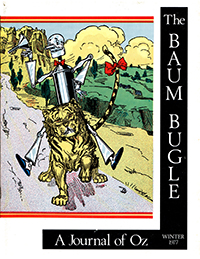
Originally published in The Baum Bugle, vol. 21, no. 3 (Winter 1977), pgs. 4–8
Citations
Chicago 17th ed.:
Koelle, Barbara S. “The Tribulations of Trot.” Baum Bugle 21, no. 3 (1977): 4–8.
MLA 9th ed.:
Koelle, Barbara S. “The Tribulations of Trot.” The Baum Bugle, vol. 21, no. 3, 1977, pp. 4–8.
(Note: In print, this article was supplemented with photographs that have not been reproduced here. However, typographical errors have been left in place to accurately reflect the printed version.)
Baum’s most courageous little girl heroine is Tiny Trot. To be sure, Dorothy is the archetypal human in Oz, everybody’s favorite and deservedly so, displaying in book after book the qualities of self-reliance, initiative, and adventurousness that have endeared her not only to countless children but also to the advocates of sexual equality in children’s literature.[1] (The preponderance of brave, autonomous boys and passive, admiring girls in American writing for children has been well documented, Nancy Drew notwithstanding.)[2] But with the exception of her imprisonment by the Wicked Witch of the West, no episode in Dorothy’s many adventures matches for sheer terror the fates threatening Trot in four of Baum’s books and one of Thompson’s. They include death or destruction by suffocation, falling from immense heights, drowning, shrinking away into nothingness by absorption into the earth, and mutation into a shadow existence—quite a fearsome list, considering Baum’s professed aversion to heartache and horror in the fairy tale.
Betsy Bobbin is not so well-developed a character as Trot or Dorothy. Although she is a gallant little adventurer in Tik-Tok of Oz, Betsy is overshadowed by the other females in that book: Polychrome, Ozga the Rose Princess, and Queen Ann Soforth. Betsy needs a book to herself, and although Ruth Plumly Thompson cast her prominently in The Hungry Tiger of Oz, the definitive Oz book with Betsy as heroine has yet to be written.
In this discussion I am considering only the three little American girls who may serve as models to their young feminine readers, although Baum’s other recurring young girls—Ozma, Polychrome, Jinjur—could (and should) be treated elsewhere. Except for the grotesque Handy Mandy and such unworldly characters as Planetty, Peg Amy, and Urtha, Thompson introduced no new young heroines. In their place, she turned to young boys for her readers to identify with—Peter, Speedy, Pompa, Tandy, Tandy, Tompy, and David Perry. (Daniel Mannix has pointed out that the most believable of Baum’s boys is Button-Bright,[3] who came from the United States and who is an especial friend of Trot’s.)
Baum doubtless had a special preference for Trot because he had hoped to write a series of books about her after he closed the Oz series with The Emerald City of Oz in 1910. Alas, the two Trot books, The Sea Fairies (1911) and Sky Island (1912), did not sell particularly well. Logically, after exploring the ocean and the sky, Trot and Cap’n Bill should have gone underground, and, in fact, they do at the beginning of The Scarecrow of Oz. With The Scarecrow, Baum yielded to his readers’ demands and brought the intrepid pair to Oz. Thus they, with Polychrome and Button-Bright, occupy a unique position in Baum’s writings, that of appearing in both Oz and non-Oz books. I do not think that the brief appearance of non-Oz characters at Ozma’s birthday party in The Road to Oz—an appearance that puzzled me mightily as a child—entitles them to that distinction.
In The Sea Fairies, we learn that Trot’s real name is Mayre Griffiths, though in Sky Island, the name becomes Griffith. Trot’s father, a sea captain named Charlie Griffiths, never appears in the books because he is always at sea. Trot’s constant companion is Cap’n Bill Weedles, a one-legged sailor who had once owned the Anemone, a schooner now skippered by Captain Griffiths; Cap’n Bill lives with Trot and Mrs. Griffiths in their home on the California coast. Baum informs us that when Mayre Griffiths “grew big enough to walk she took so many busy little steps every day that both her mother and Cap’n Bill nicknamed her ‘Trot,’ and so she was thereafter mostly called.”
Before moving on to the specific nature of Trot’s perils, we should say a little more about her great friend, mentor, companion, and (sometimes) follower, Cap’n Bill. This amiable character, with a fondness for dire prediction (“Nobody ever sawr a mermaid and lived to tell the tale”) and casual grammar, has impressed authors other than his creator. To him obviously is owed the depiction of Cap’n Bob in Frank J. Baum’s The Laughing Dragon of Oz and Uncle Charlie in A. Volkov’s Urfin Dzhus and His Wooden Soldiers. Thompson did not include him in The Giant Horse of Oz and thereby weakened the book. Cap’n Bill’s relationship with Trot is peculiarly beneficial to both: it is not authoritarian but egalitarian. Although Cap’n Bill has been Trot’s teacher and advisor, he is not a parent substitute; on occasion it is the little girl who leads. Consider the following exchange from Sky Island:
“So now, Queen Trot, what’s next on the program?”
“Next,” said Trot, “we’re goin’ to hunt for the umbrel, Cap’n. I don’t mean to stay in this dismal Blue Country long, even if I am the Queen. Let’s find the umbrel and get home as soon as we can.”
“That suits me,” the sailor joyfully exclaimed. . . .
By contrast, Trot’s mother is portrayed as a one-dimensional maternal figure, and a rather unsympathetic one at that. Baum leaves us in no doubt that she is a shrew, though also “motherly and good.” Cap’n Bill in Sea Fairies remarks that “Trot’s mother has an awful sharp tongue when she’s worrited.” And in Sky Island both the little girl and Cap’n Bill receive a tongue-lashing, in Trot’s case sufficient to bring tears to her eyes.
Curiously, both Baum and Trot show diminishing concerns for Mrs. Griffith in successive books. In Sea Fairies the mermaids assure the child that time has been halted for her mother while she is away. But no one in Sky Island seems to have accounted for the absence of Trot, Cap’n Bill, and Button-Bright during a period of at least a week (I counted the passage of ten days and nine nights). Trot simply “ran to the house, where she found her mother busy in the kitchen,” and announced her return. Her mother’s reaction is not noted.
In The Scarecrow of Oz, however, Mrs. Griffith really gets the brush-off. Before Trot and Cap’n Bill land in Oz, it is clear that the status quo is maintained at home: they still live with Trot’s mother in California. Yet by the end of the book when “Trot already began to hope that Ozma would permit her and Cap’n Bill to live always in the land of Oz,” neither one of the two seems to give a thought to poor Mrs. Griffith, who must have long since presumed them drowned in the whirlpool. Leaving her in this state seems unkind and the Royal Historian does not improve matters by having Glinda remark there was “no way, at present, for them to return again to the outside world.” Come now! No Magic Belt? No sorcery of the Wizard or Glinda that can carry them across the Desert? Baum’s summary dismissal of the claims of maternity may be due to carelessness, or it may be an unwillingness to deal with the implications of Trot’s immigration to fairyland. He had solved the problem with Dorothy by the felicitous transportation of Uncle Henry and Aunt Em, but he could hardly seek the same solution for all the relatives of all his young American protagonists. Baum probably felt also that the presence of a mother and father (as opposed to an aunt, uncle, or Cap’n Bill) is too authoritative, too inhibitory, too oppressive for his free and easy fairyland.
Shrew or not, Mrs. Griffith could well be proud of the child that she and Cap’n Bill raised between them. Trot’s sweetness, simplicity of character, and above all her extraordinary courage in the face of danger shine out in all the books in which she plays a leading role. Her philosophy is perhaps best expressed in a passage from Scarecrow, when Cap’n Bill fears a dangerous plan: “But nobody can stay alive without getting into danger sometimes, and danger doesn’t mean getting hurt, Cap’n’ it only means we might get hurt. So I guess we’ll have to take the risk.”
The most terrifying threat of destruction faced by Trot and her old friend occurs in The Sea Fairies. Who can forget the monster magician Zog—part man, part reptile, part fish, and part beast—who, in Warren Hollister’s words, “must surely rank as the most fearful villain of them all”?[4] With his horned head and hooves Zog strongly suggests a portrayal of Lucifer. The episode in which he pursues and almost overtakes his prisoners is one that still has power to chill me. How does Trot react to the prospect of being suffocated by this loathsome creature? Gallantly she reassures Cap’n Bill that they have done their best; only when the danger is past does she succumb to tears. And after one good cry she is ready to accompany the Sea Serpent Anko to his home and even to remember her curiosity about his third pain!
During Zog’s previous attempts to destroy the mermaids’ little group—attempts involving extremes of temperature, falling blocks of marble, and the infamous Yellmaker—Trot’s reaction is to trust in her fairy friends and “not allow herself to become frightened.” Only when she wakes from sleep to find herself imprisoned in a wall of ice is the little girl alarmed. And when Queen Aquareine proposes a dangerous flight, Trot’s immediate response is to get it over with.
Danger in Sky Island is of a different order. When captured by the Blueskins, Trot asserts bravely (though probably inaccurately) that she doesn’t mind, “Not much, anyhow.” Belittling danger and discomfort often helps the bearing of it, and it is a technique often resorted to by Trot and by Cap’n Bill, from whom she may have learned it. (“He . . . had a way of growing more and more cheerful when danger threatened.”)
Her reaction to the Six Subnosed Princesses while in the extremely uncomfortable position of being dragged after them, is spirited and typical: “I’m not afraid of these gawkies.” Anger at her subsequent mistreatment serves to sustain her in a most alarming situation. Trot’s last words to her captors are, “Perhaps . . . when I grow up I’ll be as big a fool as any of you.” Untactful—but admirable!
The most serious threat to the travelers’ lives in Sky island comes not from their enemies, the Blueskins, but from the friendly Pinkies. When the Queen and counselors consider the possibility of throwing them over the edge of Sky Island—in effect, killing them—Trot does become worried and anxious. At Rosalie’s decision of doom “a wave of fear swept over her.” But she does not cry or scream or even protest uselessly; rather, she trusts in her luck and in the unseen protection of the fairies.
In fact, Trot gives way to tears in this book only when her beloved Cap’n Bill is recaptured, and then she cries briefly, out of vexation. (Compare this with Dorothy, who “would cry bitterly for hours” as a captive of the Wicked Witch.) The same pattern is followed in Scarecrow, when after stoically enduring incredible hardship, Trot finds Cap’n Bill missing and “sobbed as if her heart would break.” Baum is careful, however, not to present his small heroine as a Pollyanna: she is very pleased with herself as the Pinkies’ new Queen and has to be talked out of staying there indefinitely.
When, in obedience to his reading public, Baum brought Cap’n Bill and Trot to Oz, the setting of the opening chapter is that of Sea Fairies. The ocean, the California cliffs, the giant acacia tree, and the old man and little girl form an idyllic scene which John R. Neill captured beautifully. The analogy is heightened by the unseen presence of mermaids, though unlike the leisurely Sea Fairies, danger threatens early in The Scarecrow of Oz. The companions face imminent death by drowning in a whirlpool, yet both confront the prospect courageously, Trot “with a serious, far-away look.” The reader may remember that Trot has been given a protective ring by the mermaid Queen, but does the child recall the fact? Not until they have been plunged into the ocean’s depth does the little girl feel supporting arms around her, and the tantalizing presence of the undersea fairies is withdrawn as soon as the pair are cast up safely in the underground cavern.
Here a new danger—that of starvation—arises, and it is Trot who insists, over Cap’n Bill’s objections, that they explore the black hole in the cave. It is she who calculates the dwindling supply of food and water, and is about to persuade the hesitant sailorman to enter the hole when the Ork’s arrival precipitates matters. Nor does she despair, as well she might, when they emerge into the upper world only to find themselves stranded on an island. Only on those occasions when she is deprived of her beloved Cap’n Bill does her courage temporarily falter.
The doom that almost overtakes Trot and Cap’n Bill in The Magic of Oz is one that David Greene and Dick Martin describe in The Oz Scrapbook as “the most frightening fate in all the Baum Oz books.” They link it with ancient mythic tradition because the two companions are lured to the enchanted island by the beauty of the Magic Flower.[5] “We find it difficult to conceive of evil and beauty together,” J. R. R. Tolkien has said of our times.[6] Trapped by this malignant loveliness, they face slow annihilation, as they grow roots and, inexorably sinking ever deeper into the ground, become smaller and smaller.
How does Trot respond, as the realization of doom is forced upon them? She complains initially of fatigue and, as is her habit, is philosophical about appreciating one’s blessings—in this case, fruit to eat. We do not see her becoming frightened, although the Glass Cat reports it after the two have shrunk to half their normal size. When the Wizard’s attempts to free them fail, Trot becomes resigned to destruction, and her main concern is that Ozma and the others will be distressed. She ends her speech with a moving plea that she and Cap’n Bill not be forgotten. The happy ending—Tolkien’s eucatastrophe—is made the more joyful for the bravery of the protagonists. And Trot remains a believable little girl as she reverts immediately, forgetting the horror of the immediate past, to a childish glee at the thought of the spectacular birthday present that they will present to Ozma.
Trot’s last major role in an Oz book occurs in Ruth Plumly Thompson’s The Giant Horse of Oz, in which she again finds herself in underground passages, and is again rescued from the deep—this time by a mer-man, instead of a mermaid. Though the omission of Cap’n Bill from this book is inexplicable, Thompson’s portrayal of the spunky little girl is faithful to Baum’s. She has her reward here, too: like Dorothy, she becomes a princess.
Trot and her companions have been summarily kidnapped from the Emerald City by Akbad the Soothsayer, subjected to a long and frightening air journey, and dumped on a beach of the Ozure Islands. Here they are confronted by the giant fear fish, Quiberon, who informs them that Trot, the “mortal maiden,” must become his personal slave. Although still in shock from these experiences, Trot retains her common sense and plays along with the monster in the hope of finding an escape route—which they eventually do.
Escape is also the order of the day in the riotous Round House of the Round-abouties. Trot Is her usual determined self as she seizes the opportunity to exit through the spiral staircase of the round tower. There the companions are trapped by the little round men, and the child, though frightened, does not hesitate to accede to the Scarecrow’s suggestion of a slide to freedom.
Trot’s earliest encounter with danger in The Giant Horse of Oz is with the shadowy cave-men. The living silhouettes are truly “a cruel and ghostly company,” though I would have liked to learn more of their underground kingdom.[7] Trot’s reaction to the threat of transformation into a shade is typical. She first attempts—vainly—to escape, then, finding that impossible, tries to comfort her friends: “Never mind,” she says, “Maybe it won’t hurt much and we won’t have to be shadows long. . . .” Fortunately, she does not have to find out.
The qualities that distinguish little Mayre Griffith(s) have obviously been shaped by the two important adults in her life; her determination and candor reflect her mother, her stoical endurance and compassion for others are like Cap’n Bill. But to these Trot adds her own inimitable mixture and emerges a most appealing, most American personality, one whom neither boys nor girls should be ashamed to emulate in the egalitarian spirit of our time.
[1] See Katherine Rogers, “Liberation for Little Girls,” Saturday Review, June 17, 1972, pp. 72 and 75.
[2] Carol Nagy Jacklin and Harriet N. Mishel, “As the Twig is Bent—Sex-Role Stereotyping in Early Readers” (condensed from a Ford Foundation Report), School Psychology Digest, 2, No. 3 (1973), 30–38.
[3] “The Enigma of Button-Bright,” The Baum Bugle, 16 (Christmas 1972), 18–21.
[4] “Baum’s Other Villains,” The Baum Bugle, 14 (Spring 1970), 11.
[5] The Oz Scrapbook (New York: Random House, 1977), pp. 54–56.
[6] “On Fairy Stories,” Tree and Leaf (Boston: Houghton Mifflin, 1964), p. 65.
[7] A. Merritt depicts a shadow world in compelling detail in Creep, Shadow (New York: Doubleday, Doran, 1934). So, of course, does Plato.
Authors of articles from The Baum Bugle that are reprinted on the Oz Club’s website retain all rights. All other website contents Copyright © 2025 The International Wizard of Oz Club, Inc. All Rights Reserved.