MORE DRAGONS OF OZ
by Ruth Berman
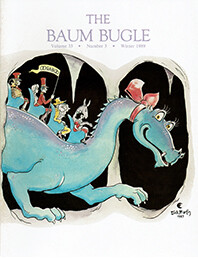
Originally published in The Baum Bugle, vol. 33, no. 3 (Winter 1989), pgs. 4–6
Citations
Chicago 17th ed.:
Berman, Ruth. “More Dragons of Oz.” Baum Bugle 33, no. 3 (1989): 4–6.
MLA 9th ed.:
Berman, Ruth. “More Dragons of Oz.” The Baum Bugle, vol. 33, no. 3, 1989, pp. 4–6.
(Note: In print, this article was supplemented with illustrations that have not been reproduced here.)
Dragons are so much a part of modern fantasy that it is startling to realize how few there were when L. Frank Baum started writing. Fantasy of all kinds had been out of favor in the eighteenth century, and in the nineteenth century fantasy writers preferred to use less well known traditional monsters (e.g. Lewis Carroll’s Mock Turtle). Until the end of the century, the only major nineteenth-century dragon was Fafner, the dragon in Wagner’s Ring Cycle and (spelled Fafnir) in William Morris’s Sigurd the Volsung, but Fafner/Fafnir, after all, was a holdover from ancient legend. Most other nineteenth-century dragons were likewise in poems retelling myths. However, there were a few exceptions. For example, Mark Twain used a dragon in a spoof German legend in “Why Germans Wear Spectacles” (in A Tramp Abroad), a brief account of how Sir Wissenschaft killed a dragon with a fire extinguisher; and Frank R. Stockton had a dragon (the king of the Snap-dragons) as a minor character in “The Bee-Man of Orn.”
Dragons were probably avoided because the previous use had stereotyped them as forms of Satan to be slain by St. George or the angel Michael. Thus Spenser in The Fairie Queene represented the triumph of Holiness as the story of St. George and the dragon, and in Milton’s Paradise Lost, Satan after the Fall turns into a dragon.
With the discovery of dinosaurs in the nineteenth century, interest in dragons (suddenly grown so much more plausible) increased. Artists began drawing dragons or creatures like dragons.[1] For instance, Tenniel’s Jabberwock is dragon-like. But writers could not comfortably use dragons until new meanings could be found. The image of the dragon as satanically evil implied a view of evil as something inhuman and alien; nineteenth-century writers, living at the same time as the development of psychology as a science, were more interested in portraying evil as part of the human soul—Mr. Hyde, say, or Dorian Gray’s portrait.
At the end of the century, three writers suddenly turned the legend of St. George upside down—Kenneth Grahame in “The Reluctant Dragon” in Dream Days (1898), E. Nesbit in The Book of Dragons (serialized in The Strand in 1899 and published in book form in 1900), and Baum in A New Wonderland (1900). The Book of Dragons contained short stories featuring a dragon, and A New Wonderland opened and closed with adventures featuring the Purple Dragon of Phunnyland. (The book was reissued in 1903 as The Magical Monarch of Mo.) Baum was thus the first important American writer to use dragons as major characters.[2]
Grahame’s dragon is a loveable and virtuous creature (with small lapses, such as vanity and a weakness for liquor), and his St. George is intelligent enough to recognize the dragon’s goodness. The battle between them is a put-up job to satisfy the conventional villagers.
Nesbit and Baum both presented traditionally wicked dragons, but without the traditional seriousness. As David L. Greene remarks, “The Purple Dragon is not frightening but ‘naughty.’”[3] These dragons are amusing, while lacking the Reluctant Dragon’s sweetness of temper.
Like Grahame, Baum and Nesbit parodied the St. George legend. Two of Nesbit’s stories in The Book of Dragons were explicit parodies: In “The Deliverers of Their Country,” the saint’s statue refuses to fight a horde of dragons but gives two children some weather-lore from his companion saint, Denis, so that they can kill the dragon on their own; and in “The Fairy Dragon,” Sabrinetta, grand-daughter of St. George and Princess Sabra, captures the dragon in an inherited dragon-proof bottle. The other stories in the collection were implicit parodies, with the comedy turning, in each case, on the discovery of an ingenious and unheroic way of getting rid of dragons.[4]
Baum, the year before, in one of his Father Goose verses, had mourned, “Pray, what can a civilized boy do now, / When the Dragons are all dead,”[5] but it had evidently occurred to him that uncivilized lands far from Kansas could harbor dragons as well as witches, and the Purple Dragon became the chief antagonist in Phunnyland/Mo. In the opening episode of A New Wonderland, the king attempts a straightforward, heroic attack and fails completely. The dragon bites his head off, producing a whimsical problem of identity as the king’s body tries out substitute heads and the dragon mischievously puts the king’s head on another man’s body.[6] In the closing episode the king tries a less heroic tactic, with more success; he tries to extract the dragon’s teeth, but the teeth are rooted too firmly to pull out. When the dragon knots its tail in the resulting tug-of-war, it turns out to be elastic, and the dragon is stretched tight and cut up for fiddlestrings. (Nesbit also had a purple dragon conquered by having its tail tied around something, in “Uncle James, or the Purple Stranger.”)
In his 1901 fantasy, The Master Key, Baum mentions dragons, but they are not characters in the story.[7] In 1903, Baum humorously refers to St. George in The Enchanted Island of Yew. The Royal Dragon, belonging to the villainous King Terribus, has green scales set with jewels and looks quite fearsome, but is too rheumatic and bedizened to be much of a killer, and too wise to try. His father got into trouble with St. George, and when the king calls him a coward and a traitor he answers proudly, “I’m a dragon and a gentleman! . . . and I believe I know what’s proper for dragons to do and what isn’t.”[8]
Grahame, Nesbit, and Baum also increased the attractiveness of their dragons by the use of bright colors. Nesbit and Baum often increased the comedy by choosing heraldically arbitrary colors. The Reluctant Dragon is a shining sea-blue, the purple Dragons are purple, and Nesbit’s other dragons include a red one (The Book of Beasts), green ones with yellow wings (The Deliverers of Their Country), and a Prussian-Blue ice dragon (The Dragon, or Do as You are Told). Dragons like Twain’s or Stockton’s had darker coloration: Twain’s was green, and Stockton’s was black with wings and a tail of fiery red.
With this new way of using dragons established, other writers went on to use dragons of all sizes, tempers, and degrees of virtue. This variety of dragon-nature was truer to the monster’s mythic reality than the allegorical depictions of utterly Satanic dragons had been. Dragons can be embodiments of patriotic strength, like the dragons of Wales and of King Arthur Pendragon (head-dragon), or they can be spirits of fresh water, or of healing wisdom. As Joseph R. Fontenrose says in Python, we should “realize that dragons and snakes did not have a uniformly bad reputation in Greece and the Near East. Greece too [like China] had its benevolent reptilian deities: snakes that were spirits of springs, genii loci, embodiments or attributes of gods, e.g., Asklepios, Athena, Apollo, Zeus himself.”[9]
Baum proceeded to put dragons of many sorts into Oz (see Camilla Townsend’s “Baum’s Dragons”),[10] and so did his successors. In The Laughing Dragon of Oz (1934), his son Frank J. Baum wrote that the Laughing Dragon would like to be terrifying, but its appearance is against it:
The Laughing Dragon had a big head of red and gold fish-scales with two big silver eyes that rolled and blinked as if the sunlight was too bright. Its nose had been pushed in just like the nose of a pug dog, and its mouth was filled with teeth that looked for all the world like big sticks of peppermint candy. The Dragon had a long neck like a giraffe, which lay on the ground, but its body was only as big as a cat and was covered with short soft fur.[11]
It thinks it would like to eat people, but it hasn’t tried and apparently has no intention of trying.
In The Royal Book of Oz (1921), Ruth Plumly Thompson mixed Oriental and Occidental legends in portraying the dragons of the underground Silver Island. Her Silver Island is based more or less on Japan and China, and the inhabitants are fond of dragons. As Camilla Townsend pointed out in “Baum’s Dragons,” dragons are usually benevolent in Oriental legends. The Silver Islanders fly dragon-kites, and the sinister Grand Gheewizard keeps “a rheumatic, silver scaled old dragon” (p. 206) as a pet. This unfortunate, and apparently harmless, dragon falls victim to Sir Hokus’s more Occidental ideas. Sir Hokus thinks it is his duty as a knight to kill a dragon, champion a lady, and go on a quest. The latter two are certainly part of a hero-knight’s routine, as may be seen in the legends of Arthur or Roland, but neither of those heroes was much given to slaying dragons. The image of the knight as dragon-slayer is based on St. George (whose legend actually pre-dated knighthood). Sir Hokus’s idea of duty seems to be unreasonably hard on the dragon, but perhaps as the Gheewizard’s pet, it had come to resemble its evil master.
Thompson included definitely hostile dragons in Grampa in Oz (1924) and Ojo in Oz (1933). Grampa subdues Enorma, a green, fire-breathing dragon on the ice-island of Isa Posa; he throws snuff at her, and she sneezes her false teeth out, then dies of falling into an ice-stream. In Ojo, Realbad melts the blue ice dragon guarding Crystal City. For good measure, he puts a Snoctorotomus, an earth-serpent, out of action, and in Neill’s color plate it looks quite dragonish.
(Realbad’s swordstroke does not kill it, for nothing dies in Oz.)
Agnes, the amiable dragon in The Giant Horse of Oz (1928), is not really a dragon, but an enchanted maid-in-waiting. The monster Quiberon, with “the head scales and talons of a dragon and the long hideous body of a giant fear-fish” (p. 24) in the same story, is a more typically Thompsonian dracoid, and is turned to stone.
Dismocolese, the Gate Keeper dragon of Somewhere in The Enchanted Island of Oz (1976), tries to stay on good behavior, but Dismo cannot control his dragonly appetite, and tries to eat David B. Perry. Queen Else describes him as “the last dragon in existence” (p. 22), and she is probably correct in terms of Thompson’s dragons, although not in terms of the other Oz Historians, who more often kept alive the dragons in their stories.
John R. Neill portrayed a genuinely amiable dragon, the purple, two-headed eight-legged dragonette in The Wonder City of Oz (1940) who graciously allows Sir Hokus to chase her (“ette” in this case is a feminine ending, not a diminutive, as in the young dragonettes of Dorothy and the Wizard in Oz). The game seems to amuse them both. The animal-plant dragon (evidently a snap-dragoon) in the same story is also an obliging creature.
Eloise Jarvis McGraw and Lauren McGraw Wagner included a wyver as a minor character in Merry Go Round in Oz (1963), living in the heraldic kingdom of Halidom in Oz. (A wyver, or wyvern, is a dragon with two legs, as opposed to the usual four. Dick Martin drew the Halidom Wyver as four-legged, however.) The wyver is small, plump, good-tempered, and a faithful guard.
Dick Martin included a dinosaur which resembled a dragon in The Ozmapolitan of Oz (1986), the Tyraicus Terrificus. A ferocious predator, this character is quite different from that of Terrybubble, the friendly dinosaur skeleton in Thompson’s Speedy in Oz (1934).
Purple dragon or purple dragonette, good-tempered or bad, the dragons of Oz maintain their dragonly ambiguity, adding to the color and amusement of Oz and the surrounding lands.
- Stephen Prickett discusses the influence of dinosaurs in reviving dragons in his Victorian Fantasy (Bloomington and London: Indiana University Press, 1979), pp. 79–91. His examples show the earlier appearance of dragons in the artwork, but he does not discuss this difference between the writers and the artists. The later interest of writers in dragons is discussed in my article, “Victorian Dragons, the Reluctant Brood,” Children’s Literature in Education, 15 (Winter 1984), pp. 220–233.
- Other writers of children’s stories, less famous than Grahame, Nesbit, and Baum, were also writing about comic dragons at the end of the century and playing on the joke of the nonheroic methods used to overcome them. Thus, in Britain, Isabel Bellerby’s “Princess Crystal” appeared in The Strand (No.11, 1896). In the United States, St. Nicholas published two stories by Tudor Jenks, “The Dragon and the Dragoon” (July 1895) and “Papa Dragon’s Tale” (April 1900); and one by Alice Calhoun Haines, “A Tender-Hearted Monster” (January 1897). These short stories are pleasant, but their dragons lean too much towards being cute and funny, and they lack the potentially dangerous strength of the more memorable dragons of Grahame, Nesbit, and Baum.
- David L. Greene, introduction to “Tales from Phunnyland,” in his collection of Baum’s The Purple Dragon and Other Fantasies (Lakemont, Georgia: Fictioneer Books, 1976), p. 18.
- The Reluctant Dragon and “The Deliverers of Their Country” have been reprinted in The Victorian Fairy Tale Book, edited by Michael Patrick Hearn, New York: Pantheon Books, 1988.
- Father Goose: His Book (Chicago: George M. Hill Co., 1899), unpaginated. W. W. Denslow drew a pair of ferocious orange dragons for this verse. He may have been remembering Baum’s lament for the extermination of dragons and giants when he had his Jimmie Jones wish to grow up to become a knight of long ago with a spear which “No Giants tall nor Dragons grim” could withstand. (“The Knight” in When I Grow Up, New York: The Century Co., 1909, unpaginated).
- This episode is, deservedly, a favorite. David L. Greene made it the lead story in the collection of Baum’s short stories, The Purple Dragon, and James Thurber praised the episode as “a fine, fantastic fairy tale” in his introduction to The Wizard of Oz (Greenwich, Connecticut: Fawcett Publications, 1960). Baum liked the theme of separation and identity; he used it with the Woodman’s gradual transformation into Tin; the composite Gump; and the many-headed Langwidere.
- Patrick Maund points out in his letter on “Baum’s Dragons” (The Baum Bugle, Autumn 1984, pp. 9–10), Rob, flying somewhere over or near the Sea of Japan, is “not far away” from “the land of the dragon, the simurg and other ferocious monsters” (The Master Key, Indianapolis: Bowen-Merrill, 1901, p. 186). Baum does not say what land this is. China is sometimes called the land of the dragon, but the simurgs are immense, intelligent birds from Persian legend. Rob is attacked by monstrous birds, but Baum does not mention if they are simurgs.
- Baum, The Enchanted Island of Yew (Indianapolis: Bobbs-Merrill, 1903), p. 88.
- Joseph R. Fontenrose, Python, A Study of Delphic Myth and Its Origins (Berkeley and Los Angeles: University of California Press, 1959), pp. 491–492. Similarly, the benevolent Chinese dragon is occasionally a trouble-maker, bringing bad weather as well as good.
- The Baum Bugle, Spring 1983, pp. 9–12.
- Frank J. Baum, The Laughing Dragon of Oz (Racine, Wisconsin: The Whitman Publishing Co., 1934), pp. 82–85.
Authors of articles from The Baum Bugle that are reprinted on the Oz Club’s website retain all rights. All other website contents Copyright © 2025 The International Wizard of Oz Club, Inc. All Rights Reserved.