
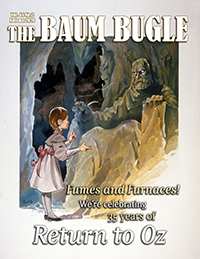
Originally published in The Baum Bugle, vol. 64, no. 2 (Autumn 2020), pgs. 36–41
Citations
Chicago 17th ed.:
Campbell, Nick. “There Must Have Been Some Magic Words: Novelizations of Return to Oz.” Baum Bugle 64, no. 2 (2020): 36–41.
MLA 9th ed.:
Campbell, Nick. “There Must Have Been Some Magic Words: Novelizations of Return to Oz.” The Baum Bugle, vol. 64, no. 2, 2020, pp. 36–41.
(Note: In print, this article was supplemented with photographs that have not been reproduced here. However, typographical errors have been left in place to accurately reflect the printed version.)
In the New York Times article “The Name is Baum,” published June 12, 1985, an anonymous writer talked glowingly of L. Frank Baum’s work. However, there was an unmistakable tone of disapproval when they spoke of Walter Murch’s new film Return to Oz, “reprocessed” out of Land and Ozma of Oz. They were especially scornful of Joan D. Vinge’s novelization, published simultaneously, which gave no credit to Baum at all.[1]
“[Baum] has become a nameless stranger in his own fairyland,” the Times wrote, “a fate one wouldn’t wish on, say, the creator of Mickey Mouse.” Vinge’s novel was a key element of the film’s merchandise, published by Target Books in the UK and translated into a number of languages. What are we to make of these texts, which seem not only to adapt Murch but rewrite Baum? Now that anyone can watch the film at home, is there any reason to read these books today?
Is the Book Always Better?
As film critic Jan Baetens has it, the concept of the novelization has come to appear “an ambiguous anachronism prizes visual texts over written ones.[2] They’re considered vulgar items, secondary to their originary film but simultaneously anti-literary. They make more sense, perhaps, at the beginning of their history, supplementing popular silent pictures; in France, they became an art form in themselves, published unillustrated in film journals. One of the earliest Hollywood talkies to be novelized—and in advance of the film’s release, perhaps indicating its promotional power—appears to be King Kong by Delos W. Lovelace (1932).[3]
The trend of movie novelizations increased over most of the rest of the twentieth century, and some are still released today.[4] Their heyday came in the 1970s and ’80s, the era of mass-market blockbusters with broad merchandising licenses. As cultural studies scholar Thomas Van Parys notes, this was also a boom time for big science-fiction and fantasy films based on original screen-plays rather than pre-existing novels.[5] The film novelization was therefore firmly linked to science-fiction readership, and the author chosen to adapt Return to Oz, Joan D. Vinge, had an exceptional pedigree in both fields.
Vinge’s author biography in Return to Oz describes her as “one of the most both innovative and monstrous,” which is “almost regressive” in a culture that popular movie novelizers today.” She began writing those more lucrative titles after the birth of her daughter, adapting such movies as Dune (1984), Mad Max: Beyond Thunderdome (1985); Ladyhawke (1985) and Willow (1988). In 1983, she spent two months on the New York Times bestseller list for the illustrated storybook of the Star Wars sequel Return of the Jedi. Before that, however, Vinge had been a prominent science-fiction author, notably as part of the first wave of feminist sci-fi.
In the 1970s, she says, “I felt that science fiction was actually living up to its reputation, sociopolitically as well as technologically—embracing change and acknowledging the movement toward greater equality between the sexes at a much faster rate than society in general.”[6] Her Hugo Award-winning novel The Snow Queen (1981), with its varied cast of female characters, described a struggle for love and power on a world of clones, sibyls and interstellar commerce.
As the title suggests, the novel reflects Vinge’s deep interest in traditional tales—she also wrote The Random House Book of Greek Myths (1998). She is equally interested in human anthropology, in which she gained a degree as a young woman. Her science-fiction novels reflect both interests, encompassing wildly imagined worlds and the clash of culture and politics. Her skill at adaptation is therefore not just that of a compelling storyteller; she is also interested in new interpretations of familiar narratives and how they illuminate the cultures in which they are created. With that in mind, her approach to the Return to Oz novelization is full of interest.
It seems absurd that a Hugo-winning author would be hired to adapt a blockbuster, but such novelizations kept stories popular and profitable in ways that aren’t necessary today. In the United States, buying Return to Oz on home video in December 1985 would have set you back $79.95—not a bad investment when renting it cost $10.00 a night. Vinge’s novel let you re-live the experience for a mere $2.95, in a pocket-sized paperback from Del Rey—a branch of Balantine Books, historically the publishers of major movie tie-ins like Star Wars.
By contrast, in the United Kingdom, Target Books—an imprint of W. H. Allen—priced their edition of the noveliation at £1.95. You might assume the two to be identical, but comparisons reveal many intriguing textual differences.
More than One Way to Kill a Witch
The Del Rey text appears to have been edited to more closely match the final film: this is signaled by differing versions of Mombi and the Nome King’s demise.
The Del Rey follows the film’s events exactly, from “I’LL TAKE CARE OF YOU LATER!” and the iron cage “like a barred coffin”[7] to “WHY DOESN’T THE SOFA . . . GO FIRST?!”[8] followed by the Nome King’s death, Dorothy re-claiming the ruby slippers, and the wish that saves the day.
As with other merchandise that re-tells the plot of Return to Oz, the earlier Target novelization appears to have been based on the seventh draft of the screenplay by Walter Murch and Gill Dennis (dated February 7, 1984). It deals with Mombi more showily, with stalactites becoming the fingers of “a gigantic hand of stone” that closes into a fist and drags her, “still screaming, down through the floor”[9]:
“I’m tired of games!” the Nome King snarled. “I’m tired of all of you!” He stared at Mombi clutched in his hand, his eyes smouldering. His cav-ernous mouth opened, and with horrifying suddenness he stuffed her down his throat, cage and all. “NOOOOOOoooooo!” she wailed, as she was swallowed up in darkness. His jaws snapped shut, but they could still hear her wail as she plummeted through the bellowing darkness of some unimaginable inner space. Dorothy and her friends turned and fled.[10]
Mombi is not dead, however—she turns up later, stripped of her powers by “the inexpressible horror of her journey through the Nome King’s entrails.”[11]
This reflects a decided change in tone, although the Del Rey version still packs a punch when it describes Dorothy as being “powerless to prevent her ‘son’ from being consumed before her very eyes.”[12] In this version, Dorothy scrambles to wish her friends away to safety: only then does she use the slippers to restore the Emerald City and her friends. In both versions, Vinge clarifies that Billina’s egg is the “ultimate source of life . . . anathema to his soulless [“unliving” in Target] being.”[13]
Other differences between the texts persist. The more noteworthy of these show the author fine-tuning her emphasis on different aspects of her story. In the Del Rey, she stresses Dr. Worley’s charisma:
He turned on a table lamp with a flourish and focused his charm on Aunt Em. It had been so long since Uncle Henry had spoken more than a few words to her that she felt quite flattered to be talked to about such grand ideas by this handsome doctor. […] Aunt Em gazed at him with respectful awe.[14]
In the Del Rey, Dorothy is also more ready to accede and trust authority: “Maybe it would be better for everyone if she did just forget about [Oz]. Maybe it was just a bump on her head,” she is said to muse[15]—while the Target makes Dorothy internally a great deal more resistant. The Target lingers on a scene of Aunt Em driving home, worrying over her decision, glancing guiltily away from a scarecrow who appears to point back to Cottonwood Falls. The Del Rey depicts both aunt and niece as vulnerable women manipulated by the doctor’s authority.
In the Target version, Vinge is quite explicit about Dorothy recognising Mombi and the Nome King as versions of their Kansas analogues. In the Del Rey, she glosses the resemblance with “something frighteningly familiar about that face that made her think of Kansas, and strange machines, and a stormy night . . .”[16] In the Target, she continues:
[The] Nome King looked like Dr Worley. The uncanny overlapping of the two worlds echoed disturbingly in her mind. People from her world could be brought to Oz. Why couldn’t people from Oz use their magic to travel to her world, for their own reasons, good or evil?[17]
While Murch develops this device, adapted from the MGM film, to become a fully-fledged, richly ambiguous theme, here Vinge appears to unambiguously expand the idea into a sort of mystic cosmology, albeit one that begs even more questions. In the Target, the Nome King muses privately that Dorothy is “more like Ozma than she would ever know,” that she will never understand “the mystical bond of power that bound the two of them together.” He ponders how it was “more than chance that had fitted [the ruby slippers] to the feet of Dorothy Gale of Kansas,” drawing even the previous adventure into this new Oz cosmology.[18]
By the time of the Del Rey, Vinge’s text more closely reflects Murch’s film, but the Target version also shows a complex explanation of the Nome King’s plans. Dorothy notices him growing progressively more human, and guesses that he is “stealing away the very essence of their living spirits with every wrong guess . . . If they all failed, he would be free to roam this land’s surface, and become an even greater tyrant.”[19] She later realises that he wants a human form so he can wear the ruby slippers, “add their magic to his own” and rule his kingdom in person. . . ”[20]
Even there, Dorothy has not quite understood the immensity of his plan, wrought ambitiously by Vinge out of a few fleeting references in the screenplay. In the Target version, Mombi is keeping Princess Ozma trapped “until the day when the Nome King was ready to claim her for his bride—and claim all she stood for as well.”[21] This disconcerting twist feels unmistakably the work of the author of The Snow Queen and its sequels, a writer alert to the symbolic power of sex and gender in matters of state.
Never Before Seen on the Big Screen
Inevitably, even in the Del Rey edition, there are copious elements from the screenplay which are not onscreen. Some lost lines of dialogue paint Jack as more morose, or play up further the “odd couple” relationship between him and Tik-Tok. Other small details add logic to the narrative (Billina hiding in Jack’s head) or drama (Tik-Tok hanging from a cliff, hanging on to the remains of the Gump). The reinstatement of dialogue where the Scarecrow renounces his crown—now dressed in “the thread-bare clothing of a scholar”[22]—underlines a key aspect of the story discussed by Murch in publicity, that Oz has been left unstable, and Dorothy “not only has to restore her dream but also find a way to stabilize it, so when she goes back to Kansas it remains secure.”[23] Conversely, we are perhaps better off not hearing that Ozma’s father, Pastoria, sold his daughter to Mombi and then drank poison in remorse, even if it does clearly echo Baum.
There is more of interest in Vinge’s own additions to the story. She encourages the reader to empathize with Aunt Em, borrowing and embroidering on the character’s self-description in the MGM film as “a good Christian woman.” In the novelization, Em is a minister’s daughter, and appears to view the tornado as a divine test: “She had tried to lead a good life,” raising Dorothy as a daughter, but she feels “her patience and her loved ones slipping away, and it [frightens] her.”[24] Em seems to see both Dorothy and Henry as lost souls, dissatisfied with life at home and giving way to hopelessness. Dorothy, for her part, is hurt by Em and Henry’s lack of faith in her, and in meaning beyond the material world: they “thought everywhere was just like Kansas.”[25] The events of Return to Oz lead to reconciliation for Dorothy.
Dorothy’s face filled with sudden joy […] Looking back at her twin, she knew now that her bond to Oz was far more mysterious—and far stronger—than she had ever dreamed. She did belong in both places. And now she would not have to give up one or the other forever and feel herself forever torn in two with longing.[26]
Moreover, she decides it’s a private feeling that she doesn’t need to worry others by expressing. Henry, meanwhile, has been galvanized by the thought of Dorothy’s loss. Henry “no longer limped; just as [Dorothy] no longer lay awake at night longing for things that were lost.”[27] For her part, we hear that Em silently thanks the Lord for Dorothy’s safe return—and Vinge places no overtones of guilt on her.
The adult undertones to Em and Henry’s individual crises of faith are absent entirely from Puffin Books’ Return to Oz novelization, written by Neil Philip (as Alistair Hedley) and published under the Young Puffin imprint. According to the back cover, its readership was clarified as “a book for those who have developed reading stamina.” Indeed, the book softens those elements which make Murch’s film so infamously frightening, without entirely erasing their drama: Dr. Worley, for example, hypnotizes Dorothy with a fob watch: “‘Soon you’re going to sleep,’ said the doctor, ‘and then my electrical machine will make you feel better.’”[28]
“I suspect if anyone at Puffin had seen the film it would have been deemed too scary for a Young Puffin,” says Neil Philip, who exercised a free hand with Murch and Dennis’ screenplay (see sidebar below). Inevitably slighter than Vinge’s work, it nonetheless offers an implicit critique of Murch in ways that Vinge would not have been free to make, even had she wished to do so.
Philip’s book might even have pleased the New York Times by reinstating “Take me home to Aunt Em”—Dorothy’s original wish, as expressed in The Wonderful Wizard of Oz— when the girl recounts her journey home to Dr. Worley.[29] In fact, both Philip and Vinge quote Baum directly in the most unlikely manner: replicating Billina’s cluck directly from the screenplay, where it was transplanted from 1907’s Ozma of Oz: “Kut, kut, kut-ka-daw-kutt!”[30] The inadvertent transmission of this element is very like Tik-Tok’s refrain of “Pick-me-up!” which, unlike many other quotations of Baum in the screenplay, originates from another media: Baum’s libretto Ozma of Oz or The Magnet of Love, which eventually became the 1913 musical extravaganza The Tik-Tok Man of Oz.[31]
A Long Tradition of Adaptation
In their refusal to play the “game” of literary authenticity, neither displacing nor truly augmenting Murch’s film as the “definitive” Return to Oz, these adaptations have a delight and a strangeness that seems distinctly Ozzy. On closer examination, Baum’s own Oz literature is full of adaptations, deriving from motion pictures as well as stageplays, exemplifying what Baetens calls “the indirect contamination of one media regime by another.”[32] Baum, as fascinated by the retelling of old narratives as Vinge, was simply working with the mentality of a freelancer in constant search of material, repurposing stories for audiences with no knowledge of their previous incarnations. The respectability of such adaptations was never in question, but the same processes are at work. These works remind us that there is no purity of genre, whether visual or literary, and no definitive version of a story. What appears straightforward—word into picture—is anything but.
Vinge’s novelization, for example, highlights many of the silences and ambiguities of Murch’s film. It draws our attention to the relationship of Dorothy and Aunt Em: watching and wondering about one another, much like members of an audience themselves. When Vinge says that Em “silently thanked the Lord,” her silence is also there onscreen for audiences to interpret.[33] Similarly, differing approaches to Dorothy’s private thoughts in Worley’s house (in one, she is resigned; in another, “numb with betrayal”[34]) highlight the irresolvable power of her silence in Murch’s film. Vinge’s two novelizations both approach the Worley/Nome King duality differently, echoing the subjective experience of audience members in those purely visual moments of recognition.
“Novelization and, more generally, all that resists purity is not therefore reactionary,” argues Baetens, “but rather a signal of vitality.”[35] The Return to Oz novelizations not only fulfill Baeten’s characterisation of the genre, they are evidence of wider Oz literature’s own resistance to “genre purity,” and, in various ways, of a vitality that is uniquely enduring. Perhaps that is why the adventures of Dorothy and her friends have withstood retellings by Baum himself, by other novelists, film-makers, and dramaturges, and so often remain compelling. Murch’s own reinvention, which alarmed many viewers on release, can now be seen as part of a tradition that started before he was born, and that will continue for years to come.
SIDEBAR: Puffin’s Junior Novelization
As with his counterpart, Joan D. Vinge, Neil Philip has a passion for mythology and traditional tales, but his work has been primarily in criticism rather than fiction. In 1981, he published A Fine Anger, a monograph on children’s author Alan Garner, which remains the definitive work on him. Since then he has written extensively on mythology; translated Perrault, Andersen, and Grimm; edited such collections as The Penguin Book of English Folktales (1992); and won several awards. He has also published volumes of poetry. His Oz entry is, therefore, both fitting and incongruous.
Return to Oz came early in Philip’s career, when he was preparing his second book and working freelance. He was commissioned by Elizabeth Attenborough, then-editor of Puffin Books (Penguin’s famed children’s imprint). Having found a narrative voice “it came very easily,” says Philip. “I wrote it very fast, between Christmas and New Year 1984, and earned enough as a flat fee to buy my first computer.” [36] A speedy write, Philip’s book is also a quick and easy read at 84 pages, and it makes a virtue of its swiftness. Rather than precisely rendering Murch and Dennis’s creenplay into abridged form, Philip transposes the whole story into his own words, with barely any of the film’s dialogue left unchanged. (“I remember I wasn’t that impressed by the script,” he says.)[37] Where Vinge’s novel is characteristically concerned with systems of meaning and psychology, Philip’s operates with the logic of a fairy tale. Ozma’s backstory here, in which Pastoria promises Mombi “the first living thing that greeted her when he got home, thinking it would be his dog” [38] reads exactly like a folk tale, as well as a Biblical story (Judges 11:31). Likewise, the Nome King’s speech takes on a fairy tale register when he solemnly admits defeat:
The egg is life, growth, change. That egg is now in my heart. [. . .] I feel it stir. It begins to peck, peck, peck at the shell. Strong is the shell, but the chicken is stronger. It will shatter my heart.[39]
Philip also takes an idiosyncratic approach to Dorothy’s trip into the Nome King’s world: she experiences “the stubborn hopelessness of rock” and sees “the beauty of secret colours on which no light has ever shone; flesh, blood, muscle and bone of her was admitted to the intimate society of the earth’s interior.”[40] With greater license to invent, Philip even gives Dorothy a small but satisfying riposte to when the Nome King offers to send her home:
“Poor Nome King,” said Dorothy. “You don’t even understand about friends.” And she set off down the dark rock tunnel towards Tik-Tok. The Nome King remained, looking sadly at the ruby slippers.[41]
Notes
[1] As the paperback publisher of Oz books in the United States, Del Rey advertised their latest releases at the back of the Return to Oz novel. Somewhat perversely, these were the first six novels by Ruth Plumly Thompson.
[2] Jan Baetens, “Novelization: A Contaminated Genre,” Critical Inquiry 32, no. 1 (Autumn 2005): 44.
[3] Randall D. Larson, Films into Books: An Analytical Bibliography of Film, Novelizations, Movie and TV Tie-Ins (Lanham, Maryland: Scarecrow Press, 1995), 3.
[4] MGM’s famous The Wizard of Oz (1939) predominantly evaded the trend, focusing on tie-in reprints of the original Baum novel. The major exception is Il Mago di Oz by Maria Rosaria Berardi, based on the screenplay and published in Italy by Editrice S.A.S. in 1949.
[5] Thomas Van Parys, “Another Canon, An-other Time: The Novelizations of the Star Wars Films,” Star Wars and the History of Transmedia Storytelling, eds. Sean Guynes and Dan Hasder-Forrest (Amsterdam: Amsterdam University Press, 2018), 73–85.
[6] Joan D. Vinge, “On the Radical Notion that Women are People,” Tor/Forge Blog, Tor Books, October 5, 2015, https://www.torforge-blog.com/2015/10/05/on-the-radical-notion-that-women-are-people/
[7] Joan D. Vinge, Return to Oz (New York: Ballantine Books, 1985), 181 (hereafter cited in notes as “Del Rey”).
[8] Del Rey, 183–84.
[9] Joan D. Vinge, Return to Oz (London: W.H. Allen, 1985), 134 (hereafter cited in notes as “Target”).
[10] Target, 136.
[11] Target, 140.
[12] Del Rey, 186.
[13] Del Rey, 187.
[14] Del Rey, 27–8.
[15] Del Rey, 30.
[16] Del Rey, 145–46.
[17] Target, 109.
[18] Target, 131.
[19] Target, 120.
[20] Target, 122.
[21] Target, 130-1.
[22] Del Rey, 196.
[23] Allan Eyles, The World of Oz (New York: Macmillan, 1986), 91.
[24] Del Rey, 14.
[25] Del Rey, 6.
[26] Target, 202.
[27] Del Rey, 210–211.
[28] Neil Philip [Alistair Hedley, pseud.], Return to Oz (Middlesex, England: Puffin Books, 1985), 7.
[29] Philip, 5.
[30] L. Frank Baum, Ozma of Oz (Chicago: Reilly and Britton, 1907), 207.
[31] L. Frank Baum, Ozma of Oz or The Magnet of Love: A Musical Extravaganza in Two Acts (n.p.: Theatre Arts Press, 2014), 30. Originally unpublished libretto, 1909.
[32] Baetens, “Novelizations,” 45.
[33] Del Rey, 212.
[34] Del Rey, 29.
[35] Baetens, 60.
[36] Neil Philip, Twitter message to author, May 22, 2020.
[37] Philip, Twitter message.
[38] Philip, Return to Oz, 79–80.
[39] Philip, Return to Oz, 73.
[40] Philip, Return to Oz, 51.
[41] Philip, Return to Oz, 63–64.
Authors of articles from The Baum Bugle that are reprinted on the Oz Club’s website retain all rights. All other website contents Copyright © 2026 The International Wizard of Oz Club, Inc. All Rights Reserved.